Educational differences in smoking: international comparison
- PMID: 10775217
- PMCID: PMC27351
- DOI: 10.1136/bmj.320.7242.1102
Educational differences in smoking: international comparison
Abstract
Objective: To investigate international variations in smoking associated with educational level.
Design: International comparison of national health, or similar, surveys.
Subjects: Men and women aged 20 to 44 years and 45 to 74 years.
Setting: 12 European countries, around 1990.
Main outcome measures: Relative differences (odds ratios) and absolute differences in the prevalence of ever smoking and current smoking for men and women in each age group by educational level.
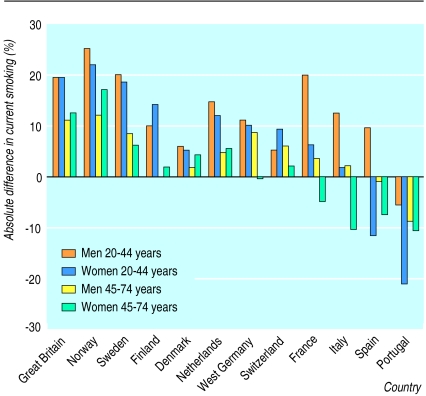
Results: In the 45 to 74 year age group, higher rates of current and ever smoking among lower educated subjects were found in some countries only. Among women this was found in Great Britain, Norway, and Sweden, whereas an opposite pattern, with higher educated women smoking more, was found in southern Europe. Among men a similar north-south pattern was found but it was less noticeable than among women. In the 20 to 44 year age group, educational differences in smoking were generally greater than in the older age group, and smoking rates were higher among lower educated people in most countries. Among younger women, a similar north-south pattern was found as among older women. Among younger men, large educational differences in smoking were found for northern European as well as for southern European countries, except for Portugal.
Conclusions: These international variations in social gradients in smoking, which are likely to be related to differences between countries in their stage of the smoking epidemic, may have contributed to the socioeconomic differences in mortality from ischaemic heart disease being greater in northern European countries. The observed age patterns suggest that socioeconomic differences in diseases related to smoking will increase in the coming decades in many European countries.
Figures
References
-
- Vågerö D, Lundberg O. Health inequalities in Britain and Sweden. Lancet. 1989;ii:35–36. - PubMed
-
- Van Doorslaer E, Wagstaff A, Bleichrodt H, Burg vdH, Calonge S, Gerdtham U, et al. Income-related inequalities in health: some international comparisons. J Health Econ. 1997;16:93–112. - PubMed
-
- Mackenbach JP, Kunst AE, Cavelaars AEJM, Groenhof F, Geurts JJM EU-Working Group on Socioeconomic Inequalities in Health. Socioeconomic inequalities in morbidity and mortality in Western Europe: a comparative study. Lancet. 1997;349:1655–1659. - PubMed
Publication types
MeSH terms
LinkOut - more resources
Full Text Sources