


Repair of intermediate structures produced at DNA interstrand cross-links in Saccharomyces cerevisiae
- PMID: 10779332
- PMCID: PMC85635
- DOI: 10.1128/MCB.20.10.3425-3433.2000
Repair of intermediate structures produced at DNA interstrand cross-links in Saccharomyces cerevisiae
Abstract
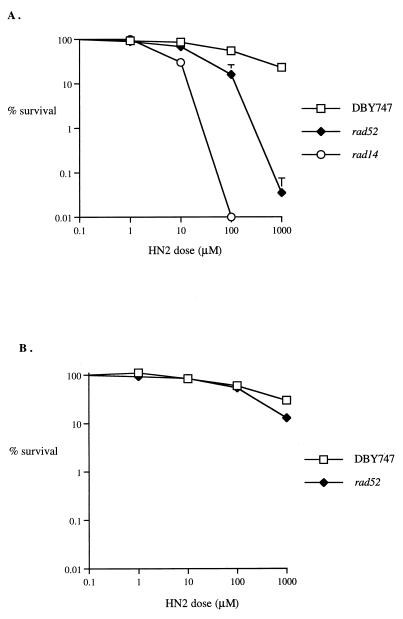
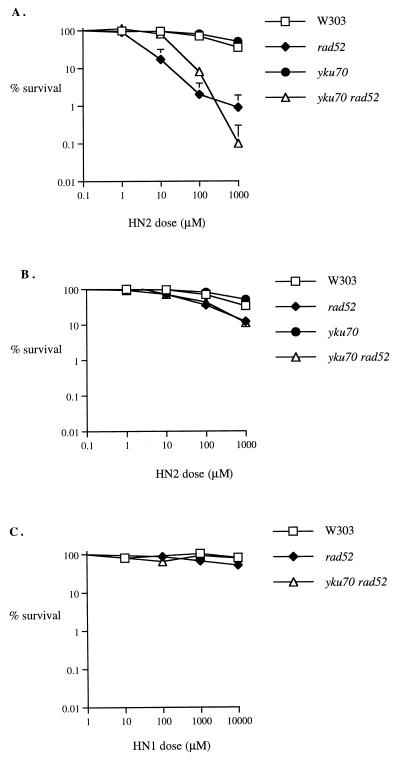
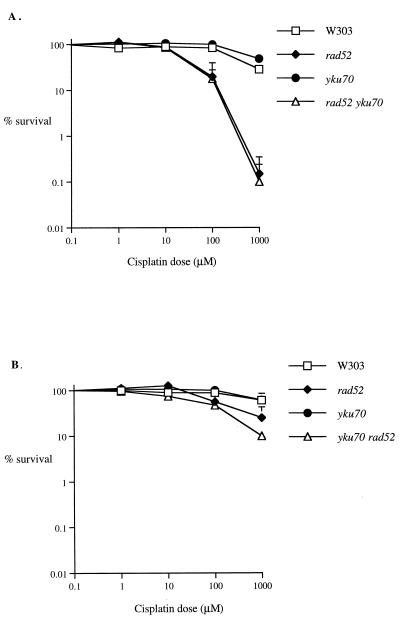
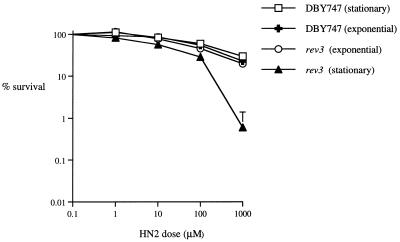
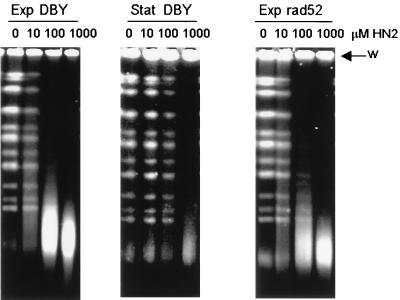
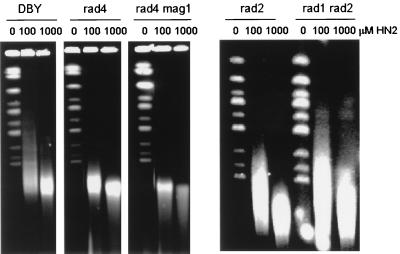
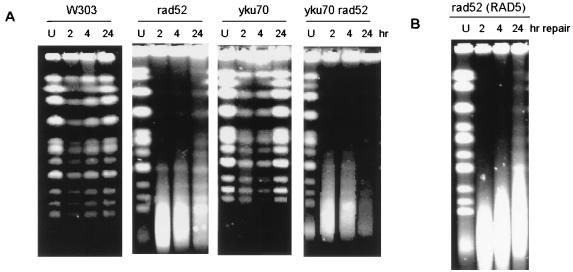
Bifunctional alkylating agents and other drugs which produce DNA interstrand cross-links (ICLs) are among the most effective antitumor agents in clinical use. In contrast to agents which produce bulky adducts on only one strand of the DNA, the cellular mechanisms which act to eliminate DNA ICLs are still poorly understood, although nucleotide excision repair is known to play a crucial role in an early repair step. Using haploid Saccharomyces cerevisiae strains disrupted for genes central to the recombination, nonhomologous end-joining (NHEJ), and mutagenesis pathways, all these activities were found to be involved in the repair of nitrogen mustard (mechlorethamine)- and cisplatin-induced DNA ICLs, but the particular pathway employed is cell cycle dependent. Examination of whole chromosomes from treated cells using contour-clamped homogenous electric field electrophoresis revealed the intermediate in the repair of ICLs in dividing cells, which are mostly in S phase, to be double-strand breaks (DSBs). The origin of these breaks is not clear since they were still efficiently induced in nucleotide excision and base excision repair-deficient, mismatch repair-defective, rad27 and mre11 disruptant strains. In replicating cells, RAD52-dependent recombination and NHEJ both act to repair the DSBs. In contrast, few DSBs were observed in quiescent cells, and recombination therefore seems dispensable for repair. The activity of the Rev3 protein (DNA polymerase zeta) is apparently more important for the processing of intermediates in stationary-phase cells, since rev3 disruptants were more sensitive in this phase than in the exponential growth phase.
Figures
References
-
- Averbeck D, Moustacchi E. 8-Methoxypsoralen plus 365nm light effects and repair in yeast. Biochim Biophys Acta. 1975;395:393–404. - PubMed
-
- Bai Y, Symington L S. A Rad52 homolog is required for RAD51-independent mitotic recombination in Saccharomyces cerevisiae. Genes Dev. 1996;10:2025–2037. - PubMed
Publication types
MeSH terms
Substances
LinkOut - more resources
Full Text Sources
Molecular Biology Databases
Research Materials
Miscellaneous
