Comparative Study
. 2000 May;20(10):3470-81.
doi: 10.1128/MCB.20.10.3470-3481.2000.

Molecular interactions involved in the transactivation of the human T-cell leukemia virus type 1 promoter mediated by Tax and CREB-2 (ATF-4)

Affiliations
Comparative Study

Molecular interactions involved in the transactivation of the human T-cell leukemia virus type 1 promoter mediated by Tax and CREB-2 (ATF-4)

F Gachon et al. Mol Cell Biol. 2000 May.

Abstract

The human T-cell leukemia virus type 1 (HTLV-1) Tax protein activates viral transcription through three 21-bp repeats located in the U3 region of the HTLV-1 long terminal repeat and called Tax-responsive elements (TxREs). Each TxRE contains nucleotide sequences corresponding to imperfect cyclic AMP response elements (CRE). In this study, we demonstrate that the bZIP transcriptional factor CREB-2 is able to bind in vitro to the TxREs and that CREB-2 binding to each of the 21-bp motifs is enhanced by Tax. We also demonstrate that Tax can weakly interact with CREB-2 bound to a cellular palindromic CRE motif such as that found in the somatostatin promoter. Mutagenesis of Tax and CREB-2 demonstrates that both N- and C-terminal domains of Tax and the C-terminal region of CREB-2 are required for direct interaction between the two proteins. In addition, the Tax mutant M47, defective for HTLV-1 activation, is unable to form in vitro a ternary complex with CREB-2 and TxRE. In agreement with recent results suggesting that Tax can recruit the coactivator CREB-binding protein (CBP) on the HTLV-1 promoter, we provide evidence that Tax, CREB-2, and CBP are capable of cooperating to stimulate viral transcription. Taken together, our data highlight the major role played by CREB-2 in Tax-mediated transactivation.


Figures
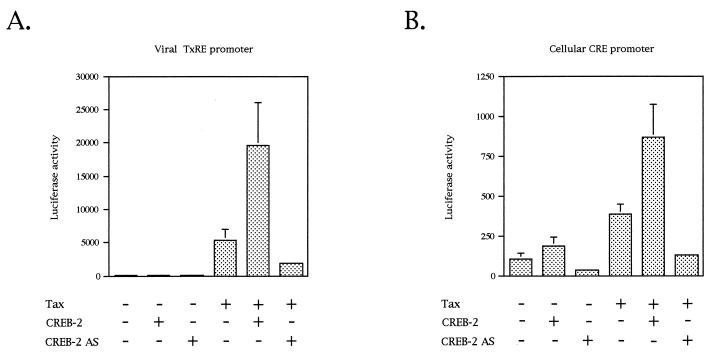
FIG. 1
FIG. 1
Tax transactivation in vivo is regulated by CREB-2. CEM cells (5 × 10⁶) were cotransfected with 2 μg of luciferase gene driven by three tandem copies of the viral promoter-proximal TxRE (A) or by three tandem copies of the cellular palindromic CRE site (B), 5 μg of pACβ1 (β-galactosidase containing reference plasmid), 1 μg of pSG-Tax, and 10 μg of pCI-CREB-2 or 20 μg of anti-sense CREB-2 expression vector (CREB-2 AS). The total amount of DNA in each series of transfection was the same, the balance being made up with the empty plasmids. Luciferase values were normalized for β-galactosidase activity. Values are the means ± standard deviation (n = 3).
FIG. 2
FIG. 2
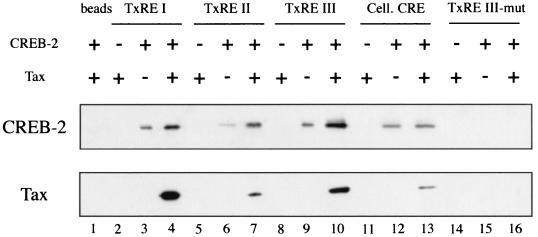
Tax stimulates the binding of CREB-2 to TxREs. Biotinylated oligonucleotides (100 ng) corresponding to the HTLV-1 21-bp repeats (TxRE I, TxRE II, and TxRE III), somatostatin CRE (Cell. CRE), and B motif-mutated TxRE III (TxRE III-mut) were incubated with 20 ng of CREB-2 in the absence (lanes 3, 6, 9, 12, and 15) or the presence (lanes 4, 7, 10, 13, and 16) of Tax (25 ng). Tax alone was also incubated with biotinylated oligonucleotides (lanes 2, 5, 8, 11, and 14). The complexes were collected on streptavidin beads, and the proteins bound to the beads were analyzed by Western blotting with anti-CREB-2 (top panel) or anti-Tax (bottom panel) serum. Lane 1 corresponds to incubation of CREB-2 and Tax with streptavidin beads. The experiment was performed three times, with similar results.
FIG. 3
FIG. 3
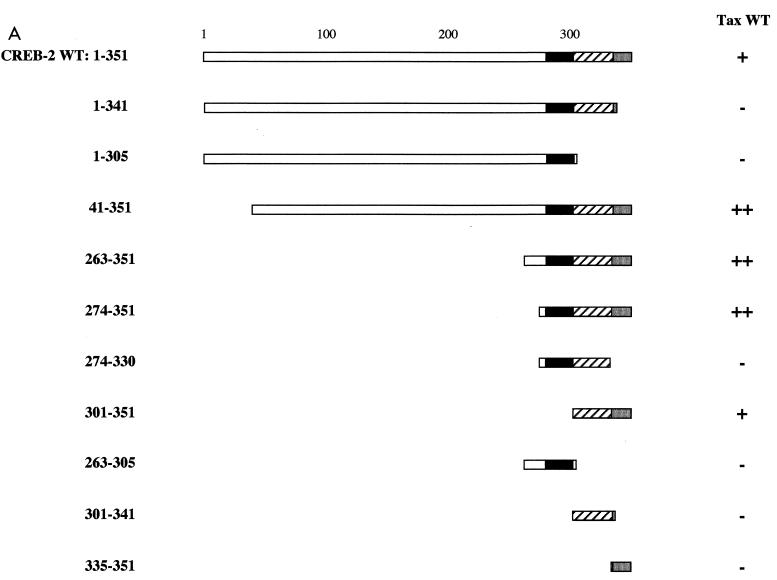
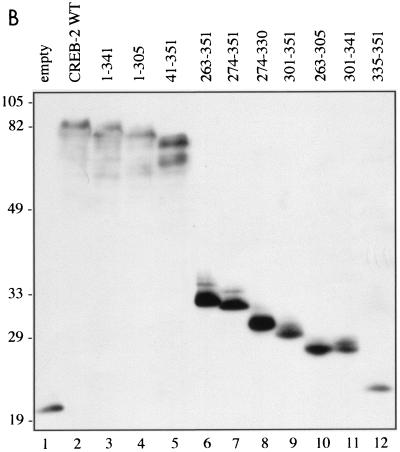
Mutagenesis of CREB-2 defines domains of interaction with Tax. (A) Schematic representation of CREB-2 proteins fused to the activation domain of GAL4: the basic and leucine zipper subdomains of the bZIP and the basic C-terminal domain are represented by black, striped, and grey boxes, respectively. The Y190 yeast cells were transformed with either WT CREB-2 or truncations of CREB-2 fused to the activation domain of GAL4 and WT Tax fused to the DNA binding domain of GAL4 (pAS2-Tax WT). The transformants were subjected to a β-galactosidase assay. Symbols: ++, β-galactosidase activity stronger than that obtained with yeasts cotransformed with pAS2-Tax WT and pGAD-CREB-2 WT; +, β-galactosidase activity corresponding to yeasts cotransformed with pAS2-Tax WT and pGAD-CREB-2 WT; —, β-galactosidase activity corresponding to yeasts cotransformed with pAS2-Tax WT and pGAD424. β-Galactosidase activity ++ corresponds to the level of interaction obtained with Tax-Tax dimer formation in the two-hybrid system. (B) Stability of the different mutant CREB-2 proteins fused to the GAL4 activation domain in S. cerevisiae. Yeast extracts were analyzed by SDS-polyacrylamide gel electrophoresis and Western blotting with GAL4 AD monoclonal antibodies. Molecular size markers (in kilodaltons) are shown on the left.
FIG. 3
FIG. 3
Mutagenesis of CREB-2 defines domains of interaction with Tax. (A) Schematic representation of CREB-2 proteins fused to the activation domain of GAL4: the basic and leucine zipper subdomains of the bZIP and the basic C-terminal domain are represented by black, striped, and grey boxes, respectively. The Y190 yeast cells were transformed with either WT CREB-2 or truncations of CREB-2 fused to the activation domain of GAL4 and WT Tax fused to the DNA binding domain of GAL4 (pAS2-Tax WT). The transformants were subjected to a β-galactosidase assay. Symbols: ++, β-galactosidase activity stronger than that obtained with yeasts cotransformed with pAS2-Tax WT and pGAD-CREB-2 WT; +, β-galactosidase activity corresponding to yeasts cotransformed with pAS2-Tax WT and pGAD-CREB-2 WT; —, β-galactosidase activity corresponding to yeasts cotransformed with pAS2-Tax WT and pGAD424. β-Galactosidase activity ++ corresponds to the level of interaction obtained with Tax-Tax dimer formation in the two-hybrid system. (B) Stability of the different mutant CREB-2 proteins fused to the GAL4 activation domain in S. cerevisiae. Yeast extracts were analyzed by SDS-polyacrylamide gel electrophoresis and Western blotting with GAL4 AD monoclonal antibodies. Molecular size markers (in kilodaltons) are shown on the left.
FIG. 4
FIG. 4
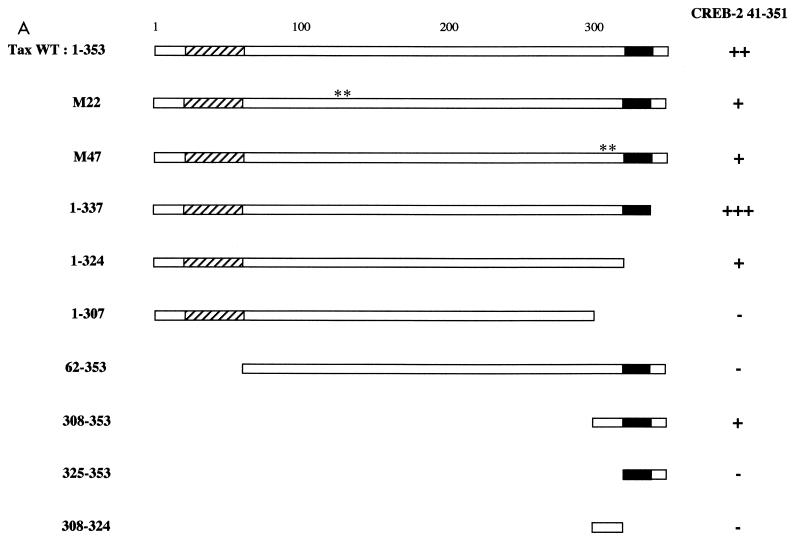
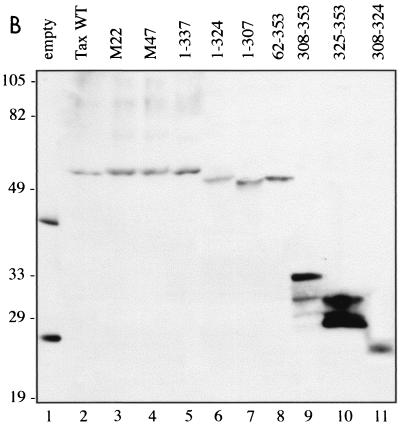
Mutagenesis of Tax defines domains which interact with CREB-2. (A) Schematic representation of Tax proteins fused to the GAL4 DNA binding domain: the cysteine-rich zinc-binding domain and the acidic amino acid stretch of Tax are represented by striped and black boxes, respectively. Both site-directed mutants, Tax M22 and M47, are indicated (∗∗). The Y190 yeast cells were transformed with either WT Tax or truncations of Tax fused to the DNA binding domain of GAL4 and the plasmid pGAD-CREB-2 41-351. The transformants were subjected to a β-galactosidase assay. β-Galactosidase activity was calculated as fold increase relative to yeasts cotransfected with the Tax mutants in the presence of empty pGAD424. Symbols: +++, β-galactosidase activity stronger than that obtained with yeasts cotransformed with pAS2-Tax WT and pGAD-CREB-2 41-351; ++, β-galactosidase activity corresponding to yeasts cotransformed with pAS2-Tax WT and pGAD-CREB-2 41-351; +, β-galactosidase activity weaker than that obtained with yeasts cotransformed with pAS2-Tax WT and pGAD-CREB-2 41-351; —, no stimulation of β-galactosidase activity. β-galactosidase activity ++ corresponds to the level of interaction obtained with Tax-Tax dimer formation in the two-hybrid system. (B) Stability of the different mutant Tax proteins fused to the GAL4 DNA binding domain in S. cerevisiae. Yeast extracts were analyzed by SDS-polyacrylamide gel electrophoresis and Western blotting with GAL4 DNA-BD monoclonal antibodies. Molecular size markers (in kilodaltons) are on the left.
FIG. 4
FIG. 4
Mutagenesis of Tax defines domains which interact with CREB-2. (A) Schematic representation of Tax proteins fused to the GAL4 DNA binding domain: the cysteine-rich zinc-binding domain and the acidic amino acid stretch of Tax are represented by striped and black boxes, respectively. Both site-directed mutants, Tax M22 and M47, are indicated (∗∗). The Y190 yeast cells were transformed with either WT Tax or truncations of Tax fused to the DNA binding domain of GAL4 and the plasmid pGAD-CREB-2 41-351. The transformants were subjected to a β-galactosidase assay. β-Galactosidase activity was calculated as fold increase relative to yeasts cotransfected with the Tax mutants in the presence of empty pGAD424. Symbols: +++, β-galactosidase activity stronger than that obtained with yeasts cotransformed with pAS2-Tax WT and pGAD-CREB-2 41-351; ++, β-galactosidase activity corresponding to yeasts cotransformed with pAS2-Tax WT and pGAD-CREB-2 41-351; +, β-galactosidase activity weaker than that obtained with yeasts cotransformed with pAS2-Tax WT and pGAD-CREB-2 41-351; —, no stimulation of β-galactosidase activity. β-galactosidase activity ++ corresponds to the level of interaction obtained with Tax-Tax dimer formation in the two-hybrid system. (B) Stability of the different mutant Tax proteins fused to the GAL4 DNA binding domain in S. cerevisiae. Yeast extracts were analyzed by SDS-polyacrylamide gel electrophoresis and Western blotting with GAL4 DNA-BD monoclonal antibodies. Molecular size markers (in kilodaltons) are on the left.
FIG. 5
FIG. 5
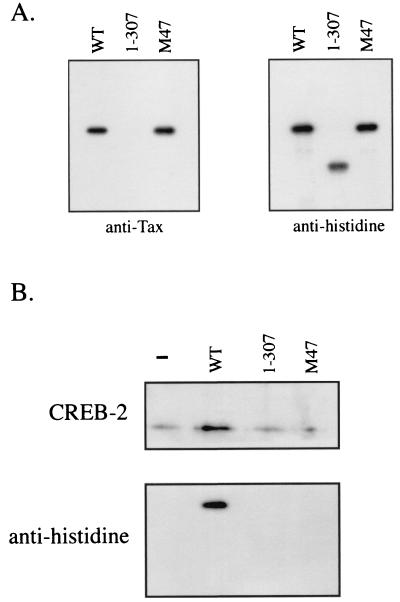
The C-terminal domain of Tax is involved in the specificity of ternary complex formation. (A) Detection of the mutants Tax 1-307 and M47 by Western blotting by using anti-histidine antibodies. Each of the Tax proteins was analyzed by Western blotting with anti-Tax or anti-histidine antibodies. (B) An amount of 100 ng of biotinylated TxRE III was incubated with 20 ng of CREB-2 in the absence (−) or the presence of 25 ng of either WT Tax (WT), mutant Tax 1-307, or Tax M47. The complexes were collected on streptavidin beads, and the proteins bound to the beads were analyzed by Western blotting with anti-CREB-2 (top panel) or anti-histidine (bottom panel) serum. The experiment was performed three times, with similar results.
FIG. 6
FIG. 6
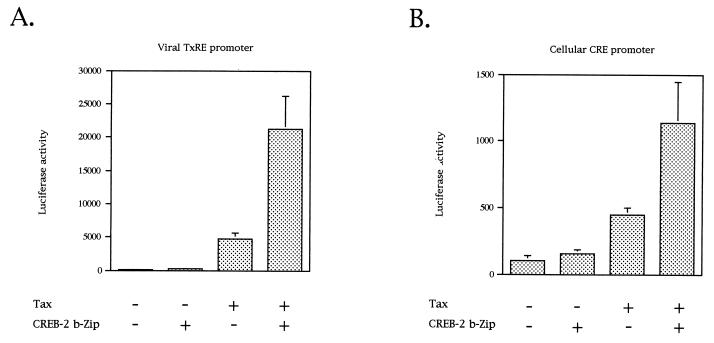
The bZIP domain of CREB-2 cooperates with Tax to activate a luciferase gene reporter driven by a synthetic promoter containing three tandem copies of either the HTLV-1 promoter-proximal TxRE (A) or the cellular palindromic CRE site (B). CEM cells were cotransfected as described for Fig. 1 but pCI-CREB-2 was replaced by 0.5 μg of pCDM7-CREB-2262-351. Values are the means ± standard deviation (n = 3).
FIG. 7
FIG. 7
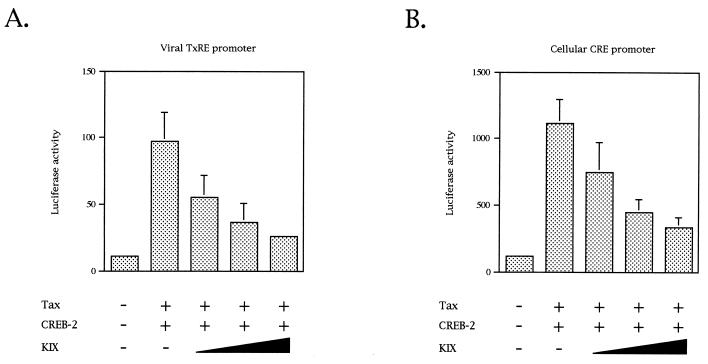
KIX represses activation of the viral or cellular CRE by Tax and CREB-2. Cotransfections were performed with CEM cells with either 100 ng of the luciferase gene driven by the viral promoter-proximal TxRE, 50 ng of pSG-Tax, 500 ng of pCI-CREB-2, and 1, 3, or 9 μg of pRSV-KIX (A) or 2 μg of the luciferase gene driven by the cellular palindromic CRE, 1 μg of pSG-Tax, 10 μg of pCI-CREB-2, and 1, 3, or 9 μg of pRSV-KIX (B). Luciferase values were normalized for β-galactosidase activity. Values are the means ± standard deviations (n = 3).
FIG. 8
FIG. 8
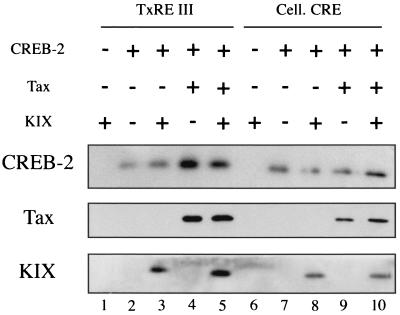
Tax facilitates KIX association with CREB-2. Biotinylated oligonucleotides (100 ng) corresponding to the HTLV-1 TxRE III or somatostatin CRE (Cell. CRE) were incubated with 20 ng of CREB-2 in the presence of either 60 ng of KIX (lanes 3 and 8), or 25 ng of Tax (lanes 4 and 9), or both Tax and KIX (lanes 5 and 10). KIX alone (lanes 1 and 6) and CREB-2 alone (lanes 2 and 7) were also incubated with biotinylated oligonucleotides. The complexes were collected on streptavidin beads, and the proteins bound to the beads were analyzed by Western blotting with anti-CREB-2 (top), anti-Tax (middle), and anti-KIX (bottom) serum. The experiment was performed three times, with similar results.
FIG. 9
FIG. 9
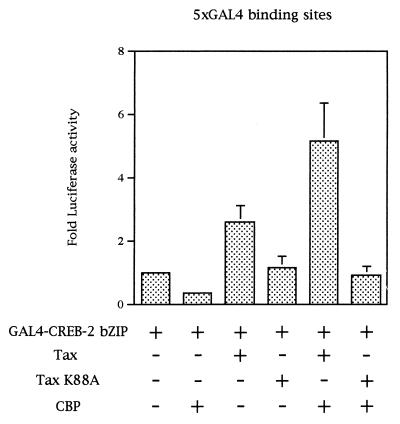
Tax promotes association of CBP with GAL4-CREB-2 bZIP in vivo. CEM cells were cotransfected with 2 μg of the luciferase reporter vector pG5luc, 5 μg of pACβ1, 2.5 μg of a eukaryotic vector expressing a GAL4-CREB-2 bZIP fusion protein, 1 μg of a plasmid expressing the WT Tax or the Tax point mutant K88A, and 10 μg of pRSV-CBP. The total amount of DNA in each series of transfections was the same, the balance being made up with the empty plasmids. Luciferase values were normalized for β-galactosidase activity and are expressed as fold increase relative to that of cells transfected with pSG-5, pCI-neo, pG5luc, and the eukaryotic vector expressing GAL4-CREB-2 bZIP. Values are the means ± standard deviations (n = 3).
FIG. 10
FIG. 10
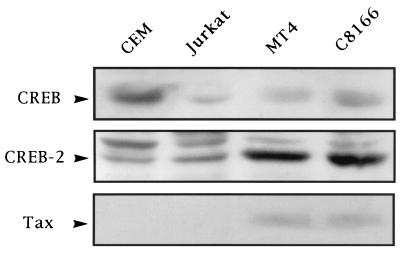
Analysis of CREB and CREB-2 expression in human T-cell lines infected with HTLV-1. For immunoblot analysis, 30 μg of protein of nuclear extracts prepared as already described (47) from CEM and Jurkat cells and from HTLV-1-infected T cells, MT4 and C8166, was electrophoresed through an SDS–8% polyacrylamide gel and analyzed by immunoblotting using anti-CREB (top), anti-CREB-2 (middle), or anti-Tax (bottom) serum. The Western blot was stained with naphthol blue black to be sure that the same amount of protein was loaded for each sample (data not shown).
FIG. 11
FIG. 11
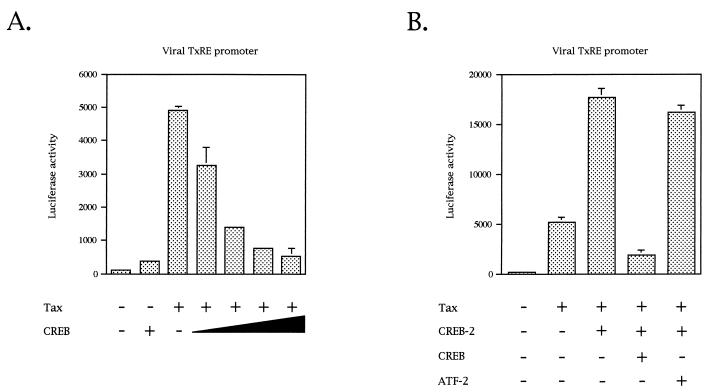
CREB downregulates Tax-mediated transcription in CEM cells. (A) CEM cells were cotransfected with 2 μg of the luciferase gene driven by three tandem copies of the viral promoter-proximal TxRE, 5 μg of pACβ1, 1 μg of pSG-Tax, and 0.1, 1, 5, and 10 μg of pcDNA3.1/His-expressing CREB. Luciferase values were normalized for β-galactosidase activity. Values are the means ± standard deviation (n = 3). (B) Cotransfection assays were performed as described above in the presence of 10 μg of vector expressing either CREB-2, CREB, or ATF-2. Values are the means ± standard deviation (n = 3).

References

    1. Adya N, Giam C-Z. Distinct regions in human T-cell lymphotropic virus type 1 Tax mediate interactions with activator protein CREB and basal transcription factors. J Virol. 1995;69:1834–1841. - PMC - PubMed
    1. Adya N, Zhao L-J, Huang W, Boros I, Giam C-Z. Expansion of CREB's DNA recognition specificity by Tax results from interaction with Ala-Ala-Arg at positions 282-284 near the conserved DNA-binding domain of CREB. Proc Natl Acad Sci USA. 1994;91:5642–5646. - PMC - PubMed
    1. Anderson M G, Dynan W S. Quantitative studies of the effect of HTLV-I Tax protein on CREB protein-DNA binding. Nucleic Acids Res. 1994;22:3194–3201. - PMC - PubMed
    1. Bantignies F, Rousset R, Desbois C, Jalinot P. Genetic characterization of transactivation of the human T-cell leukemia virus type 1 promoter: binding of Tax to Tax-responsive element 1 is mediated by the cyclic AMP-responsive members of the CREB/ATF family of transcription factors. Mol Cell Biol. 1996;16:2174–2182. - PMC - PubMed
    1. Baranger A M, Palmer C R, Hamm M K, Giebler H A, Brauweiler A, Nyborg J K, Schepartz A. Mechanism of DNA-binding enhancement by the human T-cell leukaemia virus transactivator Tax. Nature. 1995;376:606–608. - PubMed

Publication types

MeSH terms

LinkOut - more resources