Comparative Study
. 2000 May;20(10):3633-9.
doi: 10.1128/MCB.20.10.3633-3639.2000.

Complex transcriptional regulatory mechanisms control expression of the E2F3 locus

Affiliations
Comparative Study

Complex transcriptional regulatory mechanisms control expression of the E2F3 locus

M R Adams et al. Mol Cell Biol. 2000 May.

Abstract

E2F transcription activity has been shown to play a critical role in cell growth control, regulating the expression of a variety of genes that encode proteins important for the initiation of DNA replication and cell cycle regulation. We have shown that the E2F3 locus encodes two protein products: the E2F3a product, which is tightly regulated by cell growth, and the E2F3b product, which is constitutively expressed throughout the cell cycle. To further explore the mechanism controlling the expression of the two E2F3 gene products, we analyzed the genomic sequences flanking the 5' region of E2F3a and E2F3b. We find that a series of E2F binding sites confer negative control on the E2F3a promoter in quiescent cells, similar to the control of the E2F1 and E2F2 promoters. In addition, a group of E-box elements, which are Myc binding sites, confer responsiveness to Myc and are necessary for full activation of the E2F3a promoter in response to growth stimulation. Based on these results and past experiments, it appears that the E2F1, E2F2, and E2F3a genes are similarly regulated by growth stimulation, involving a combination of E2F-dependent negative control and Myc-mediated positive control. In contrast, the constitutive expression of the E2F3b gene more closely reflects the control of expression of the E2F4 and E2F5 genes.


Figures
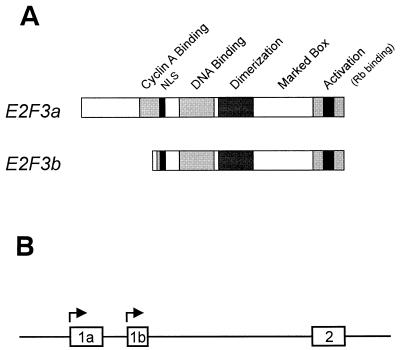
FIG. 1
FIG. 1
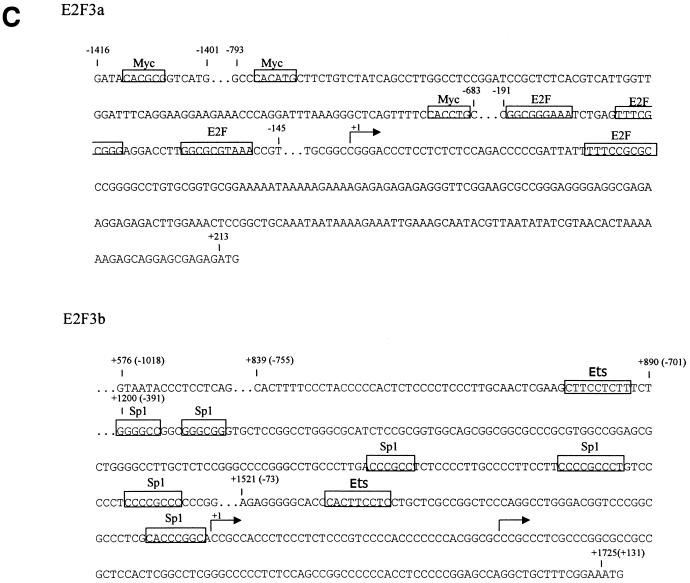
E2F3 genomic organization. (A) Schematic depiction of the domain organization of the E2F3a and E2F3b products. (B) Schematic depiction of the E2F3 genomic organization at the sites specifying initiation of transcription. The exon structures defining the E2F3a and E2F3b transcripts, which involve utilization of alternate transcription start sites and thus distinct initial exon sequences, have been defined (19). (C) DNA sequence in the 5′-flanking region of the mouse E2F3 gene. The +1 transcription site for both E2F3a and E2F3b is based on the longest clone sequenced from the RACE analysis as well as on primer extension analysis. Boxed sequences represent putative E2F and Myc binding sites as well as other consensus sites.
FIG. 1
FIG. 1
E2F3 genomic organization. (A) Schematic depiction of the domain organization of the E2F3a and E2F3b products. (B) Schematic depiction of the E2F3 genomic organization at the sites specifying initiation of transcription. The exon structures defining the E2F3a and E2F3b transcripts, which involve utilization of alternate transcription start sites and thus distinct initial exon sequences, have been defined (19). (C) DNA sequence in the 5′-flanking region of the mouse E2F3 gene. The +1 transcription site for both E2F3a and E2F3b is based on the longest clone sequenced from the RACE analysis as well as on primer extension analysis. Boxed sequences represent putative E2F and Myc binding sites as well as other consensus sites.
FIG. 2
FIG. 2
Sequences required for E2F3b promoter activity. (A) Schematic depiction of E2F3b promoter constructs. Luciferase reporter constructs containing the indicated 5′-flanking sequence were used for assays of promoter activity. (B) REF52 cells were transfected with 4 μg of the indicated E2F3b-luciferase plasmids together with 2 μg of CMV–β-galactosidase. Transfected cells were treated as described in Materials and Methods and harvested at the indicated time points. Luciferase activity was normalized to the β-galactosidase activity. Symbols: □, E2F3b (−1018); ■, E2F3b (−733); ○, E2F3b (−350).
FIG. 3
FIG. 3
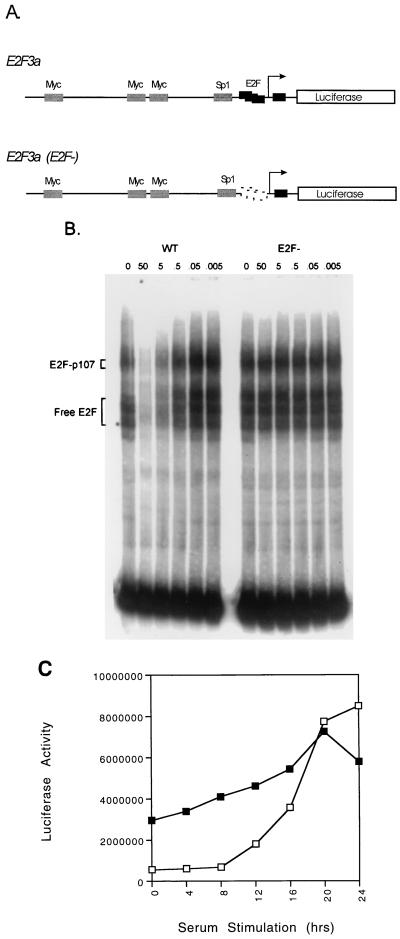
E2F-dependent regulation of the E2F3a promoter. (A) Schematic depiction of the E2F3a wild-type promoter and the promoter containing alterations in the E2F binding elements. (B) E2F binds to the E2F3a promoter. Gel mobility shift assays were performed with a nuclear extract from G1/S-arrested mouse embryo fibroblasts and an end-labeled DNA fragment derived from the DHFR promoter that contains two overlapping E2F binding sites as the probe. Competition assays were performed as described in Materials and Methods using the indicated amount (in nanograms) of PCR products derived from either the wild-type E2F3a promoter sequence spanning the E2F sites or the mutant promoter in which the E2F sites were altered by point mutations. The positions of either the E2F-p107 complex or free E2F complexes are indicated. (C) REF52 cells were transfected with 4 μg of the wild-type E2F3a-luciferase plasmid (□) or 4 μg of the E2F3a (E2F−)-luciferase plasmid (■), together with 2 μg of CMV–β-galactosidase. Transfected cells were processed as described in Fig. 2. Luciferase activity was normalized to β-galactosidase activity.
FIG. 4
FIG. 4
Myc activates the E2F3a promoter but not the E2F3b promoter. (A) Schematic depiction of the E2F3a wild-type promoter and the promoter containing alterations in the Myc binding elements. (B) Myc binds to the E2F3a promoter. Gel mobility shift assays for Myc binding were performed as described in Materials and Methods using baculovirus-produced Myc and Max proteins and an end-labeled double-stranded oligonucleotide that contains an E-box sequence (27). Specificity of binding was demonstrated by competition with cold wild-type DNA probe (WT) or a mutant version of the probe in which the E-box element was disrupted by mutation (Mut). Competition assays to demonstrate binding to the sites in the E2F3a promoter were performed using PCR products containing the wild-type sequence of the proximal two sites (Site1,2) or the distal site (Site3) or mutant versions of each (Mut1,2 and Mut3). (C) The E2F3a promoter, but not the E2F3b promoter, is activated by Myc. REF52 cells were transfected with 8 μg of either the E2F3a-luciferase plasmid or the E2F3b-luciferase plasmid, together with the indicated amount (in micrograms) of a CMV-driven Myc expression vector along with 2 μg of CMV–β-galactosidase. When less than 3 μg of CMV-Myc was used, the control vector pRc-CMV was included to bring the total amount of CMV vector added to 3 μg. Transfected cells were incubated in low-serum medium for 48 h, at which time cells were harvested, extracts were prepared, and luciferase and β-galactosidase activities were measured. (D) Activation of wild-type E2F3a by Myc is dependent on intact E-box elements. REF52 cells were transfected with 8 μg of either wild-type E2F3a-luciferase or the E-box-site mutant E2F3a (E-box−)-luciferase plasmid in which the E-box sequences were altered by mutation as described in Materials and Methods. Each plasmid was cotransfected with either 10 μg of CMV-Myc or 10 μg of the control pRc-CMV, together with 2 μg of β-galactosidase.
FIG. 5
FIG. 5
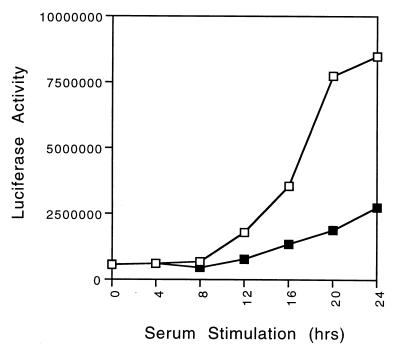
E-box elements are required for full activity of the E2F3a promoter in response to stimulation of cell proliferation. Effects of mutation of Myc binding sites on growth stimulated the expression of the E2F3a promoter. REF52 cells were transfected with 4 μg of the wild-type E2F3a-luciferase plasmid (□) or the mutant E2F3a (E-box−)-luciferase plasmid (■), together with 2 μg of CMV–β-galactosidase. Transfected cells were treated as described in Fig. 2, and the luciferase and β-galactosidase activities were measured. The luciferase activity was normalized to the β-galactosidase activity.
FIG. 6
FIG. 6
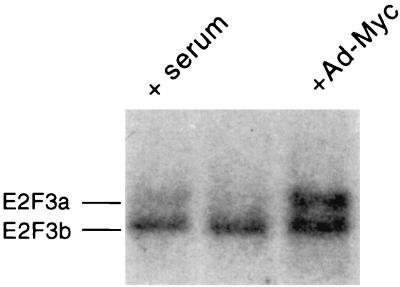
Myc activates the endogenous E2F3a gene but not the E2F3b gene. REF52 cells were brought to quiescence and then infected with an adenovirus recombinant containing the c-myc gene (Ad-Myc) (right lane) or a control virus lacking an insert (Ad-CMV) (middle lane). An additional aliquot of cells was stimulated by serum addition (left lane). Poly(A)+ RNA was isolated and subjected to Northern analysis. E2F3a and E2F3b RNAs were detected using an E2F3 cDNA probe.

References

    1. Beijersbergen R L, Kerkhoven R M, Zhu L, Carlee L, Voorhoeve P M, Bernards R. E2F-4, a new member of the E2F gene family, has oncogenic activity and associates with p107 in vivo. Genes Dev. 1994;8:2680–2690. - PubMed
    1. DeGregori J, Kowalik T, Nevins J R. Cellular targets for activation by the E2F1 transcription factor include DNA synthesis and G1/S regulatory genes. Mol Cell Biol. 1995;15:4215–4224. - PMC - PubMed
    1. DeGregori J, Leone G, Miron A, Jakoi L, Nevins J R. Distinct roles for E2F proteins in cell growth control and apoptosis. Proc Natl Acad Sci USA. 1997;94:7245–7250. - PMC - PubMed
    1. Dynlacht B D, Moberg K, Lees J A, Harlow E, Zhu L. Specific regulation of E2F family members by cyclin-dependent kinases. Mol Cell Biol. 1997;17:3867–3875. - PMC - PubMed
    1. Dyson N. The regulation of E2f by pRB-family proteins. Genes Dev. 1998;12:2245–2262. - PubMed

Publication types

MeSH terms

Substances

LinkOut - more resources