. 2000 Apr;10(4):411-5.
doi: 10.1101/gr.10.4.411.

Frequent human genomic DNA transduction driven by LINE-1 retrotransposition

Affiliations

Frequent human genomic DNA transduction driven by LINE-1 retrotransposition

O K Pickeral et al. Genome Res. 2000 Apr.

Abstract

Human L1 retrotransposons can produce DNA transduction events in which unique DNA segments downstream of L1 elements are mobilized as part of aberrant retrotransposition events. That L1s are capable of carrying out such a reaction in tissue culture cells was elegantly demonstrated. Using bioinformatic approaches to analyze the structures of L1 element target site duplications and flanking sequence features, we provide evidence suggesting that approximately 15% of full-length L1 elements bear evidence of flanking DNA segment transduction. Extrapolating these findings to the 600,000 copies of L1 in the genome, we predict that the amount of DNA transduced by L1 represents approximately 1% of the genome, a fraction comparable with that occupied by exons.


Figures
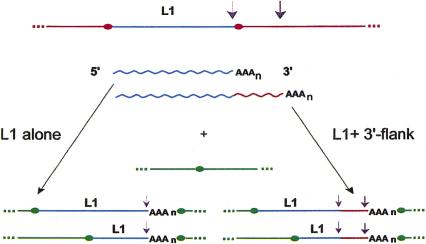
Figure 1
Figure 1
L1-driven 3′ transduction. Incorporation of additional (3′ flanking) sequence into the transcript generated from the L1 promoter is followed by reverse transcription and integration of this longer cDNA into new genomic loci. (Ovals) Target site duplications; (purple arrows) polyadenylation signals (weak and strong); (AAAn) poly(A) tail.
Figure 2
Figure 2
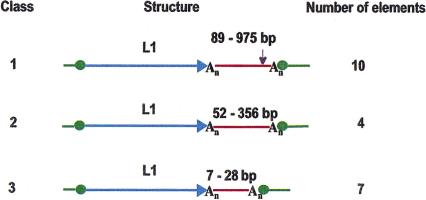
Three classes of L1 elements with 3′ transduced segments. Transduced segments are shown in red. Range of transduced segment lengths is shown above each line. (Ovals) Target side duplications; (purple arrow) polyadenylation signal found in the transduced regions of class 1; (An) poly(A) tail.
Figure 3
Figure 3
L1 integration into other transposons. Numbers at left indicate gi numbers of GenBank records in which the L1 elements and their associated 3′-transduced segments are found (see Table 1 for exact coordinates). Repetitive elements recognized in the 3′-transduced segments by RepeatMasker are represented by filled gray arrows, with annotation shown at top (L1 or Alu subfamily name is followed by the coordinates projected onto the consensus sequence for that subfamily). Remarkably, in all four cases, the L1 that produced the observed new insertion depicted here must have inserted previously into another L1 or Alu in the same orientation. [A similar tendency has been noticed previously for newly inserted Alu elements (Jurka 1995)]. In two of the examples shown above, the transduced segment terminates at the end of the pre-existing L1. This suggests that once an L1 element inserts into such a region, subsequent transcription of the newly inserted element frequently reads through into the flanking DNA, and is then polyadenylated using a signal in the 3′ UTR of the pre-existing L1 element. By this means, L1 elements may acquire new, hybrid 3′ UTRs. This process likely contributes to the rapid evolution of L1 3′ UTR sequences (Smit 1996) and could explain why they are so rich in A residues, as well as provide a clue to the mechanism leading to the similarity of L1 and Alu 3′ UTR sequences (Boeke 1997).
Figure 4
Figure 4
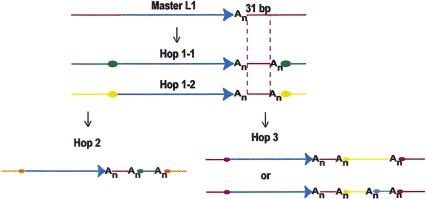
Model for the generation of L1 elements and their 3′-transduced regions in gi 3288437 and gi 2588627. Hop 2 (gi 3288437) and Hop3 (gi 2588627) are likely to be related descendants of the same Master L1 element. At least two, and possibly three (in case of gi 2588627) 3′-transducing intermediate transposition events would result in the structures seen at the DNA sequence level. The 31-bp sequence immediately downstream from the L1 is 100% identical between the two transduced segments, and in both cases is followed by a poly(A) tail. The proposed intermediates have not yet been found in the human genomic sequence available to date. The blue segment in Hop 3 reflects the possibility of two rather than one intermediate retrotransposition events between the master and Hop 3 elements, as there are two internal poly(A) sequences within the transduced segment.

References

    1. Altschul SF, Madden TL, Schaffer AA, Zhang J, Zhang Z, Miller W, Lipman DJ. Gapped BLAST and PSI-BLAST: A new generation of protein database search programs. Nucleic Acids Res. 1997;25:3389–3402. - PMC - PubMed
    1. Boeke JD. LINEs and Alus—the polyA connection. Nat Genet. 1997;16:6–7. - PubMed
    1. Boeke JD, Pickeral OK. Retroshuffling the genomic deck. Nature. 1999;398:108–109. , 111. - PubMed
    1. Boeke JD, Stoye JP. Retrotransposons, endogenous retroviruses, and the evolution of retroelements. In: Varmus H, Hughes S, Coffin J, editors. Retroviruses. Cold Spring Harbor, NY: Cold Spring Harbor Laboratory; 1997. pp. 343–435. - PubMed
    1. Dhellin O, Maestre J, Heidmann T. Functional differences between the human LINE retrotransposon and retroviral reverse transcriptases for in vivo mRNA reverse transcription. EMBO J. 1997;16:6590–6602. - PMC - PubMed

Publication types

MeSH terms

LinkOut - more resources