Comparative Study
. 2000 Apr;10(4):577-86.
doi: 10.1101/gr.10.4.577.

PipMaker--a web server for aligning two genomic DNA sequences

Affiliations
Comparative Study

PipMaker--a web server for aligning two genomic DNA sequences

S Schwartz et al. Genome Res. 2000 Apr.

Abstract

PipMaker (http://bio.cse.psu.edu) is a World-Wide Web site for comparing two long DNA sequences to identify conserved segments and for producing informative, high-resolution displays of the resulting alignments. One display is a percent identity plot (pip), which shows both the position in one sequence and the degree of similarity for each aligning segment between the two sequences in a compact and easily understandable form. Positions along the horizontal axis can be labeled with features such as exons of genes and repetitive elements, and colors can be used to clarify and enhance the display. The web site also provides a plot of the locations of those segments in both species (similar to a dot plot). PipMaker is appropriate for comparing genomic sequences from any two related species, although the types of information that can be inferred (e.g., protein-coding regions and cis-regulatory elements) depend on the level of conservation and the time and divergence rate since the separation of the species. Gene regulatory elements are often detectable as similar, noncoding sequences in species that diverged as much as 100-300 million years ago, such as humans and mice, Caenorhabditis elegans and C. briggsae, or Escherichia coli and Salmonella spp. PipMaker supports analysis of unfinished or "working draft" sequences by permitting one of the two sequences to be in unoriented and unordered contigs.


Figures
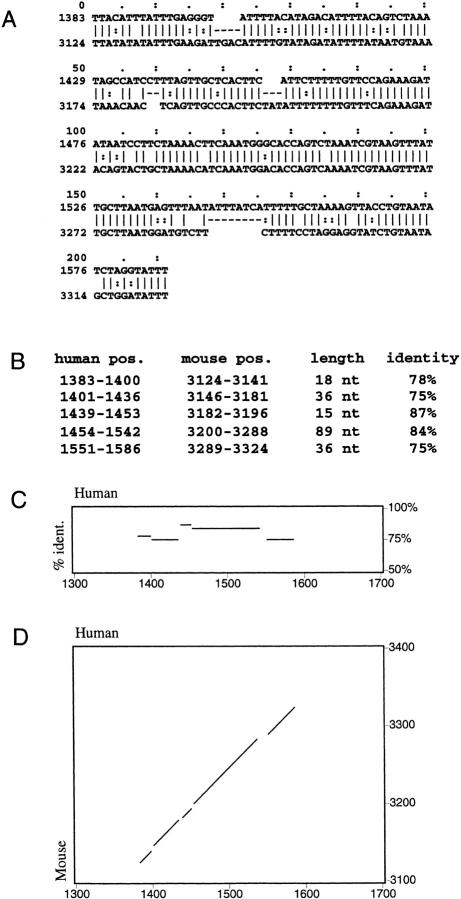
Figure 1
Figure 1
An illustration of pips. (A) An alignment. (B) Positions and percent identity of gap-free segments within that alignment. (C) The corresponding pip. (D) The corresponding dot plot.
Figure 2
Figure 2
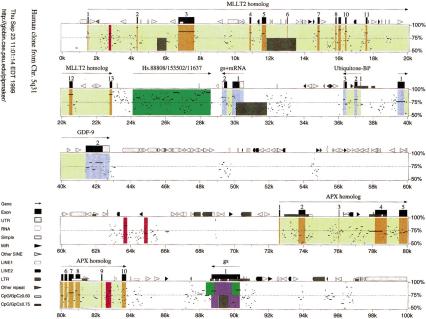
Pip of the alignments between a portion of the sequence of human chromosome 5q31 and its homolog in mouse.
Figure 3
Figure 3
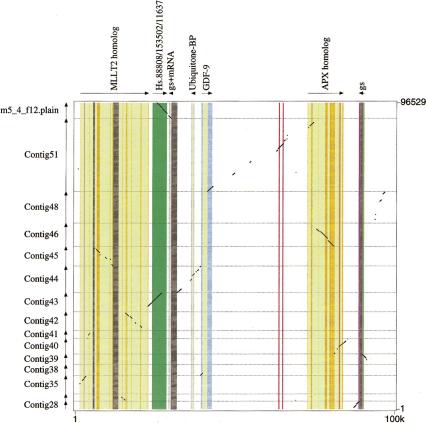
Dot plot of the same alignments as plotted in Fig. 2.
Figure 4
Figure 4
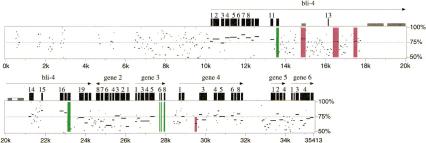
Pip of the region encompassing the bli-4 locus in C. elegans and C. briggsae. The C. elegans sequence was obtained from GenBank (accession no. AF039719); the C. briggsae sequence from clones G06P23 and G25K01 was obtained from http://genome.wustl.edu/gsc/index.shtml. Green indicates annotated exons that are poorly conserved; red indicates high-scoring segments that are not included in the exon annotations in GenBank.
Figure 5
Figure 5
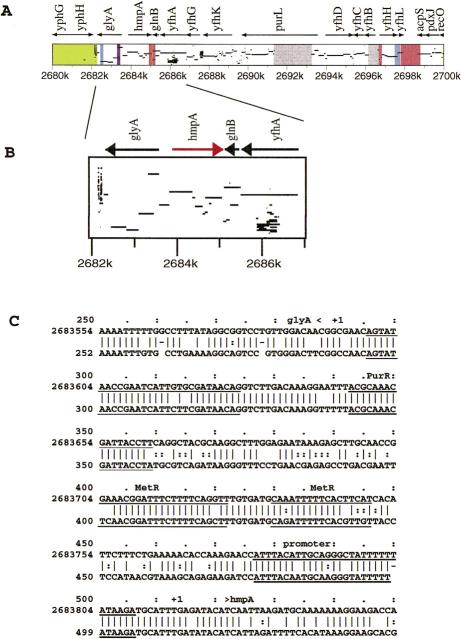
Analysis of a portion of the genomes of E. coli and S. typhimurium. The E. coli K12 sequence is from Blattner et al. (1997); the S. typhimurium sequence was obtained from ftp://ftp.sanger.ac.uk/pub/pathogens/st/ST.dbs. (A) A pip of the region. Yellow–green indicates E. coli genes not homologous to S. typhimurium genes. Red indicates an end of a gene in S. typhimurium whose immediate neighbor has its ortholog elsewhere in E. coli. Blue indicates the end of a gene in S. typhimurium whose immediate neighbor has no detectable homolog in E. coli. Gray indicates regions not yet sequenced in S. typhimurium. An overlap between contigs within glyA is colored purple. The capacity to orient gene names vertically is currently not supported by the public server. (B). A closeup showing the region between the glyA and hmpA genes. (C) Textual representation of the pairwise alignment in the intergenic region between glyA and hmpA. Promoters, including the −10 and −35 boxes, and binding sites for PurR and MetR are underlined.
Figure 6
Figure 6
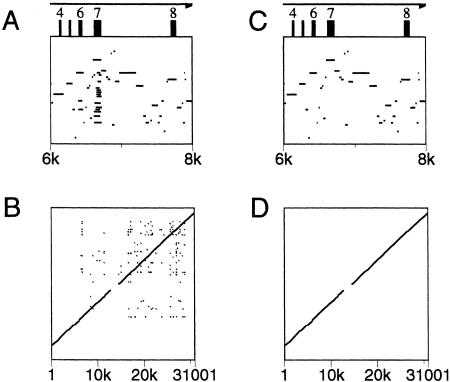
Illustration of the effects of chaining. The pro-α1 type II collagen loci of humans (GenBank accession no. HUMCOL2A1Z) and mice (GenBank entry MUSPACOLL) were aligned. With PipMaker defaults, exon duplications produce redundant matches in the pip and dot plot (A,B), which are eliminated by the chaining option (C,D).
Figure 7
Figure 7
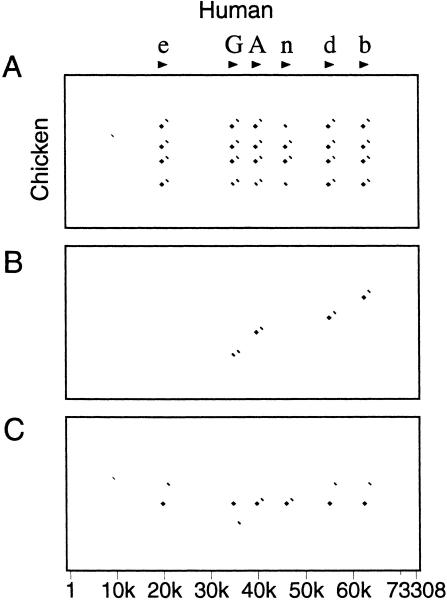
Illustration of the effects of Single coverage.The β-globin gene clusters of human (GenBank entry HUMHBB) and chicken (GenBank entry CHKHBBRE) were aligned. Because there are six genes in human and four in chicken (A), the chaining option would leave two of the human genes unaligned (B). However, a dot plot made with the Single coverage option shows all human regions having matches in the chicken sequence, with no duplicate matches (C).

References

    1. Altschul SF, Gish W, Miller W, Myers EW, Lipman DJ. Basic local alignment search tool. J Mol Biol. 1990;215:403–410. - PubMed
    1. Altschul SF, Madden TL, Schaffer AA, Zhang J, Zhang Z, Miller W, Lipman DJ. Gapped BLAST and PSI-BLAST: A new generation of protein database search programs. Nucleic Acids Res. 1997;25:3389–3402. - PMC - PubMed
    1. Bailey LC, Jr, Searls DB, Overton GC. Analysis of EST-driven gene annotation in human genomic sequence. Genome Res. 1998;8:362–376. - PubMed
    1. Battey J, Jordan E, Cox D, Dove W. An action plan for mouse genomics. Nat Genet. 1999;21:73–75. - PubMed
    1. Blattner FR, Plunkett G, III, Bloch CA, Perna NT, Burland V, Riley M, Collado-Vides J, Glasner JD, Rode CK, Mayhew GF, et al. The complete genome sequence of Escherichia coli K-12. Science. 1997;277:1453–1474. - PubMed

Publication types

MeSH terms

LinkOut - more resources