


doi: 10.1073/pnas.97.9.4426.
The Cambrian "explosion": slow-fuse or megatonnage?
Affiliations
- PMID: 10781036
- PMCID: PMC34314
- DOI: 10.1073/pnas.97.9.4426
Item in Clipboard
The Cambrian "explosion": slow-fuse or megatonnage?
Proc Natl Acad Sci U S A.
.
Abstract
Clearly, the fossil record from the Cambrian period is an invaluable tool for deciphering animal evolution. Less clear, however, is how to integrate the paleontological information with molecular phylogeny and developmental biology data. Equally challenging is answering why the Cambrian period provided such a rich interval for the redeployment of genes that led to more complex body plans.
Figures
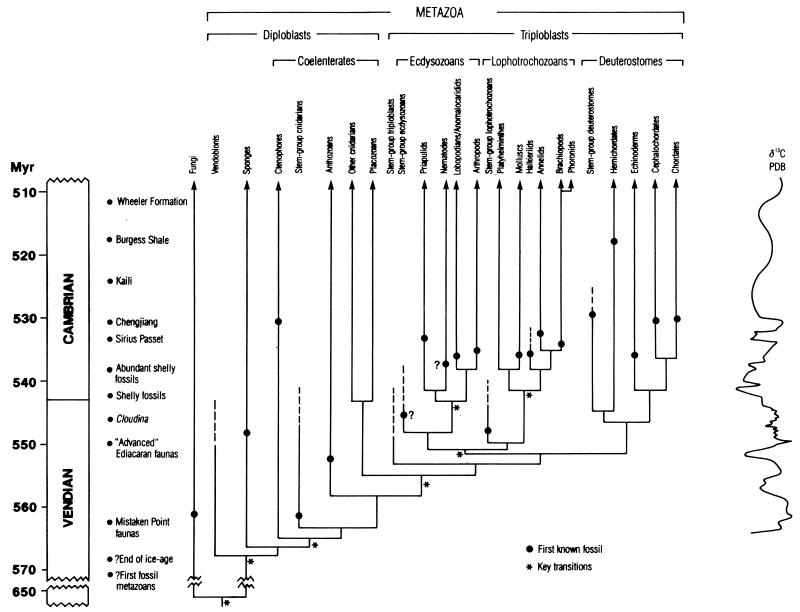
Principal events across the Vendian-Cambrian boundary, spanning an
interval of approximately 60 Myr (570–510 Myr), in the context of the
early evolution of metazoans. On the left are denoted a series of
important fossil assemblages, e.g., Burgess Shale, and various other
significant events, e.g., cessation of ice age. To the right is the
carbon isotope curve (redrawn from ref. 4), which provides an
independent tool for correlation by chemostratigraphy and may also
indicate substantial changes in ocean state with possible implications
for evolutionary diversification. The evolutionary framework is largely
based on molecular data (12, 19, 20), but the available fossil record
not only gives a temporal perspective but also indicates major
anatomical transitions that mark the emergence of distinct bodyplans.
The sister-group of the Metazoa are the Fungi (35), and a possible time
of divergence was ≈650 Myr ago. No fossil evidence for this event is
yet available, and the early history of animals (≈650–570 Myr) is
also cryptic. This is presumably because the earliest metazoans were
microscopic and too fragile to fossilize readily. The most primitive
animals in the fossil record may be represented by the vendobionts
(36). Metazoans are otherwise divided into various major groupings, of
which the most significant depends on the number of germ layers:
respectively, two in the diploblasts and three in the triploblasts. The
Ediacaran faunas postdate episodes of major glaciation and, with the
exception of a few mineralized taxa (e.g., Cloudina),
lack hard-parts. These Vendian-age assemblages comprise the problematic
vendobionts, various coelenterates, and stem-group representatives of
the three main groups of triploblast, referred to, respectively, as the
ecdysozoans, lophotrochozoans, and deuterostomes. The process of
exoskeleton molting, known as ecdysis, is a characteristic of the
ecdysozoans. The most important group is the arthropods, and, possibly,
they derive from a priapulid-like worm. Lophotrochozoans derive their
name from a tentacular feeding organ (lophophore) found in some groups
and the most widespread occurrence of a type of ciliated larva known as
the trochophore. Lophotrochozoans are a diverse group encompassing the
molluscs, annelids, and brachiopods. The ancestral form was probably
rather slug-like. The deuterostomes are notably disparate and include
the echinoderms and chordates.
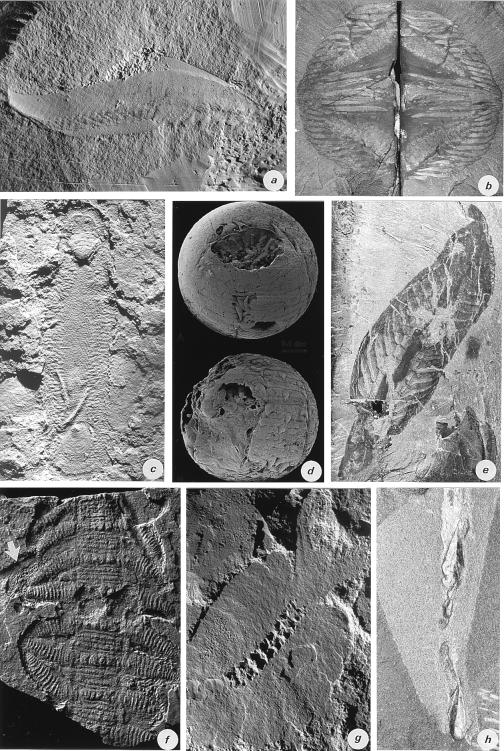
Representative Cambrian animals from Burgess Shale-type deposits
(all except d) and an example of early phosphatization
(d). (a) The agnathan chordate
Myllokunmingia fengjiao from the Lower Cambrian (lower
Botomian) Chengjiang lagerstätte, at Haikou near Kunming, Yunnan,
China. The photograph is courtesy of D. Shu (North-West University,
Xilan, People's Republic of China). (b) The holotype
and only known specimen (part and counterpart) of the ctenophore
Fasciculus vesanus from the Middle Cambrian Burgess
Shale lagerstätte, at Field in British Columbia, Canada.
(c) The halkieriid Halkieria evangelista
from the Lower Cambrian (upper Atdabanian) Sirius Passet
lagerstätte in Peary Land, North Greenland. (d)
Phosphatized embryos, possibly of a halkieriid, and referred to as
Markuelia secunda from the Pestrotsvet Formation
(Tommotian) of south-east Siberia. The figures show views of two
embryos that are wrapped around the surface. The photograph is courtesy
of S. Bengtson (Swedish Museum of Natural History, Stockholm).
[Reprinted (abstracted/excerpted) with permission from ref. .
Copyright 1997, American Association for the Advancement of Science.]
(e) The Ediacaran survivor and presumed anthozoan
(Cnidaria) Thaumaptilon walcotti from the Middle
Cambrian Burgess Shale lagerstätte, at Field in British Columbia,
Canada. (f) The lobopodian Hadranax
augustus from the Lower Cambrian (upper Atdabanian) Sirius
Passet lagerstätte in Peary Land, North Greenland. The photograph
is courtesy of G. Budd (Uppsala University, Uppsala).
(g) The primitive arthropod Kerygmachela
kierkegaardi from the Lower Cambrian (upper Atdabanian) Sirius
Passet lagerstätte in Peary Land, North Greenland. The photograph
is courtesy of G. Budd. (h) The posterior trunk of the
priapulid worm Ottoia prolifica from the Middle Cambrian
Burgess Shale lagerstätte, at Field in British Columbia, Canada.
The specimen shows the intestine and three hyoliths, interpreted as
ingested prey. (a, ×2.0; b, ×0.3;
c, ×0.8; d, ×55; e,
×0.3; f, ×0.8; g, 0.9;
h, ×1.9.)
References
-
- Bowring S A, Erwin D H. Geol Soc Am Today. 1998;8:1–8.
-
- Narbonne G M, Kaufman A J, Knoll A H. Geol Soc Am Bull. 1994;106:1281–1292. - PubMed
-
- Chen J-Y, Zhou G-Q. Bull Natl Mus Nat Sci Taiwan. 1997;10:11–105.
-
- Shields G. Eclogae Geol Helv. 1999;92:221–233.
-
- Narbonne G M. Geol Soc Am Today. 1998;8:1–6.
Publication types
MeSH terms
LinkOut - more resources
Full Text Sources
