Comparative Study
. 2000 Apr 25;97(9):4838-43.
doi: 10.1073/pnas.97.9.4838.

Human herpesvirus 8 infections in the Amsterdam Cohort Studies (1984-1997): analysis of seroconversions to ORF65 and ORF73

Affiliations
Comparative Study

Human herpesvirus 8 infections in the Amsterdam Cohort Studies (1984-1997): analysis of seroconversions to ORF65 and ORF73

J Goudsmit et al. Proc Natl Acad Sci U S A. .

Abstract

We have shown previously that human herpesvirus 8 (HHV8) seroconversion for antibodies to the latency-associated nuclear antigen encoded by ORF73 and/or the lytic capsid antigen (vp19) encoded by ORF65 is associated with orogenital contact and is strongly linked to the development of Kaposi's sarcoma among HIV-infected individuals in the Amsterdam Cohort Studies. Here, we investigate the relationship between seroconversion to these antigens and primary HHV8 infection. Between 1984 and 1997, 215 HHV8 seroconversions to ORF73 (106 cases or 49%) and/or to ORF65 (159 cases or 74%) were recorded in the cohort of homosexual men. The HHV8 seroconversion rate among HIV-infected homosexual men (6.2 per 100 person years) was consistently higher than among HIV-uninfected men (2.6 per 100 person years). In HIV-infected but not in uninfected individuals, seroconversion to ORF73/latency-associated nuclear antigen precedes that to ORF65/vp19. Antibody levels to both ORF65- and ORF73-encoded antigens were higher in HIV-infected than in HIV-uninfected men, and among HIV-seropositives, antibody levels to ORF65/vp19 rise even higher with declining CD4 cell counts and peak with Kaposi's sarcoma development, suggesting continuing and increasing viral replication. In 10.3% of HHV8 seroconversions, transient serum viremia could be demonstrated before or at seroconversion. Together with the previously reported link between unprotected orogenital sex and HHV8 seroconversion, our observations suggest that HHV8 seroconversions result from primary infections.


Figures
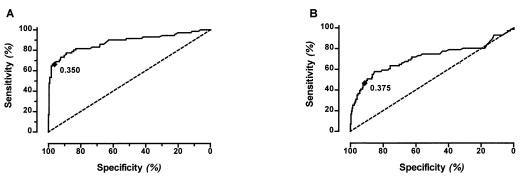
Figure 1
Figure 1
Receiver–operator characteristic curve for assays to detect antibodies against HHV8 lytic ORF65 (A) and latent ORF73 (B) antigens.
Figure 2
Figure 2
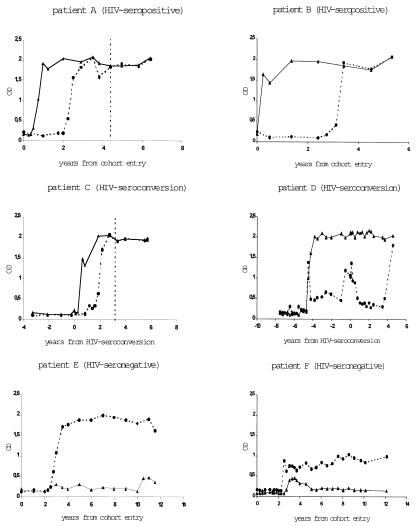
Antibody responses against HHV8 lytic ORF65 and latent ORF73 antigens in six homosexual individuals, either HIV-infected (patients A and B), HIV seroconverters (patients C and D), or HIV-seronegative (patients D and E); dashed line, OD of ORF65; solid line, OD of ORF73; vertical, dashed line, KS diagnosis.
Figure 3
Figure 3
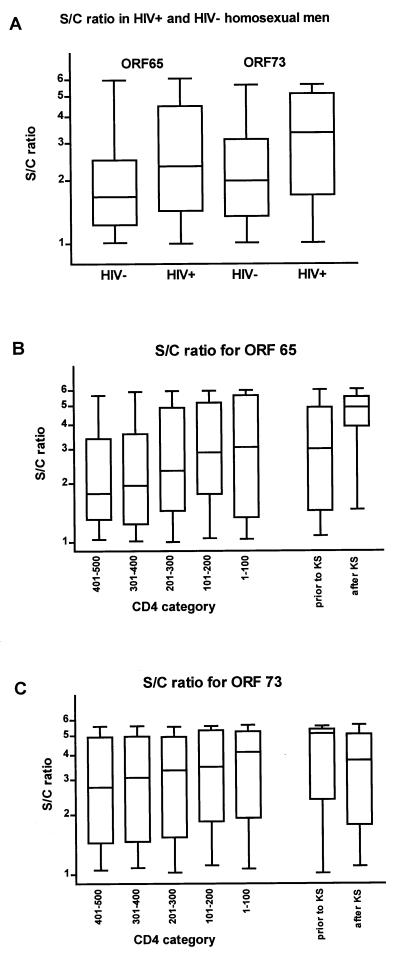
S/C ratios for antibody responses to HHV8 lytic ORF65 and latent ORF73 antigens in HIV-infected and uninfected homosexual men (A), in HIV-infected men without KS according to five CD4 categories (401–500, 301–400, 201–300, 101–200, and 1–100 cells/mm3), and in HIV-infected men with KS before and after KS was diagnosed [ORF65 (B) and ORF73 (C)]. Of 71 patients with KS, 69 had samples taken before and after KS was diagnosed. Of these, 41 and 44 tested positive for antibodies against ORF65 before and after KS was diagnosed, respectively (B); 36 and 33 tested positive for antibodies against ORF73 before and after KS was diagnosed, respectively (C).
Figure 4
Figure 4
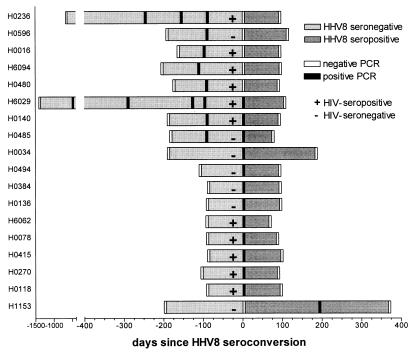
HHV8 antibody status and PCR positivity for HHV8 DNA in serum among HIV-seropositive (+) and HIV-seronegative (−) homosexual men.
Figure 5
Figure 5
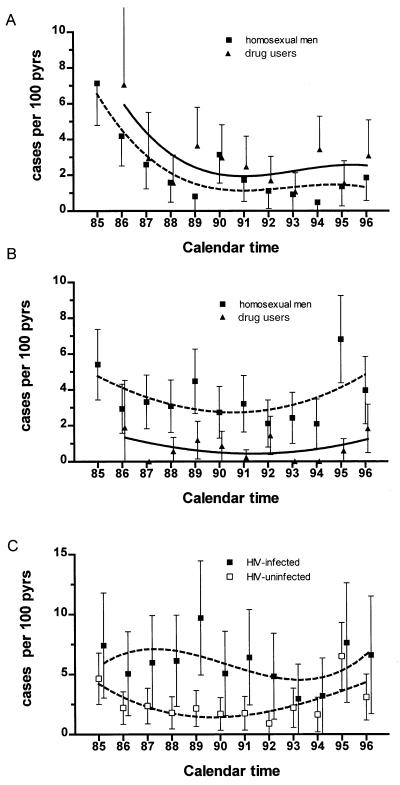
Seroconversion rate (incidence) per 100 pyrs of HIV (A) and HHV8 (B) among homosexual men (■, dashed line) and drug users (▴, bold line). (C) HHV8 seroconversion rate per 100 person years among HIV-infected (■) and HIV-uninfected (□) homosexual men.
Figure 6
Figure 6
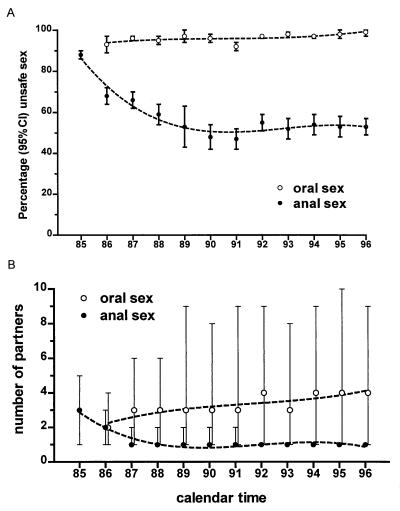
(A and B) Unprotected anogenital vs. orogenital sexual behavior over time in the Amsterdam Cohort of homosexual men. (A) Percentage of participants with at-risk contacts (95% CI). (B) Number of partners with whom at-risk behavior was practiced (median and interquartile ranges).

References

    1. Chang Y, Cesarman E, Pessin M S, Lee F, Culpepper J, Knowles D M, Moore P S. Science. 1994;266:1865–1869. - PubMed
    1. Desrosiers R C, Sasseville V G, Czajak S C, Zhang X, Mansfield K G, Kaur A, Johnson R P, Lackner A A, Jung J U. J Virol. 1997;71:9764–9769. - PMC - PubMed
    1. Rose T M, Strand K B, Schultz E R, Schaefer G, Rankin G W J, Thouless M E, Tsai C C, Bosch M L. J Virol. 1997;71:4138–4144. - PMC - PubMed
    1. Melendez L V, Daniel M D, Hunt R D, Garcia F G. Lab Anim Care. 1968;18:374–381. - PubMed
    1. Plummer G, Waterson A P. Virology. 1963;12:412–416. - PubMed

Publication types

MeSH terms