Comparative Study
. 2000 Apr 25;97(9):4956-60.
doi: 10.1073/pnas.97.9.4956.

The molecular physiology of heavy metal transport in the Zn/Cd hyperaccumulator Thlaspi caerulescens

Affiliations
Comparative Study

The molecular physiology of heavy metal transport in the Zn/Cd hyperaccumulator Thlaspi caerulescens

N S Pence et al. Proc Natl Acad Sci U S A. .

Abstract

An integrated molecular and physiological investigation of the fundamental mechanisms of heavy metal accumulation was conducted in Thlaspi caerulescens, a Zn/Cd-hyperaccumulating plant species. A heavy metal transporter cDNA, ZNT1, was cloned from T. caerulescens through functional complementation in yeast and was shown to mediate high-affinity Zn(2+) uptake as well as low-affinity Cd(2+) uptake. It was found that this transporter is expressed at very high levels in roots and shoots of the hyperaccumulator. A study of ZNT1 expression and high-affinity Zn(2+) uptake in roots of T. caerulescens and in a related nonaccumulator, Thlaspi arvense, showed that alteration in the regulation of ZNT1 gene expression by plant Zn status results in the overexpression of this transporter and in increased Zn influx in roots of the hyperaccumulating Thlaspi species. These findings yield insights into the molecular regulation and control of plant heavy metal and micronutrient accumulation and homeostasis, as well as provide information that will contribute to the advancement of phytoremediation by the future engineering of plants with improved heavy metal uptake and tolerance.


Figures

Figure 1
Figure 1
Functional complementation of Zn transport in yeast by ZNT1. A yeast zrt1 zrt2 mutant (zhy3) lacks both high- and low-affinity Zn transporters, and unlike the wild type (wt), requires high-Zn medium for growth. The ZNT1 cDNA ligated into the yeast expression vector pFL61 (denoted pZNT1) restores growth of zhy3 on low-Zn medium (10). Yeast was grown on supplemented minimal medium (14) amended with 0.1% Casamino acids, 20 mg/liter adenine, 20 mg/liter tryptophan, 1 mM EDTA, and 10 μM Fe-EDTA. High- and low-Zn media included 1 mM and 650 μM ZnSO4, respectively.
Figure 2
Figure 2
Sequence identity among ZNT1, ZIP4, and IRT1. The deduced amino acid sequence of ZNT1 (GenBank accession no. AF133267) is aligned with the ZIP4 (GenBank accession no. U95973) and IRT1 (GenBank accession no. U27590) members of the ZIP gene family, by using the clustal method in lasergene software (DNAstar, Madison, WI). The predicted peptide encoded by ZNT1 exhibits 88% sequence identity to ZIP4 and 34% identity to IRT1; shaded areas indicate regions of identity to ZNT1. The asterisks above the sequence alignment identify the histidine-rich region located in a putative cytoplasmic domain, and the gray bars indicate the eight potential transmembrane domains predicted by tmpred (17).
Figure 3
Figure 3
ZNT1 mediates Zn and Cd transport when expressed in yeast. (Upper) ZNT1-mediated Zn influx kinetics (denoted by solid line) were determined by the subtraction of residual Zn uptake in ZHY3 transformed with pFL61 (●) from the complex Zn influx kinetics exhibited by ZHY3 transformed with pFL61:ZNT1 (□). The resolved curve followed classical Michaelis–Menten kinetics for Zn influx. The Km of 7.5 μM and Vmax of 2.2 pmol of Zn per min per 106 cells were determined graphically by Lineweaver–Burke analysis of the uptake data. (Lower) The concentration-dependent kinetics of Cd influx did not conform to Michaelis–Menten kinetics, and a saturable component could not be resolved. Cd influx was enhanced by the presence of ZNT1 (□) as seen in comparison to residual Cd uptake in ZHY3 transformed with pFL61 (●). Error bars represent SE, and n = 6–10.
Figure 4
Figure 4
ZNT1 expression in T. caerulescens and T. arvense. Total RNA was isolated from roots and shoots of T. caerulescens (Tc) and T. arvense (Ta) grown for 14 days in a modified Johnson's solution with 0 (−) or 1 (+) μM Zn. The Northern blot, equally loaded with 7 μg of total RNA per lane, depicts the extremely high ZNT1 transcript abundance in T. caerulescens roots and shoots when probed with the full-length cDNA of ZNT1. Visualization of rRNA indicated that total RNA was equally loaded (data not shown). A subsequent probing with a gene-specific 0.4-kb fragment of the ZNT1 homolog from T. arvense (ZNT1-arvense) revealed that ZNT1 is expressed in the nonaccumulator under Zn deficiency in both the roots and shoots. Signals from both probes indicate a transcript size of ≈1.2 kb.
Figure 5
Figure 5
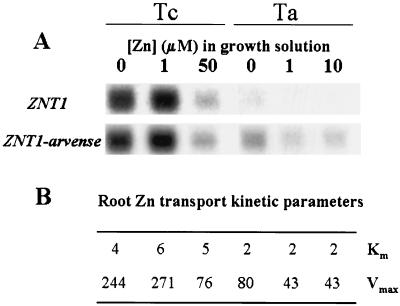
Influence of varying plant Zn status on ZNT1 expression in T. caerulescens and T. arvense. T. caerulescens (Tc) and T. arvense (Ta) were grown for 14 days in a modified Johnson's solution containing 0, 1, or 10 μM Zn (for T. arvense) and 50 μM Zn (for T. caerulescens). (A) Total RNA was isolated from roots and shoots. The Northern blot, equally loaded with 20 μg of total RNA per lane, is shown probed with ZNT1 from T. caerulescens or the ZNT1 homolog from T. arvense. (B) Radiotracer studies of unidirectional 65Zn2+ influx in roots of T. caerulescens and T. arvense grown under the different Zn concentrations were performed. The Km and Vmax values were determined for saturable Zn2+ uptake from the resulting concentration-dependent kinetics [after subtraction of the nonsaturating uptake component that we previously had shown to be root cell-wall-bound 65Zn that remained after desorption of radiolabel (10)]. The units for Km and Vmax are μM and pmol of Zn absorbed per 106 cells per min, respectively.

References

    1. Salt D E, Blaylock M, Kumar N P B A, Dushenkov V, Ensley B D, Chet I, Raskin I. Bio/Technology. 1995;13:468–474. - PubMed
    1. Salt D E, Smith R D, Raskin I. Annu Rev Plant Physiol Plant Mol Biol. 1998;49:643–668. - PubMed
    1. Baker A J M. J Plant Nutr. 1981;3:643–654.
    1. Baker A J M, Brooks R R. Biorecovery. 1989;1:81–126.
    1. Brown S L, Chaney R L, Angle J S, Baker A J M. Soil Sci Soc Am J. 1995;59:125–132.

Publication types

MeSH terms

Associated data

LinkOut - more resources