


doi: 10.1128/JB.182.10.2982-2984.2000.
Positioning of region 4 of the Escherichia coli RNA polymerase sigma(70) subunit by a transcription activator
Affiliations
- PMID: 10781573
- PMCID: PMC102013
- DOI: 10.1128/JB.182.10.2982-2984.2000
Item in Clipboard
Positioning of region 4 of the Escherichia coli RNA polymerase sigma(70) subunit by a transcription activator
J Bacteriol.
2000 May.
Abstract
A DNA cleavage reagent, specifically tethered to residue 581 of the Escherichia coli RNA polymerase sigma(70) subunit, has been used to investigate the location of sigma(70) region 4 in different complexes at the galp(1) promoter and the effect of the cyclic AMP receptor protein. The positions of DNA cleavage by the reagent are not affected by the cyclic AMP receptor protein. We conclude that transcription activation at the galp(1) promoter by the cyclic AMP receptor protein does not involve major conformation changes in or repositioning of sigma(70) region 4.
Figures
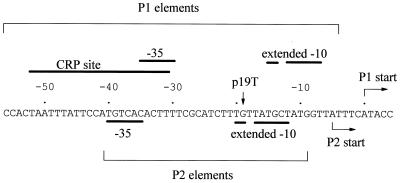
Base sequence of the wild-type E. coli gal operon regulatory region, showing the two overlapping promoters P1 and P2. The sequence is numbered with the P1 transcript start as +1. Above the sequence are shown the various P1 elements: the 22-bp DNA site for CRP and the −35 and extended −10 elements. Below the sequence are shown the P2 −35 and extended −10 element and the P2 start point. The location of the p19T substitution, which completely inactivates P2, is indicated. With the gal regulatory region carrying the p19T substitution, RNAP initiates transcription at P1 in both the absence and the presence of CRP.
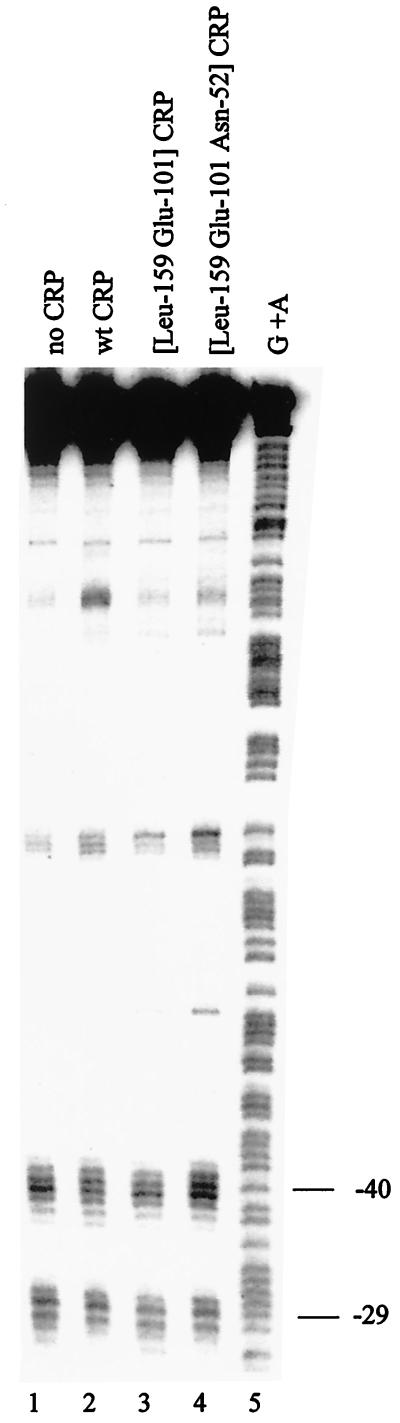
DNA cleavage of galp19T by RNAP containing FeBABE-tagged [Cys581] ς70. Purified wild-type (wt) CRP (150 nM) or mutant derivatives were mixed, as indicated, with 32P-end-labeled AatII-HindIII DNA fragments (0.4 nM, labeled on the template strand) carrying the gal promoter region with the p19T mutation in a reaction volume of 35 μl [20 mM HEPES (pH 8.0), 5 mM MgCl2, 200 μM cyclic AMP, 50 mM potassium glutamate, 50 μg of bovine serum albumin per ml, 5 μg of poly(dI-dC)]. RNAP holoenzyme (30 nM) reconstituted with FeBABE-tagged [Cys-581] ς70 was then added and incubated at 37°C for 20 min. Complexes were challenged with heparin (200 μM for 5 min), and DNA cleavage was initiated by the addition of sodium ascorbate (2 mM) followed by incubation at 37°C for 20 min. Modified DNA was extracted with phenol-chloroform and analyzed on a 6% polyacrylamide sequencing gel, which was calibrated with Maxam-Gilbert G+A sequence ladders and processed and scanned using a Molecular Dynamics PhosphorImager (full protocols are given in reference 3). Bands due to DNA cleavage near positions −40 and −29 upstream of the galp1 transcription start point are indicated. Lane 1, no CRP; lane 2, wild-type CRP; lane 3, [Leu159 Glu101] CRP; lane 4, [Leu159 Glu101 Asn52] CRP; lane 5, G+A sequencing ladder.
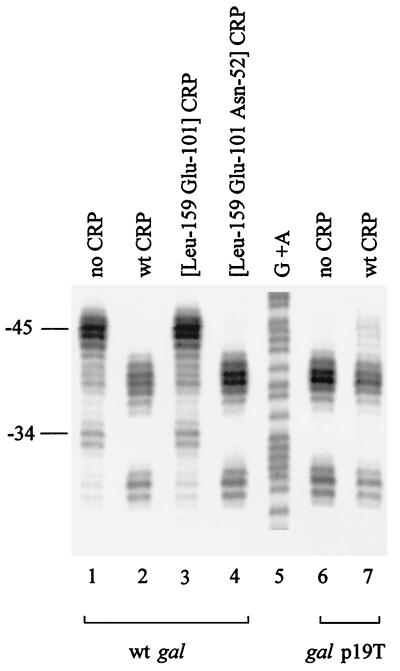
DNA cleavage of wild-type (wt) gal by RNAP containing FeBABE-tagged [Cys581] ς70. Purified wild-type CRP (150 nM) or mutant derivatives were mixed, as indicated, with 32P-end-labeled AatII-HindIII DNA fragments (0.4 nM, labeled on the template strand) carrying gal promoter DNA in a reaction volume of 35 μl, and RNAP holoenzyme (30 nM) reconstituted with FeBABE-tagged [Cys581] ς70 was then added. Samples were processed exactly as described in the legend to Fig. 2 (full protocols are given in reference 3). Bands due to DNA cleavage at different positions upstream of the galp1 transcription start point are indicated. Lane 1, wild-type gal, no CRP; lane 2, wild-type gal, wild-type CRP; lane 3, wild-type gal, [Leu159 Glu101] CRP; lane 4, wild-type gal, [Leu159 Glu101 Asn52] CRP; lane 5, G+A sequencing ladder; lane 6, galp19T, no CRP; lane 7, galp19T, wild-type CRP.
References
-
- Bingham A, Ponnambalam S, Chan B, Busby S. Mutations that reduce expression from the P2 promoter of the Escherichia coli galactose operon. Gene. 1986;41:67–74. - PubMed
-
- Bown J, Owens J, Meares C, Fujita N, Ishihama A, Busby S, Minchin S. Organization of open complexes at Escherichia coli promoters: location of promoter DNA sites close to region 2.5 of the ς70 subunit of RNA polymerase. J Biol Chem. 1999;274:2263–2270. - PubMed
-
- Busby S, Ebright R. Promoter structure, promoter recognition, and transcription activation in prokaryotes. Cell. 1994;79:743–748. - PubMed
-
- Busby S, Ebright R. Transcription activation at class II CAP-dependent promoters. Mol Microbiol. 1997;23:853–859. - PubMed
Publication types
MeSH terms
Substances
Grants and funding
LinkOut - more resources
Full Text Sources
Molecular Biology Databases
