Proteolysis in Caenorhabditis elegans sex determination: cleavage of TRA-2A by TRA-3
Affiliations
- PMID: 10783162
- PMCID: PMC316540
Item in Clipboard
Proteolysis in Caenorhabditis elegans sex determination: cleavage of TRA-2A by TRA-3
Genes Dev.
.
Abstract
The Caenorhabditis elegans tra-3 gene promotes female development in XX hermaphrodites and encodes an atypical calpain regulatory protease lacking calcium-binding EF hands. We report that despite the absence of EF hands, TRA-3 has calcium-dependent proteolytic activity and its proteolytic domain is essential for in vivo function. We show that the membrane protein TRA-2A, which promotes XX female development by repressing the masculinizing protein FEM-3, is a TRA-3 substrate. Cleavage of TRA-2A by TRA-3 generates a peptide predicted to have feminizing activity. These results indicate that proteolysis regulated by calcium may control some aspects of sexual cell fate in C. elegans.
Figures
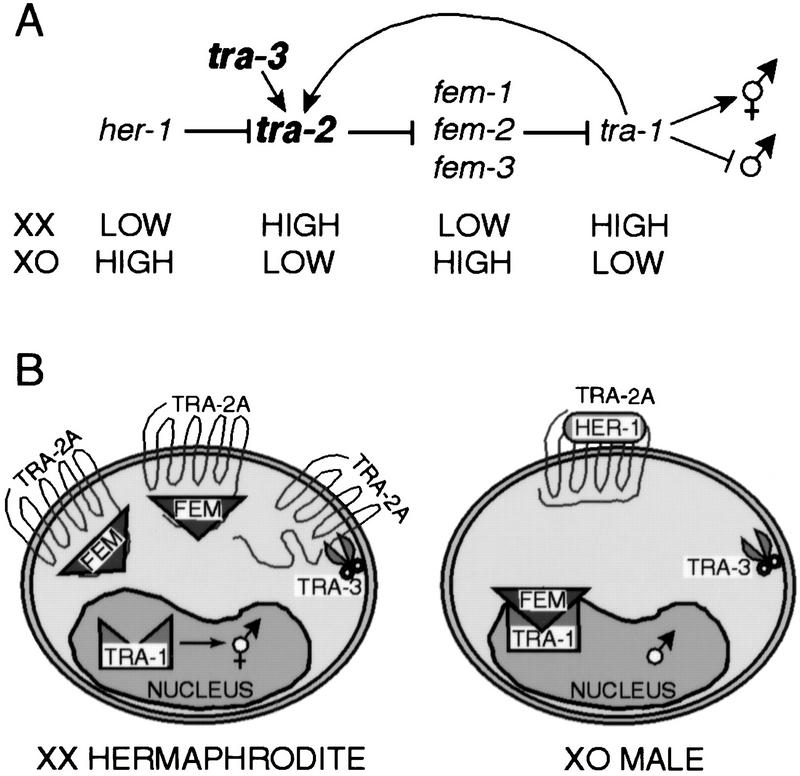
Regulation of sexual fate in C. elegans focusing on the role of tra-3. (A) Simplified genetic pathway of somatic sex determination (Meyer 1997; Kuwabara 1999; and references therein). Wild-type XX diploids are hermaphrodites, which are self-fertile females that produce first sperm, then oocytes, and XO diploids are males. The pathway consists of a cascade of negative regulatory interactions, whereby an upstream gene inhibits the activity of its downstream neighbor. The state of each gene (high/low) during XX or XO development is indicated. The decision to adopt a male or female somatic fate is determined by tra-1. The pathway has been modified to indicate that tra-2 is epistatic to tra-3 (this work). (B) Molecular model of the signal transduction pathway underlying the genetic pathway of somatic sex-determination. In XX hermaphrodites, TRA-2A is depicted as a multipass membrane protein that binds and represses FEM-3 through its carboxyl terminus, possibly by sequestration. We propose that TRA-3 is a protease that cleaves and potentiates the activity of TRA-2A (this work); however, the fate of the carboxy-terminal TRA-2A peptide is unknown. TRA-3 is present in both sexes (S. Sokol and P. Kuwabara, unpubl.).
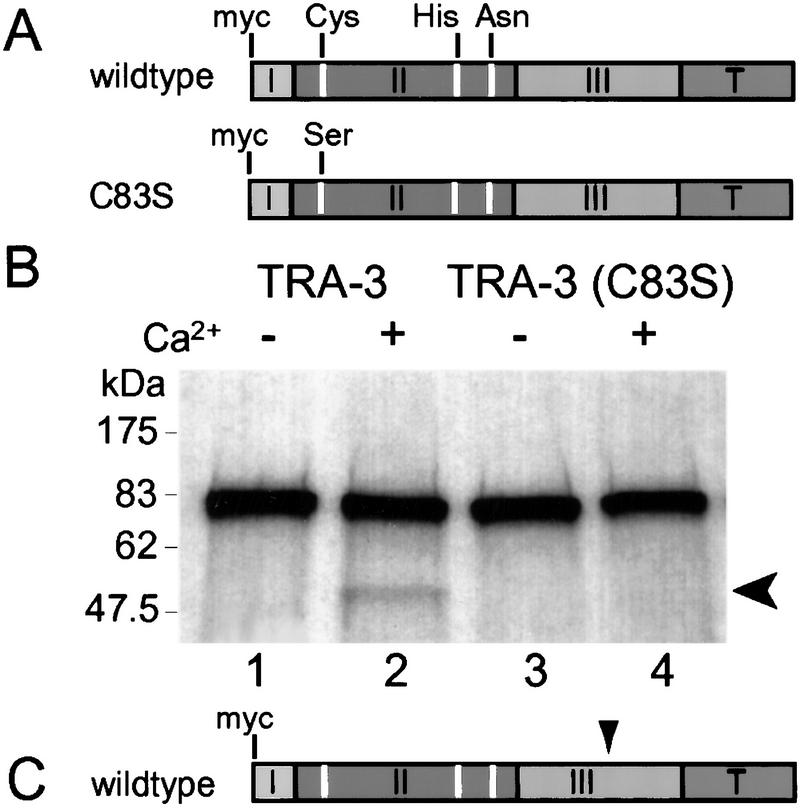
The C. elegans sex-determining protein TRA-3 catalyzes calcium-dependent autolysis in vitro. (A) Schematic representation of amino-terminally myc-tagged wild-type TRA-3 and catalytically inactive TRA-3(C83S) expressed in vitro. The catalytic triad of Cys, His, and Asn is marked in white. The four domains of TRA-3 are labeled I–III, and T. (B) Wild-type TRA-3 incubated in the absence (−) or presence (+) of 5 mm calcium (lanes 1,2); catalytically inactive TRA-3(C83S) incubated in the absence (−) or presence (+) of 5 mm calcium (lanes 3,4). Full-length TRA-3 (∼76 kD); (arrow) TRA-3 cleavage product (∼50 kD). (C) Predicted site of TRA-3 autolysis based on sizes of wild-type and truncated TRA-3 cleavage products (S. Sokol and P. Kuwabara, unpubl.).
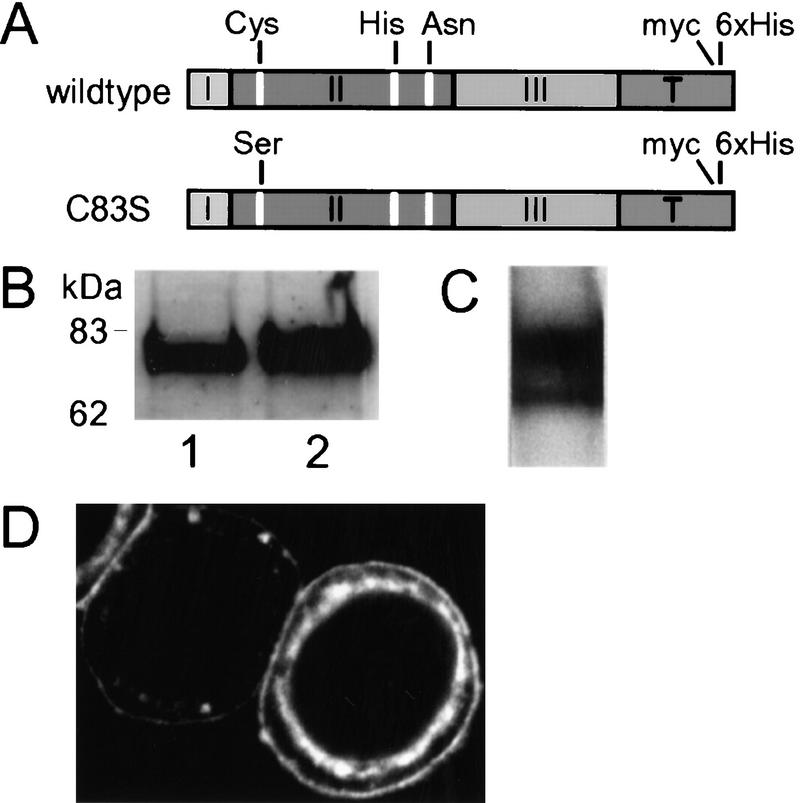
Expression and immunological detection of myc-tagged TRA-3 and TRA-2A in Sf9 cells. (A) Schematic representation of wild-type TRA-3 and catalytically inactive TRA-3(C83S) proteins expressed in Sf9 cells (see legend to Fig. 2A). (B) Immunoblot of Sf9 extracts expressing TRA-3 or TRA-3(C83S) probed with anti-myc (lanes 1,2). (C) Immunoblot of membrane-enriched Sf9 extracts expressing myc-tagged TRA-2A probed with anti-TRA-2. (D) Localization of TRA-2A to the plasma membrane of Sf9 cells using anti-TRA-2. Note that cell at right expresses TRA-2A more strongly than cell at left because of variability in infection efficiency.
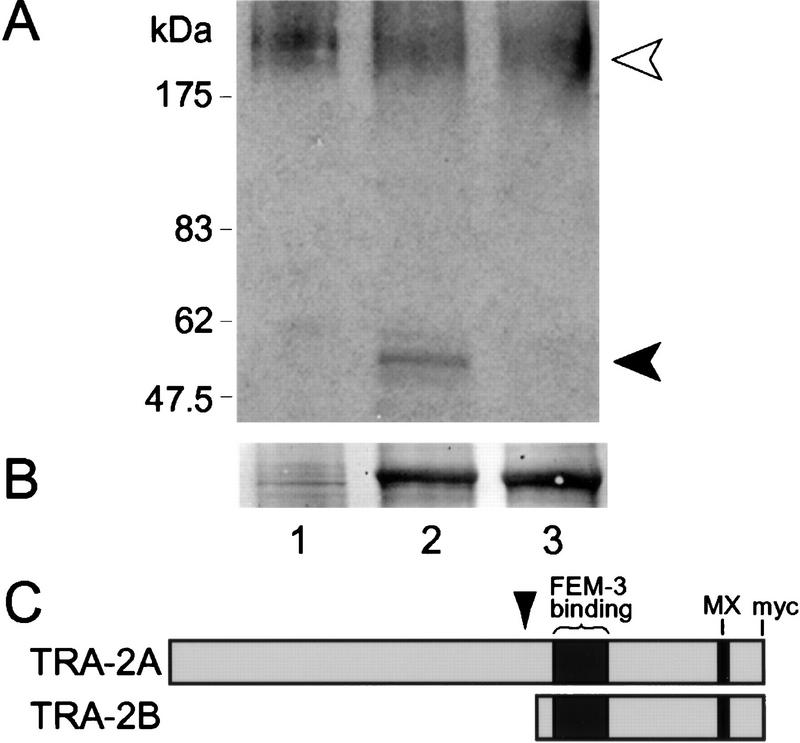
Proteolytic cleavage of TRA-2A by TRA-3. (A) Immunoblot probed with anti-TRA-2 of Sf9 cell extracts expressing TRA-2A alone (lane 1), coexpressing TRA-2A and wild-type TRA-3 (lane 2), or coexpressing TRA-2A and catalytically inactive TRA-3(C83S) (lane 3). (Open arrowhead) Full-length TRA-2A (∼170 kD); (solid arrowhead) carboxy-terminal TRA-2A proteolytic peptide (∼55 kD). (B) Immunoblot from A stained with Ponceau S to show that wild-type and inactive TRA-3 are comparably expressed. (C) Proposed relationship between TRA-2A/B and TRA-2A cleavage peptide. Predicted site of TRA-2A cleavage by TRA-3 is indicated by arrowhead.
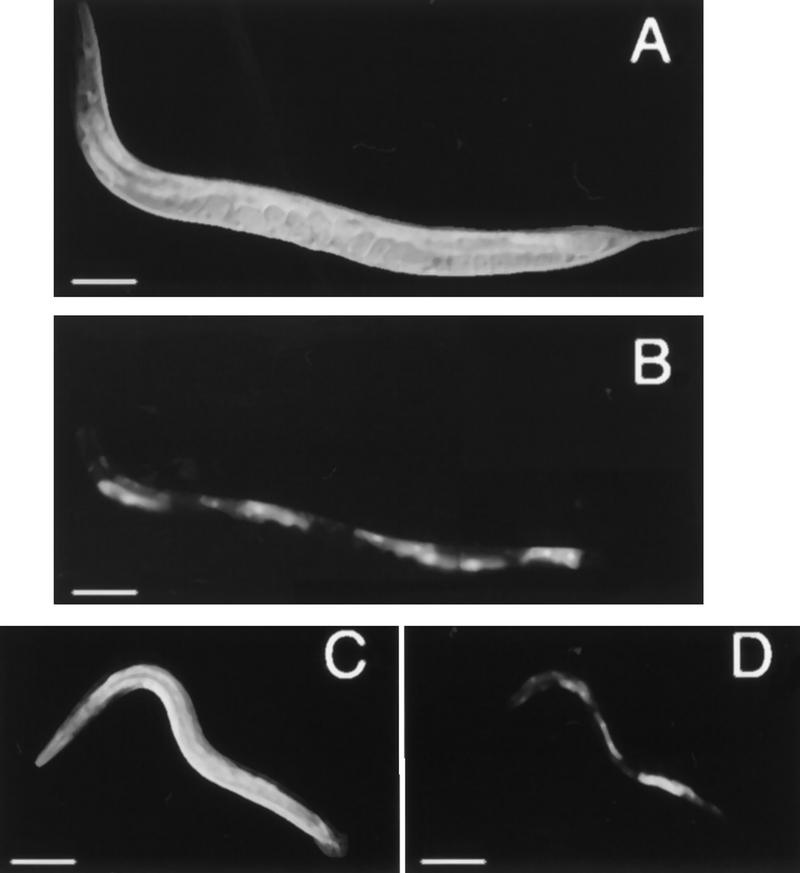
Detection of somatic feminization in XX and XO animals using a vit-2::gfp reporter. (A) Nomarski DIC photomicrograph of an adult XX him-8; crEx65 hermaphrodite. (B) The same animal in A examined by epifluorescence to reveal intestinal GFP expression. (C) Nomarski DIC photomicrograph of an adult XO him-8; crEx65 male following heat shock. (D) The same animal in C examined by epifluorescence to reveal ectopic intestinal GFP fluorescence, which is indicative of somatic feminization. In all panels: anterior, left; ventral, down. Scale bar, 10 μm.
Similar articles
-
Germ-line regulation of the Caenorhabditis elegans sex-determining gene tra-2.Dev Biol. 1998 Dec 1;204(1):251-62. doi: 10.1006/dbio.1998.9062. Dev Biol. 1998. PMID: 9851857
-
The TRA-1 transcription factor binds TRA-2 to regulate sexual fates in Caenorhabditis elegans.EMBO J. 2001 Mar 15;20(6):1363-72. doi: 10.1093/emboj/20.6.1363. EMBO J. 2001. PMID: 11250902 Free PMC article.
-
The PLZF-like protein TRA-4 cooperates with the Gli-like transcription factor TRA-1 to promote female development in C. elegans.Dev Cell. 2006 Oct;11(4):561-73. doi: 10.1016/j.devcel.2006.07.015. Dev Cell. 2006. PMID: 17011494
-
It ain't over till it's ova: germline sex determination in C. elegans.Bioessays. 2001 Jul;23(7):596-604. doi: 10.1002/bies.1085. Bioessays. 2001. PMID: 11462213 Review.
-
Sex determination in the Caenorhabditis elegans germ line.Curr Top Dev Biol. 2008;83:41-64. doi: 10.1016/S0070-2153(08)00402-X. Curr Top Dev Biol. 2008. PMID: 19118663 Review.
Cited by
-
Identification of BiP as a temperature sensor mediating temperature-induced germline sex reversal in C. elegans.EMBO J. 2024 Sep;43(18):4020-4048. doi: 10.1038/s44318-024-00197-z. Epub 2024 Aug 12. EMBO J. 2024. PMID: 39134659 Free PMC article.
-
A Caenorhabditis elegans wild type defies the temperature-size rule owing to a single nucleotide polymorphism in tra-3.PLoS Genet. 2007 Mar 2;3(3):e34. doi: 10.1371/journal.pgen.0030034. Epub 2007 Jan 9. PLoS Genet. 2007. PMID: 17335351 Free PMC article.
-
Sex Determination in Nematode Germ Cells.Sex Dev. 2022;16(5-6):305-322. doi: 10.1159/000520872. Epub 2022 Feb 16. Sex Dev. 2022. PMID: 35172320 Free PMC article. Review.
-
Abnormal glucose homeostasis and pancreatic islet function in mice with inactivation of the Fem1b gene.Mol Cell Biol. 2005 Aug;25(15):6570-7. doi: 10.1128/MCB.25.15.6570-6577.2005. Mol Cell Biol. 2005. PMID: 16024793 Free PMC article.
-
Outcrossing and the maintenance of males within C. elegans populations.J Hered. 2010 Mar-Apr;101 Suppl 1(Suppl 1):S62-74. doi: 10.1093/jhered/esq003. Epub 2010 Mar 8. J Hered. 2010. PMID: 20212008 Free PMC article.
References
-
- Aza-Blanc P, Kornberg TB. Ci: A complex transducer of the hedgehog signal. Trends Genet. 1999;15:458–462. - PubMed
-
- Blanchard H, Grochulski P, Li Y, Arthur JS, Davies PL, Elce JS, Cygler M. Structure of a calpain Ca2+-binding domain reveals a novel EF-hand and Ca2+-induced conformational changes. Nat Struct Biol. 1997;4:532–538. - PubMed
-
- The C. elegans Sequencing Consortium (Consortium) Genome sequence of the nematode C. elegans: A platform for investigating biology. Science. 1998;282:2012–2018. - PubMed
-
- Dear N, Matena K, Vingron M, Boehm T. A new subfamily of vertebrate calpains lacking a calmodulin-like domain: Implications for calpain regulation and evolution. Genomics. 1997;45:175–184. - PubMed
Publication types
MeSH terms
Substances
LinkOut - more resources
Full Text Sources
Molecular Biology Databases
Miscellaneous