Temperature measured at the axilla compared with rectum in children and young people: systematic review
- PMID: 10784539
- PMCID: PMC27359
- DOI: 10.1136/bmj.320.7243.1174
Temperature measured at the axilla compared with rectum in children and young people: systematic review
Abstract
Objective: To evaluate the agreement between temperature measured at the axilla and rectum in children and young people.
Design: A systematic review of studies comparing temperature measured at the axilla (test site) with temperature measured at the rectum (reference site) using the same type of measuring device at both sites in each patient. Devices were mercury or electronic thermometers or indwelling thermocouple probes.
Studies reviewed: 40 studies including 5528 children and young people from birth to 18 years.
Data extraction: Difference in temperature readings at the axilla and rectum.
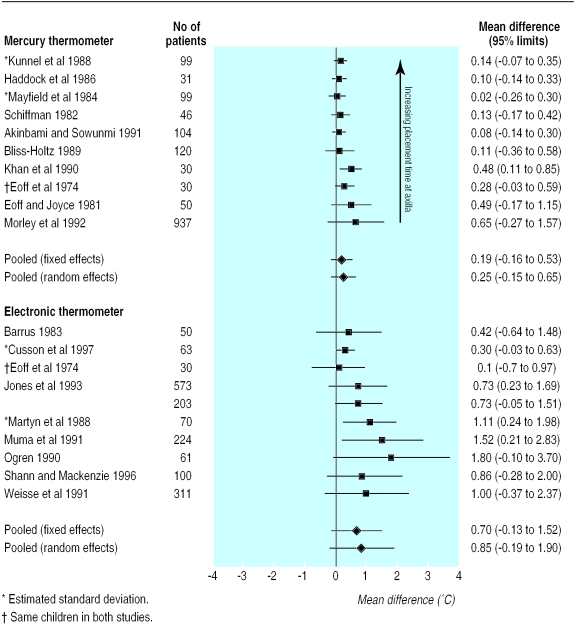
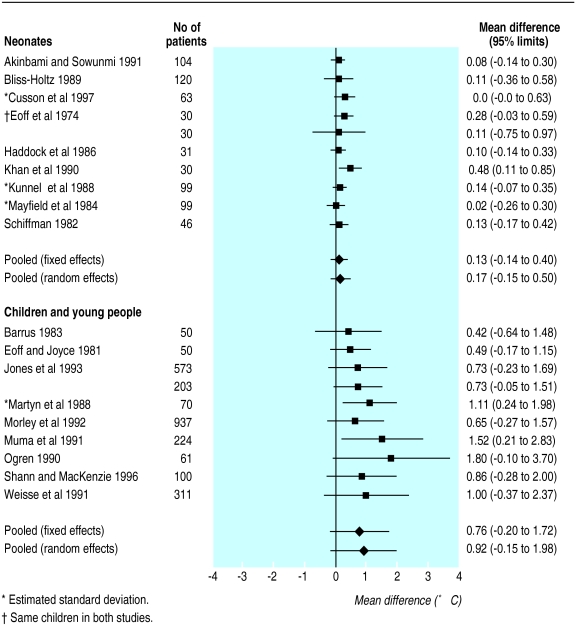
Results: 20 studies (n=3201 (58%) participants) had sufficient data to be included in a meta-analysis. There was significant residual heterogeneity in both mean differences and sample standard deviations within the groups using different devices and within age groups. The pooled (random effects) mean temperature difference (rectal minus axillary temperature) for mercury thermometers was 0.25 degrees C (95% limits of agreement -0.15 degrees C to 0.65 degrees C) and for electronic thermometers was 0. 85 degrees C (-0.19 degrees C to 1.90 degrees C). The pooled (random effects) mean temperature difference (rectal minus axillary temperature) for neonates was 0.17 degrees C (-0.15 degrees C to 0. 50 degrees C) and for older children and young people was 0.92 degrees C (-0.15 degrees C to 1.98 degrees C).
Conclusions: The difference between temperature readings at the axilla and rectum using either mercury or electronic thermometers showed wide variation across studies. This has implications for clinical situations where temperature needs to be measured with precision.
Figures
References
-
- Schmitt BD. Fever phobia: misconceptions of parents about fever. Am J Dis Child. 1980;134:176–181. - PubMed
-
- Thomas V, Andrea J, Gerhart A, Gocka I. National survey of pediatric fever management practices among emergency department nurses. J Emerg Nurs. 1994;20:505–510. - PubMed
-
- Erickson RS, Woo TM. Accuracy of infrared ear thermometry and traditional temperature methods in young children. Heart Lung. 1994;23:181–195. - PubMed
-
- Haddock B, Vincent P, Merrow D. Axillary and rectal temperatures of full-term neonates: are they different? Neonatal Network. 1986;5:36–40. - PubMed
Publication types
MeSH terms
LinkOut - more resources
Full Text Sources