Sedation with "non-sedating" antihistamines: four prescription-event monitoring studies in general practice
- PMID: 10784544
- PMCID: PMC27362
- DOI: 10.1136/bmj.320.7243.1184
Sedation with "non-sedating" antihistamines: four prescription-event monitoring studies in general practice
Abstract
Objectives: To investigate the frequency with which sedation was reported in post-marketing surveillance studies of four second generation antihistamines: loratadine, cetirizine, fexofenadine, and acrivastine.
Design: Prescription-event monitoring studies.
Setting: Prescriptions were obtained for each cohort in the immediate post-marketing period.
Subjects: Event data were obtained for a total of 43 363 patients.
Main outcome measures: Reporting of sedation or drowsiness.
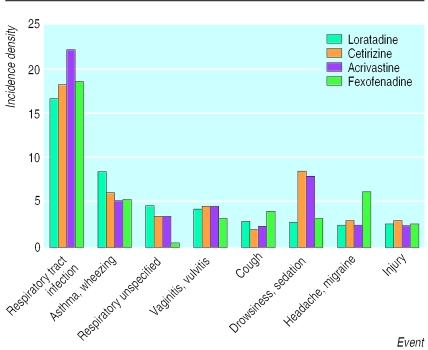
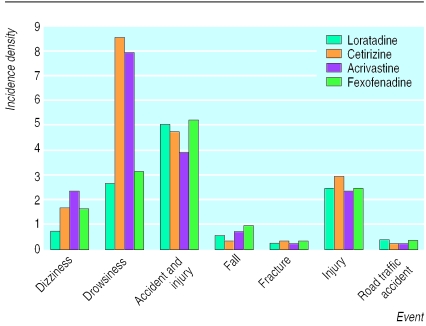
Results: The odds ratios (adjusted for age and sex) for the incidence of sedation were 0.63 (95% confidence interval 0.36 to 1.11; P=0.1) for fexofenadine; 2.79 (1.69 to 4.58; P<0.0001) for acrivastine, and 3.53 (2.07 to 5.42; P<0.0001) for cetirizine compared with loratadine. No increased risk of accident or injury was evident with any of the four drugs.
Conclusions: Although the risk of sedation was low with all four drugs, fexofenadine and loratadine may be more appropriate for people working in safety critical jobs.
Figures
Comment in
-
Commentary: Reporting of adverse events is worth the effort.BMJ. 2000 Apr 29;320(7243):1186-7. BMJ. 2000. PMID: 10836821 No abstract available.
-
All antihistamines cross blood-brain barrier.BMJ. 2000 Sep 2;321(7260):572. BMJ. 2000. PMID: 11023307 Free PMC article. No abstract available.
References
-
- Nolen TM. Sedative effects of antihistamines: safety, performance, learning and quality of life. Clin Therapeutics. 1997;19:39–55. - PubMed
-
- Nightingale CH. Treating allergic rhinitis with second-generation antihistamines. Pharmacother. 1996;16:905–914. - PubMed
-
- Slater JW, Zechnich AD, Haxby DG. Second-generation antihistamines: a comparative review. Drugs. 1999;57:31–47. - PubMed
-
- Gonzalez MA, Estes KS. Pharmacokinetic overview of oral second-generation H1 antihistamines. Int J Clin Pharmacol Ther. 1998;36:292–300. - PubMed
Publication types
MeSH terms
Substances
LinkOut - more resources
Full Text Sources