


Distribution of genes encoding putative transmissibility factors among epidemic and nonepidemic strains of Burkholderia cepacia from cystic fibrosis patients in the United Kingdom
- PMID: 10790095
- PMCID: PMC86581
- DOI: 10.1128/JCM.38.5.1763-1766.2000
Distribution of genes encoding putative transmissibility factors among epidemic and nonepidemic strains of Burkholderia cepacia from cystic fibrosis patients in the United Kingdom
Abstract
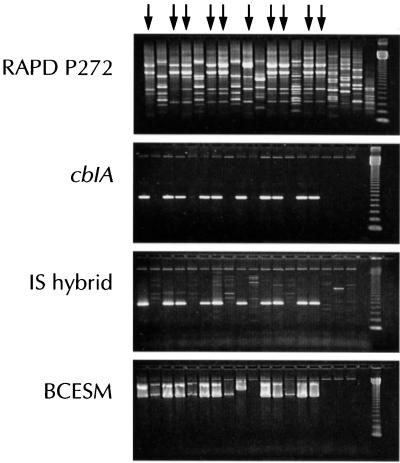
In the last 15 years, Burkholderia cepacia has emerged as a significant pathogen in cystic fibrosis (CF) patients, mainly due to the severity of infection observed in a subset of patients and the fear of transmission of the organism to noncolonized patients. Although patients who deteriorate rapidly cannot be predicted by microbiological characteristics, three genetic markers have been described for strains that spread between patients. These are the cblA gene, encoding giant cable pili; a hybrid of two insertion sequences, IS1356 and IS402; and a 1.4-kb open reading frame known as the B. cepacia epidemic strain marker (BCESM). The latter two are of unknown function. An epidemic strain lineage was previously identified among CF patients in the United Kingdom that apparently had spread from North America and that was characterized by a specific random amplified polymorphic DNA (RAPD) pattern. We searched for the described genetic markers using specific PCR assays with 117 patient isolates of B. cepacia from 40 United Kingdom hospitals. Isolates were grouped according to genomovar and epidemic strain lineage RAPD pattern with a 10-base primer, P272. A total of 41 isolates from patients in 12 hospitals were classified as the epidemic strain, and 40 of these were distributed in genomovars IIIa (11 isolates), IIIb (1 isolate), and IIIc (28 isolates). All isolates of the epidemic strain were positive for the cblA gene and BCESM, but two lacked the insertion sequence hybrid. None of the 76 sporadic isolates contained cblA or the insertion sequence hybrid, but 11 of them were positive for BCESM. Nonepidemic isolates were distributed among genomovars I or IV (9), II (49), IIIa (11), IIIb (3), and IIIc (4). There were three clusters of cross-infection (one involving two patients and two involving three patients) with isolates of genomovar II. We conclude that in the United Kingdom, a single clonal lineage has spread between and within some hospitals providing care for CF patients. The presence of the cblA gene is the most specific marker for the epidemic strain. We recommend that all isolates of B. cepacia from CF patients should be screened by PCR to influence segregation and infection control strategies.
Figures
References
-
- Govan J R W, Brown P H, Maddison J, Doherty C J, Nelson J W, Dodd M, Greening A P, Webb A K. Evidence for transmission of Pseudomonas cepacia by social contact in cystic fibrosis. Lancet. 1993;342:15–19. - PubMed
MeSH terms
Substances
LinkOut - more resources
Full Text Sources
Medical
Molecular Biology Databases
