. 2000 May 1;191(9):1611-6.
doi: 10.1084/jem.191.9.1611.

Induction and suppression of collagen-induced arthritis is dependent on distinct fcgamma receptors

Affiliations

Induction and suppression of collagen-induced arthritis is dependent on distinct fcgamma receptors

S Kleinau et al. J Exp Med. .

Abstract

Receptors for immunoglobulin (Ig)G (FcgammaRs) are important for the antibody-mediated effector functions of the immune system. FcgammaRI and FcgammaRIII trigger cell activation through a common gamma chain, whereas FcgammaRII acts as a negative regulator of antibody production and immune complex-triggered activation. Here we describe the in vivo consequences of FcgammaR deficiency in a mouse model of human rheumatoid arthritis. FcRgamma chain-deficient mice on arthritis-susceptible DBA/1 background were immunized with collagen for induction of collagen-induced arthritis. The DBA/1 mice lacking FcRgamma chain were protected from collagen-induced arthritis in contrast to wild-type mice, although both groups produced similar levels of IgG anticollagen antibodies. In comparison, DBA/1 mice lacking FcgammaRII developed an augmented IgG anticollagen response and arthritis. These observations suggest a crucial role of FcgammaRI and FcgammaRIII in triggering autoimmune arthritis.


Figures
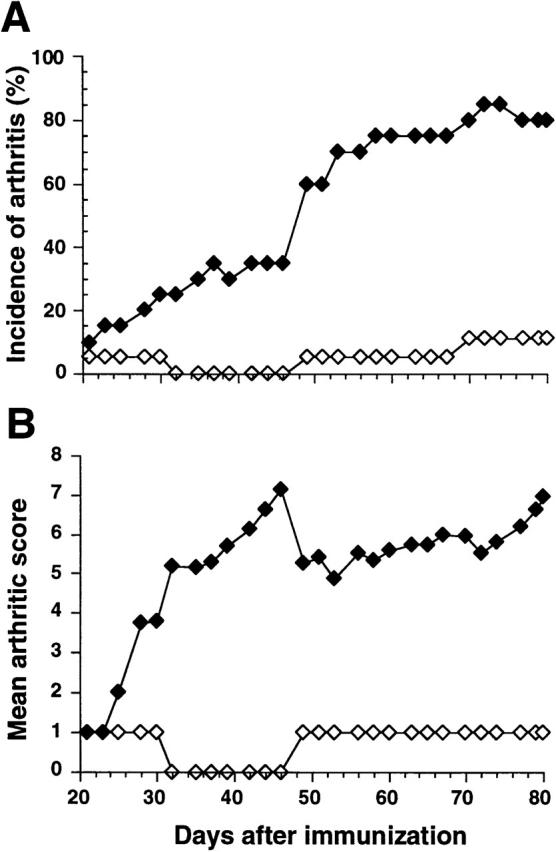
Figure 1
Figure 1
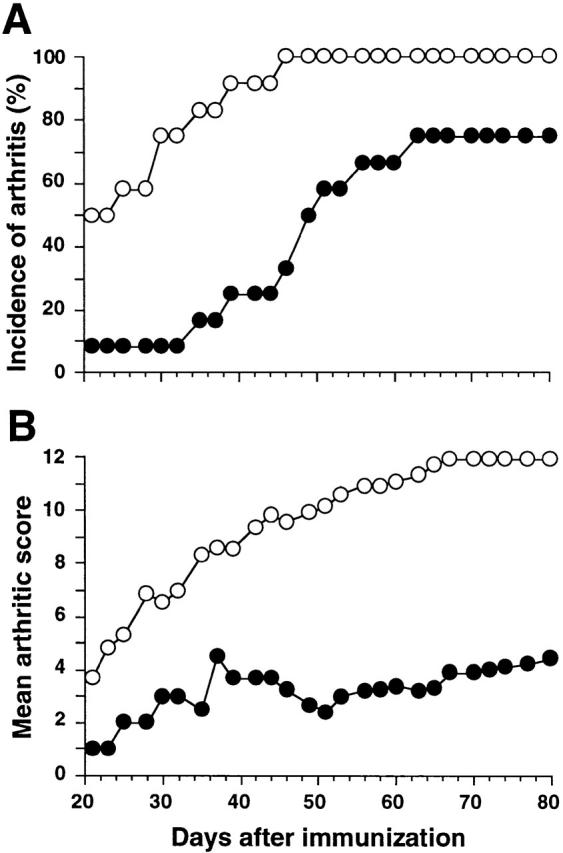
Protection from CIA in FcRγ-deficient DBA/1 mice. CII-immunized FcRγ+/+ mice (filled symbols, n = 20) and FcRγ−/− mice (open symbols, n = 18) were observed for arthritic lesions, and the percentage of mice that developed disease (A) and the mean severity of arthritis in diseased animals (B) are shown. The figure shows results from one representative experiment out of two performed.
Figure 3
Figure 3
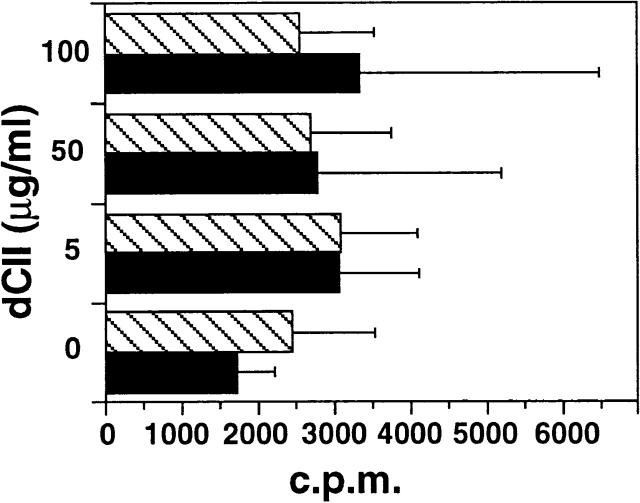
Proliferation of CII-primed LNCs in response to CII. LNCs from BCII-immunized FcRγ+/+ (black bars, n = 4) and FcRγ−/− mice (hatched bars, n = 4) were stimulated in vitro with different antigen doses of heat-denatured CII (dCII). Proliferative responses were determined after 4 d of culturing by uptake of [3H]TdR. No significant difference between the groups was found.
Figure 2
Figure 2
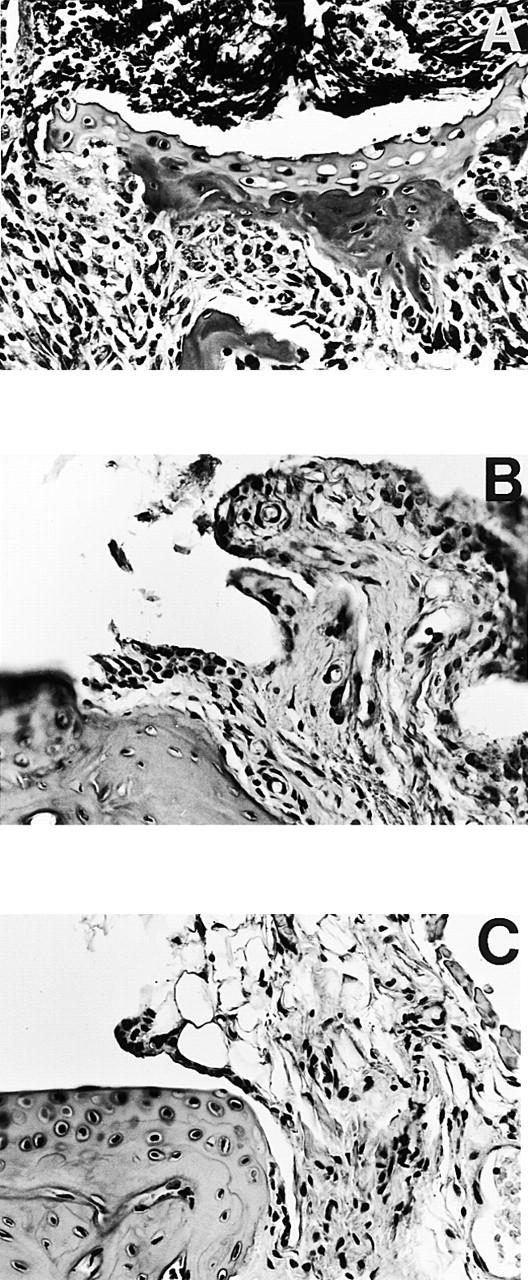
Histopathology of tarsal joints from FcRγ+/+ and FcRγ−/− DBA/1 mice 80 d after CII immunization. Severe arthritis was seen in FcRγ+/+ mice (A) with inflammatory cellular infiltrate, invasive pannus, and erosions of cartilage and bone clearly detectable. The few FcRγ−/− mice that developed disease (B) showed proliferation of synovial lining layer, synovial villi formation, but absence of cellular infiltrate and erosions. Joints of nonaffected FcRγ−/− mice (C) were normal in appearance, with normal synovia and smooth intact cartilage. Representative sagittal paraffin sections with hematoxylin-eosin stain; original magnifications: (A) ×20; (B and C) ×50.
Figure 4
Figure 4
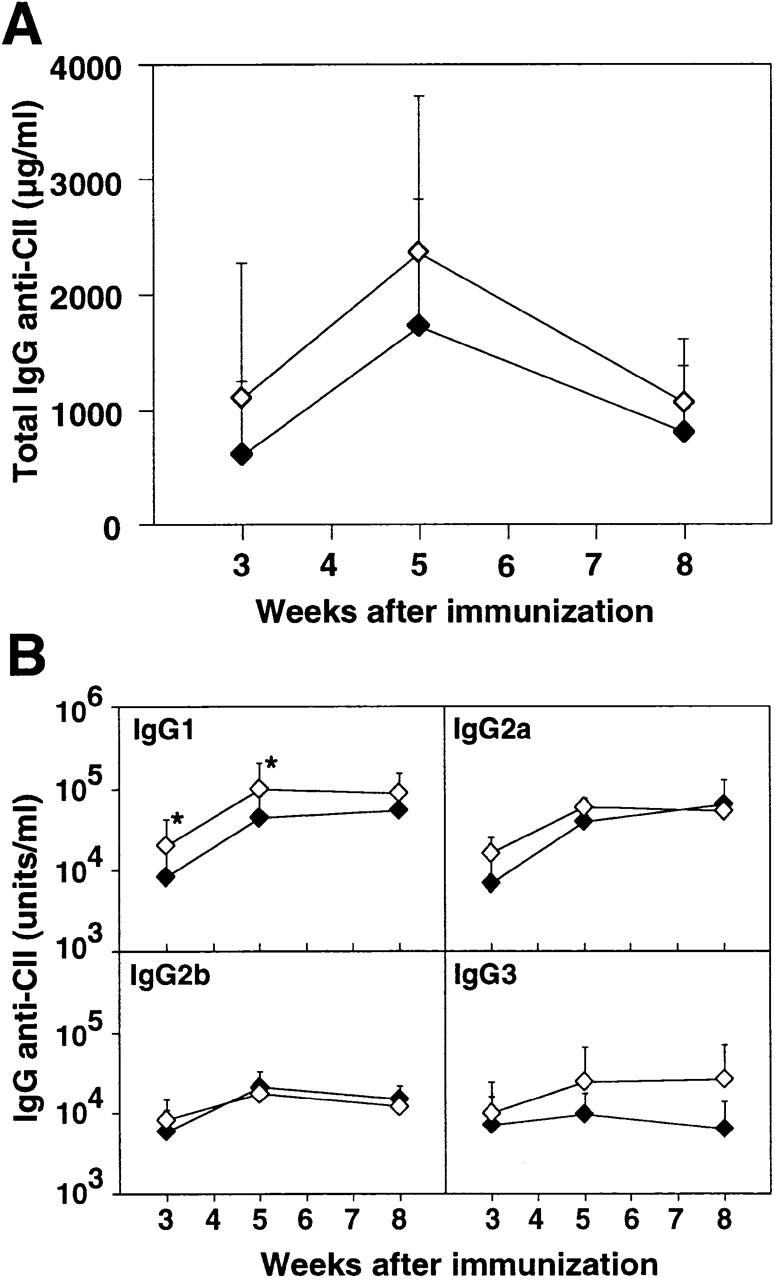
Anti-CII antibodies in FcRγ-deficient DBA/1 mice. Circulating CII-specific antibodies were determined periodically after BCII immunization in individual sera of FcRγ+/+ (filled symbols) and FcRγ−/− mice (open symbols). The mean ± SD antibody levels of total IgG anti-CII (A) and subclass-specific IgG anti-CII (B) are shown. *P < 0.05 compared with the FcRγ+/+ group.
Figure 6
Figure 6
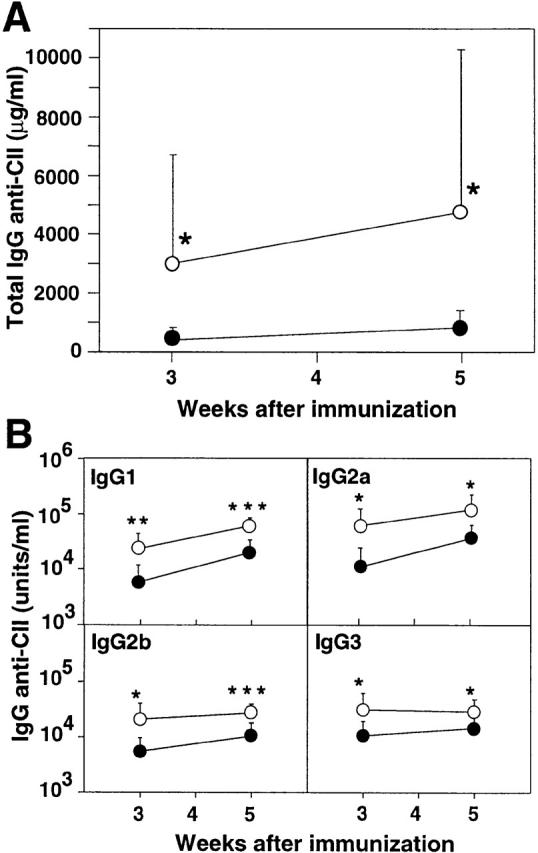
Anti-CII antibodies in FcγRII-deficient DBA/1 mice. Circulating CII-specific antibodies were determined periodically after BCII immunization in individual sera of FcγRII+/+ (filled symbols) and FcγRII−/− mice (open symbols). The mean ± SD antibody levels of total IgG anti-CII (A) and subclass-specific IgG anti-CII (B) are shown. *P < 0.05, **P < 0.01, and ***P < 0.001 compared with the FcγRII+/+ group.
Figure 5
Figure 5
Augmented CIA in FcγRII-deficient DBA/1 mice. CII-immunized FcγRII+/+ (filled symbols, n = 12) and FcγRII−/− mice (open symbols, n = 12) were observed for arthritic lesions, and the percentage of mice that developed disease (A) and the mean severity of arthritis in diseased animals (B) are depicted. The figure shows results from one representative experiment out of two performed.

References

    1. Gessner J.E., Heiken H., Tamm A., Schmidt R.E. The IgG Fc receptor family. Ann. Hematol. 1998;76:231–248. - PubMed
    1. Takai T., Li M., Sylvestre D., Clynes R., Ravetch J.V. FcR γ chain deletion results in pleiotrophic effector cell defects. Cell. 1994;76:519–529. - PubMed
    1. Wernersson S., Karlsson M.C.I., Dahlström J., Mattsson R., Verbeek J.S., Heyman B. IgG-mediated enhancement of antibody responses is low in Fc receptor γ chain-deficient mice and increased in FcγRII-deficient mice. J. Immunol. 1999;163:618–622. - PubMed
    1. Sylvestre D.L., Ravetch J.V. Fc receptors initiate the Arthus reactionredefining the inflammatory cascade. Science. 1994;265:1095–1098. - PubMed
    1. Clynes R., Ravetch J. Cytotoxic antibodies trigger inflammation through Fc receptors. Immunity. 1995;3:21–26. - PubMed

Publication types