


Density-dependent decline of host abundance resulting from a new infectious disease
- PMID: 10792031
- PMCID: PMC25823
- DOI: 10.1073/pnas.080551197
Density-dependent decline of host abundance resulting from a new infectious disease
Abstract
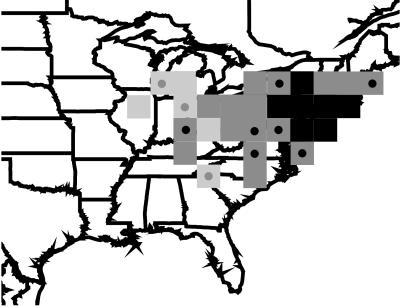
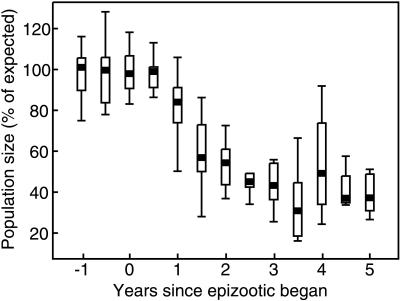
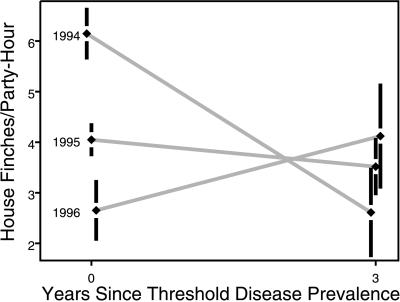
Although many new diseases have emerged within the past 2 decades [Cohen, M. L. (1998) Brit. Med. Bull. 54, 523-532], attributing low numbers of animal hosts to the existence of even a new pathogen is problematic. This is because very rarely does one have data on host abundance before and after the epizootic as well as detailed descriptions of pathogen prevalence [Dobson, A. P. & Hudson, P. J. (1985) in Ecology of Infectious Diseases in Natural Populations, eds. Grenfell, B. T. & Dobson, A. P. (Cambridge Univ. Press, Cambridge, U.K.), pp. 52-89]. Month by month we tracked the spread of the epizootic of an apparently novel strain of a widespread poultry pathogen, Mycoplasma gallisepticum, through a previously unknown host, the house finch, whose abundance has been monitored over past decades. Here we are able to demonstrate a causal relationship between high disease prevalence and declining house finch abundance throughout the eastern half of North America because the epizootic reached different parts of the house finch range at different times. Three years after the epizootic arrived, house finch abundance stabilized at similar levels, although house finch abundance had been high and stable in some areas but low and rapidly increasing in others. This result, not previously documented in wild populations, is as expected from theory if transmission of the disease was density dependent.
Figures
Comment in
-
Raccoon rabies in space and time.Proc Natl Acad Sci U S A. 2000 Dec 19;97(26):14041-3. doi: 10.1073/pnas.97.26.14041. Proc Natl Acad Sci U S A. 2000. PMID: 11121013 Free PMC article. Review. No abstract available.
References
-
- Anderson R M, May R M. Infectious Diseases of Humans: Dynamics and Control. Oxford: Oxford Univ. Press; 1991.
-
- Grenfell B T, Dobson A P. Infectious Diseases of Wildlife. Cambridge, U.K.: Cambridge Univ. Press; 1985.
-
- Fenner F, Ratcliffe F N. Myxomatosis. London: Cambridge Univ. Press; 1965.
-
- Cully J F, Barnes A M, Quan T J, Maupin G. J Wildl Dis. 1997;33:706–719. - PubMed
-
- Mutze G, Cooke B, Alexander P. J Wildl Dis. 1998;34:221–227. - PubMed
Publication types
MeSH terms
LinkOut - more resources
Full Text Sources
Miscellaneous
