


Mothers' child-feeding practices influence daughters' eating and weight
- PMID: 10799366
- PMCID: PMC2530928
- DOI: 10.1093/ajcn/71.5.1054
Mothers' child-feeding practices influence daughters' eating and weight
Abstract
Background: Childhood overweight has increased dramatically, particularly among young girls. Genetic and environmental factors produce the overweight phenotype. Nonshared environments appear to account for a substantial proportion of the population variance in overweight but remain largely unspecified and unmeasured.
Objective: Our goal was to evaluate the influence of maternal control in feeding, an aspect of nonshared family environment, on daughters' eating and relative weight.
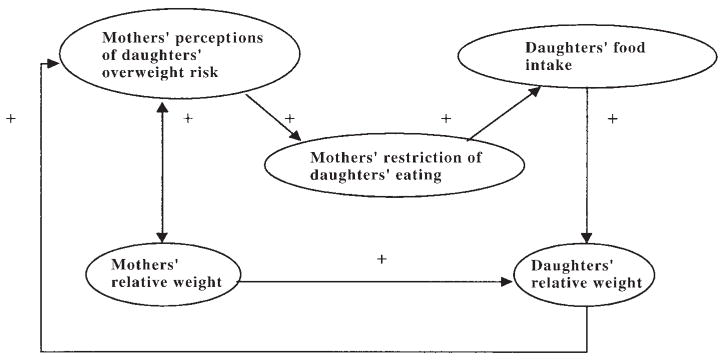
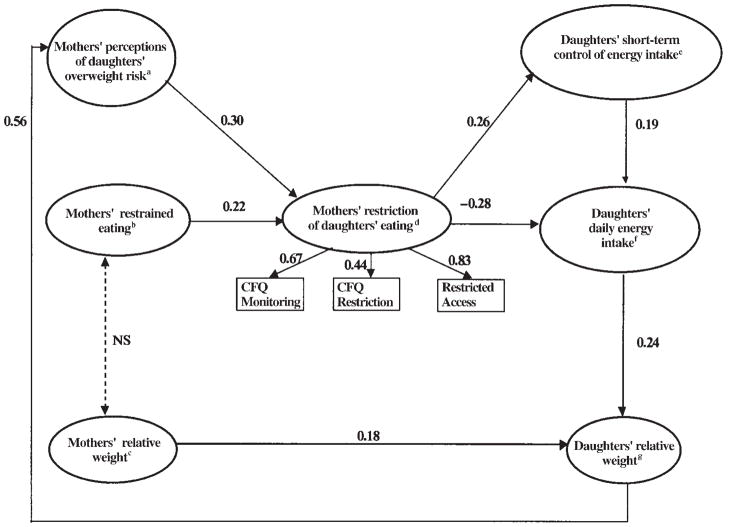
Design: Structural equation modeling was used to test models that describe maternal influences on daughters' eating and relative weight. The participants were 197 white, non-Hispanic families with 5-y-old daughters. The mothers' own dietary restraint and their perceptions of their daughters' risk of overweight were used to predict maternal control in feeding, which was used to predict the daughters' eating and weight outcomes.
Results: Maternal body mass index was a modest predictor of daughters' relative weight. The addition of the family-environment pathway provided a good fit and showed additional, independent prediction of daughters' relative weight. Mothers' dietary restraint and perceptions of their daughters' risk of overweight predicted maternal child-feeding practices, which in turn predicted daughters' eating and relative weight.
Conclusions: Child-specific aspects of the family environment, including mothers' child-feeding practices and perceptions of their daughters' risk of overweight, may represent important, nonshared, environmental influences on daughters' eating and relative weight. The environmental effects noted were modest but comparable in magnitude to the direct association between maternal and child weight, which indicates that measuring family environmental factors can enhance our understanding of the etiology of childhood overweight.
Figures
References
-
- Grilo CM, Pogue-Geile MF. The nature of environmental influences on weight and obesity: a behavior genetics analysis. Psychol Bull. 1991;110:520–37. - PubMed
-
- Maes HHM, Neale MC, Eaves LJ. Genetic and environmental factors in relative body weight and human adiposity. Behav Genet. 1997;27:325–51. - PubMed
-
- Whitaker RC, Wright JA, Pepe MS, Seidd RD, Dietz WH. Predicting obesity in young adulthood from childhood and parental obesity. N Engl J Med. 1997;337:869–73. - PubMed
-
- Bouchard C, editor. The genetics of obesity. Boca Raton, FL: CRC Press; 1998.
-
- Plomin R. Genetics and experience: the interplay between nature and nurture. Thousand Oaks, CA: Sage Publications; 1994.
Publication types
MeSH terms
Grants and funding
LinkOut - more resources
Full Text Sources
Medical