


Analysis of ku80-mutant mice and cells with deficient levels of p53
- PMID: 10805721
- PMCID: PMC85695
- DOI: 10.1128/MCB.20.11.3772-3780.2000
Analysis of ku80-mutant mice and cells with deficient levels of p53
Abstract
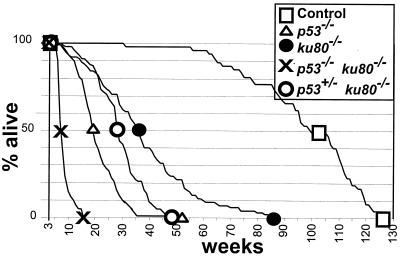
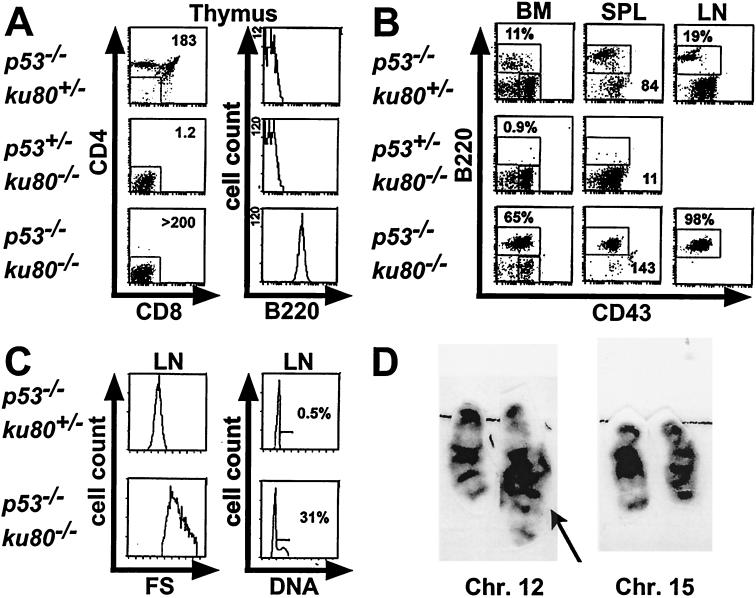
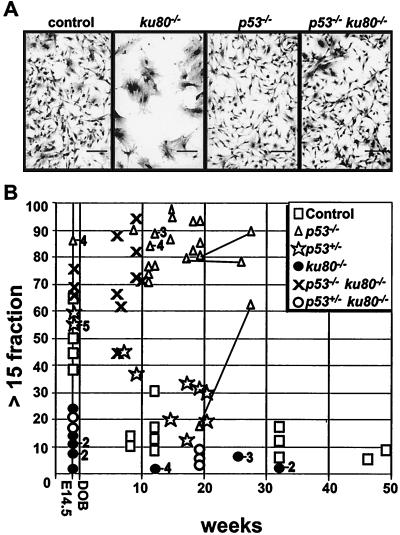
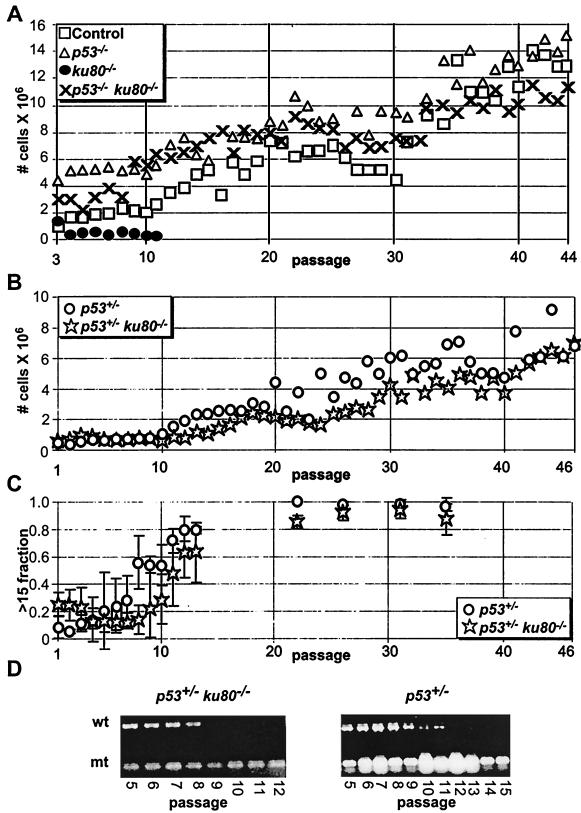
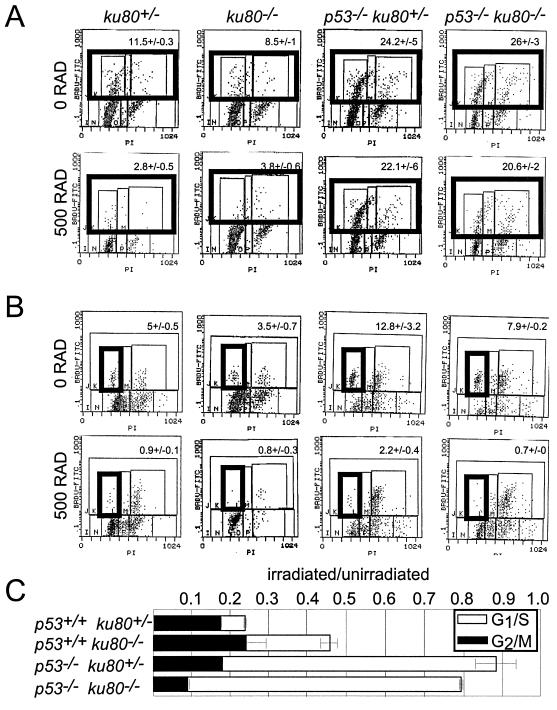
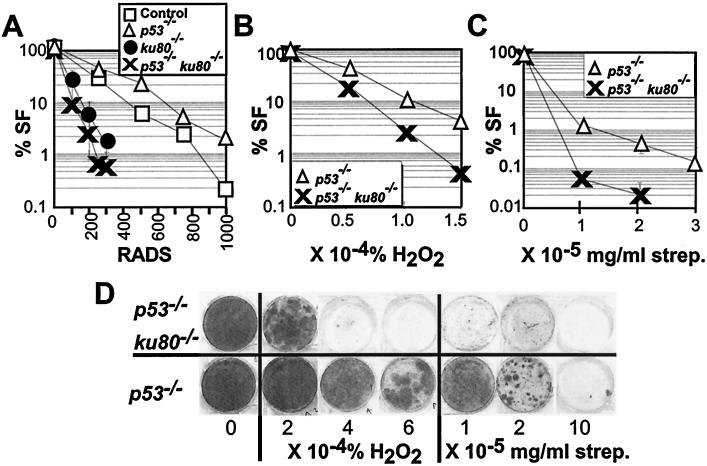
Absence of Ku80 results in increased sensitivity to ionizing radiation, defective lymphocyte development, early onset of an age-related phenotype, and premature replicative senescence. Here we investigate the role of p53 on the phenotype of ku80-mutant mice and cells. Reducing levels of p53 increased the cancer incidence for ku80(-/-) mice. About 20% of ku80(-/-) p53(+/-) mice developed a broad spectrum of cancer by 40 weeks and all ku80(-/-) p53(-/-) mice developed pro-B-cell lymphoma by 16 weeks. Reducing levels of p53 rescued populations of ku80(-/-) cells from replicative senescence by enabling spontaneous immortalization. The double-mutant cells are impaired for the G(1)/S checkpoint due to the p53 mutation and are hypersensitive to gamma-radiation and reactive oxygen species due to the Ku80 mutation. These data show that replicative senescence is caused by a p53-dependent cell cycle response to damaged DNA in ku80(-/-) cells and that p53 is essential for preventing very early onset of pro-B-cell lymphoma in ku80(-/-) mice.
Figures
References
-
- Bernstein C, Bernstein H. Aging, sex, and DNA repair. San Diego, Calif: Academic Press; 1991.
-
- Bogue M A, Wang C, Zhu C, Roth D B. V(D)J recombination in Ku86-deficient mice: distinct effects on coding, signal, and hybrid joint formation. Immunity. 1997;7:37–47. - PubMed
-
- Bogue M A, Zhu C, Aguilar-Cordova E, Donehower L A, Roth D B. p53 is required for both radiation-induced differentiation and rescue of V(D)J rearrangement in scid mouse thymocytes. Genes Dev. 1996;10:1–13. - PubMed
Publication types
MeSH terms
Substances
Grants and funding
LinkOut - more resources
Full Text Sources
Medical
Molecular Biology Databases
Research Materials
Miscellaneous
