. 2000 May 9;97(10):5307-12.
doi: 10.1073/pnas.97.10.5307.

Novel gene conversion between X-Y homologues located in the nonrecombining region of the Y chromosome in Felidae (Mammalia)

Affiliations

Novel gene conversion between X-Y homologues located in the nonrecombining region of the Y chromosome in Felidae (Mammalia)

J Pecon Slattery et al. Proc Natl Acad Sci U S A. .

Abstract

Genes located on the mammalian Y chromosome outside of the pseudoautosomal region do not recombine with those on the X and are predicted to either undergo selection for male function or gradually degenerate because of an accumulation of deleterious mutations. Here, phylogenetic analyses of X-Y homologues, Zfx and Zfy, among 26 felid species indicate two ancestral episodes of directed genetic exchange (ectopic gene conversion) from X to Y: once during the evolution of pallas cat and once in a common predecessor of ocelot lineage species. Replacement of the more rapidly evolving Y homologue with the evolutionarily constrained X copy may represent a mechanism for adaptive editing of functional genes on the nonrecombining region of the mammalian Y chromosome.


Figures
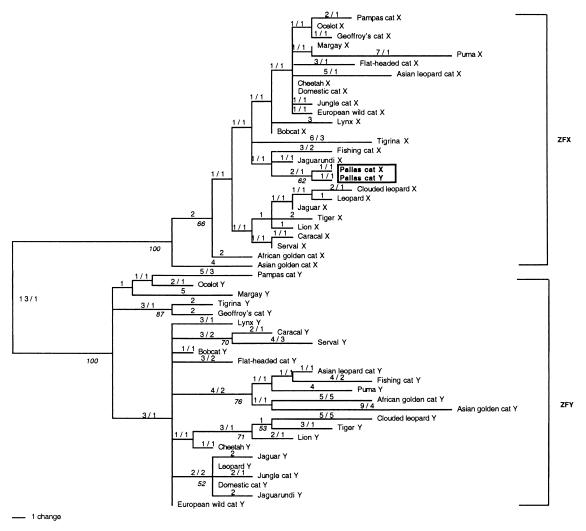
Figure 1
Figure 1
Phylogenetic analysis using 1,181 bp of the Zn-finger exon of Zfx and Zfy for 26 species of Felidae. Shown is the 50% majority rule consensus (length = 171; consistency index = 0.672) of 10,850 trees generated by maximum parsimony analysis. Numbers on branches are length/homoplasies. Numbers in italics are bootstrap proportions in support of adjacent node that exceeded 50%. Bootstrap analysis consisted of 100 iterations (43). Note that the Zfx and Zfy sequences are respectively monophyletic with the exception of the pallas cat Y, which resembles X chromosomes Zfx genes and more precisely, the pallas cat Zfx homologue (see text). The resolution of species divergence hierarchies within the Zfx and Zfy groups are not robust because of slow-moving evolution of these genes in the period of Felidae evolution (10–15 million years). The derived tree is significantly different from a constrained tree representing established species lineages as listed in Fig. 2 (Kishino-Hasegawa test; t = 2.59; P < 0.0095). For this reason, the species topologies should not be considered to reflect Felidae phylogenetic divergence accurately.
Figure 2
Figure 2
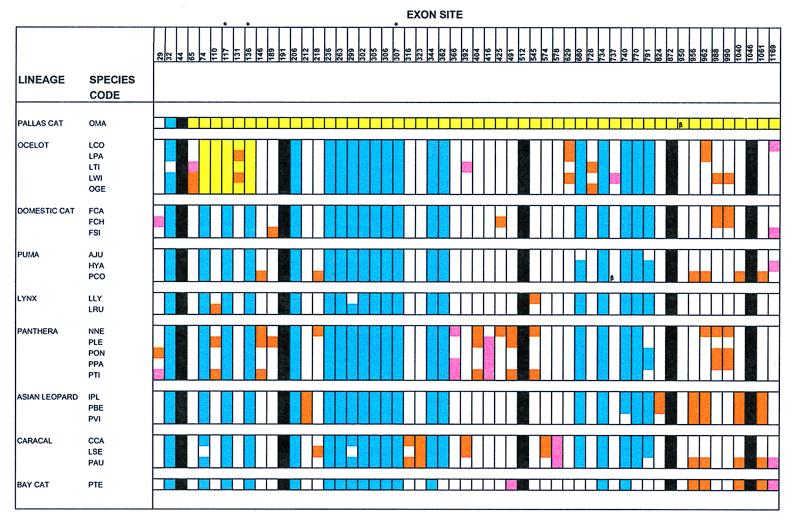
Distribution of nucleotide sites that vary in two or more felid species in the Zn-finger exon of Zfy and Zfx. Except for the phylogenetically unaligned pallas cat, all other species are listed within the eight monophyletic evolutionary groups within Felidae (–18). Five categories of substitutions are depicted. Blue: substitution diagnostic between Zfy and Zfx and fixed in the majority of species from all lineages. Black: Zfx-Zfy polymorphism, not sex specific. Orange: Newly derived Zfy substitution shared by some, or all, of the corresponding species group. Pink: Newly derived Zfx substitution shared by some, or all, of the corresponding species group. Yellow: Site where the Zfy-specific nucleotide is replaced by that from Zfx in some, or all of the corresponding species group. The yellow continuum for pallas cat includes those sites that are identical between Zfy and Zfx in most felid species (including pallas cat). In addition, the clearest evidence of gene conversion is that each of the fixed diagnostic sites (blue) shared by all other felid lineages are not present in the yellow region of Zfy exons from pallas cat or ocelot lineage species. Caracal group includes serval. β = Substitution that is unique and shared by Zfy and Zfx within a single species. *: Sites that encode amino acid substitutions distinguishing between Zfy and Zfx in all felids. For specific alignment details of polymorphic sites, please see Fig. 4 at PNAS web site http://www.pnas.org and http://lgd.nci.nih.gov.
Figure 3
Figure 3
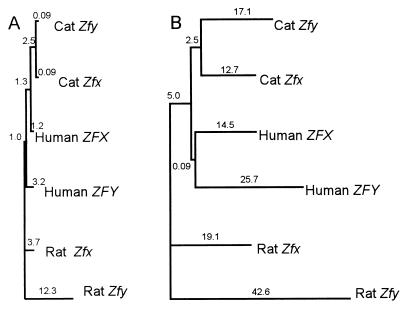
(A) Phylogenetic tree of exon sequences from cat, human, and rat Zfx and Zfy genes. The tree is derived from minimum-evolution using neighbor-joining derived from an exhaustive search using Kimura 2P model. Branch lengths are % sequence divergence. (B) Phylogenetic tree of adjacent 5′ intron of Zfy and Zfx from cat, human, and rat. Shown is the minimum evolution-neighbor joining tree derived from an exhaustive search of all possible trees based on the Tajima-Nei model of substitution. Numbers on branches represent % sequence divergence.

References

    1. Ellison J W, Li X, Francke U, Shapiro L J. Mamm Genome. 1996;7:25–30. - PubMed
    1. Lahn B, Page D. Science. 1999;286:964–967. - PubMed
    1. Graves J A M. BioEssays. 1995;17:311–321. - PubMed
    1. Graves J A M. J Exp Zool. 1998;281:472–481. - PubMed
    1. Charlesworth B, Charlesworth D. Genet Res. 1997;70:63–73. - PubMed

Associated data

LinkOut - more resources