. 2000 May;12(5):757-70.
doi: 10.1105/tpc.12.5.757.

The NPH4 locus encodes the auxin response factor ARF7, a conditional regulator of differential growth in aerial Arabidopsis tissue

Affiliations

The NPH4 locus encodes the auxin response factor ARF7, a conditional regulator of differential growth in aerial Arabidopsis tissue

R M Harper et al. Plant Cell. 2000 May.

Abstract

Organ bending through differential growth represents a major mechanism by which plants are able to adaptively alter their morphology in response to local changes in the environment. Two plant hormones, auxin and ethylene, have been implicated as regulators of differential growth responses; however, the mechanisms by which they elicit their effects remain largely unknown. Here, we describe isolation of the NPH4 gene of Arabidopsis, which is conditionally required for differential growth responses of aerial tissues, and we report that NPH4 encodes the auxin-regulated transcriptional activator ARF7. The phenotypes of nph4 mutants, which include multiple differential growth defects associated with reduced auxin responsiveness, including impaired auxin-induced gene expression, are consistent with the predicted loss of function of a transcriptional activator, and these phenotypes indicate that auxin-dependent changes in gene transcription are prerequisite for proper organ bending responses. Although NPH4/ARF7 appears to be a major regulator of differential growth, it is not the sole regulator because phenotypes of nph4 null mutants were suppressed by application of ethylene. This latter finding illustrates the intimate connection between auxin and ethylene in the control of growth in higher plants.


Figures

Figure 1.
Figure 1.
Phototropic Response of 3-Day-Old Dark-Grown Wild-Type (Col) and nph4 Seedlings. (A) Seedlings exposed to 8 hr of unilateral blue light (BL; 0.1 μmol m−2 sec−1) from the left. Col, Columbia ecotype. (B) Quantitative analysis of hypocotyl phototropism in 3-day-old dark-grown seedlings exposed to 8 hr of unilateral blue light. Data represent the mean response of a minimum of 20 seedlings for each genotype. Error bars indicate sd.
Figure 2.
Figure 2.
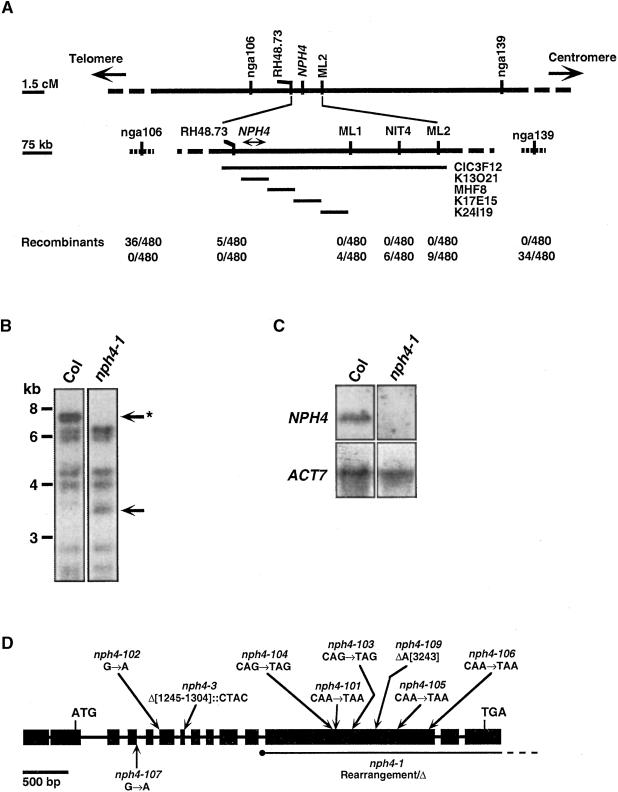
Map-Based Cloning and Structure of the NPH4 Gene. (A) Mapping of the NPH4 locus on the proximal arm of chromosome 5. Genetic linkage map is shown at top; physical linkage map is shown in the middle; and numbers of recombinant chromosomes out of the total examined are shown at bottom. nga106, nga139, and ML2 are SSLP markers (Bell and Ecker, 1994); NIT4 is a cleaved amplified polymorphic sequence marker (Bartel and Fink, 1994; modified as described in Methods); ML1 is a simple nucleotide polymorphism marker (Cho et al., 1999); and RH48.73 is an amplified fragment length polymorphism marker (Liscum, 1999). CIC3F12 is a yeast artificial chromosome clone (Creusot et al., 1995; see Methods); MHF8 is a P1 phagemid clone (Liu et al., 1995); and K13O21, K17E15, and K24I19 are transformation-competent artificial chromosome clones (Liu et al., 1999). Arrows indicate that the chromosome continues beyond the region shown. cM, centimorgans. (B) DNA gel blot made from Columbia (Col) and nph4-1 genomic DNA double digested with EcoRI and XbaI and hybridized with 32P-labeled K13O21 (see [A]). Arrows indicate polymorphic bands. The asterisk indicates the band cloned from wild-type DNA that was used as a probe in (C). Numbers at left denote size markers in kilobases. (C) RNA gel blot made with total RNA from 7-day-old Col and nph4-1 seedlings and hybridized with the 6.9-kb DNA fragment described in (B) or with ACT7 (McDowell et al., 1996) as a control. (D) Structure of the NPH4 gene and position of nph4 mutations. The locations of start (ATG) and stop (TGA) codons are indicated. Exon (boxes) and intron (lines) positions were determined by comparing the genomic DNA sequence with the sequences of ARF7 and BIPOSTO cDNAs. The position and identity of various nph4 mutations are shown. For purposes of nucleotide numbering, the adenine of the start codon is considered position 1. The dashed line indicates that the end of the rearrangement is unknown.
Figure 3.
Figure 3.
Expression of NPH4/ARF7 in nph4 Mutant Backgrounds. (A) RT-PCR analysis of steady state amounts of NPH4/ARF7 transcript in 2.5-day-old dark-grown wild-type (Col) and nph4 mutants. RT-PCR products were detected by DNA gel blot analysis using 32P-labeled NPH4/ARF7 (top) or PHYTOCHROME E (PHYE; bottom). Genomic DNA from Col (Col-DNA) was used as a control template for both genes. Because the amplimers from genomic DNAs contain intron sequences, they are larger than the amplimers from RNA templates. (B) Structure of wild-type (WT) NPH4/ARF7 (Ulmasov et al., 1999b) and nph4-3/arf7 proteins predicted from nph4-3 sequence. Amino acid changes in nph4-3/arf7 (top line) are shown relative to the wild-type sequence (bottom line). C, C terminus; DBD, DNA binding domain; N, N terminus; Q-Rich, glutamine rich; III/IV, motifs homologous with domains III and IV of the C-terminal protein–protein interaction domain of Aux/IAA proteins (Guilfoyle, 1998).
Figure 4.
Figure 4.
Effects of Ethylene on Phototropism of Wild-Type (Col) and nph4 Seedlings. (A) Phototropic curvature of 3-day-old seedlings grown in darkness under ambient air conditions (filled bars) or exposed to 50 μL/L ethylene (open bars) and then exposed to 8 hr of unilateral blue light (0.1 μmol m−2 sec−1). Data represent the mean response of at least 40 seedlings from at least two replicate experiments. Error bars indicate se. (B) Dose–response curve for phototropism of wild-type (filled circles), nph4-1 (open circles), nph1-5 (open triangles), and etr1-1 (open diamonds) seedlings grown on ACC. Seedlings were grown in darkness for 3 days on medium containing the indicated concentration of ACC and then exposed to 8 hr of unilateral blue light (0.1 μmol m−2 sec−1). Data represent the mean response of at least 40 seedlings from at least two replicate experiments. Error bars indicate se. Because errors are small, many error bars are not visible. (C) Ethylene production in wild-type and nph4 mutant seedlings. Seedlings were grown in sealed glass vials on a nutrient medium–agar plug for 72 hr in darkness. For auxin treatments, the nutrient medium was supplemented with the indicated concentration of IAA. Ethylene accumulation was measured as described in Methods. Values represent the mean response from three replicate experiments. Error bars indicate sd.
Figure 5.
Figure 5.
Effects of Ethylene on Gravity-Dependent Growth Orientation of Wild-Type (Col) and nph4 Seedlings. (A) Seedlings grown on horizontally oriented plates in the presence or absence of ACC. (B) Dose–response curve for hypocotyl gravitropic growth orientation of wild-type (filled circles), nph4-1 (open circles), and nph4-3 (open inverted triangles) seedlings grown on ACC. Seedlings were grown in darkness for 3 days on vertically oriented plates containing the indicated concentration of ACC. Data represent the mean response of at least 45 seedlings from at least two replicate experiments. Error bars indicate se. Because errors are small, many error bars are not visible.
Figure 6.
Figure 6.
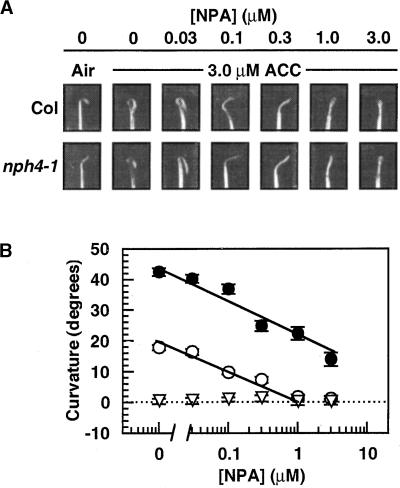
Effects of the Polar Auxin Transport Inhibitor NPA on Ethylene-Dependent Changes in Apical Hook Structure and Phototropism in Wild-Type (Col) and nph4-2 Seedlings. (A) Hook regions of 3-day-old seedlings grown in darkness on 3.0 μM ACC or in the absence of ACC (Air), with various concentrations of NPA. (B) Dose–response curve for phototropism of wild-type (filled circles), nph4-1 (open circles), and nph1-5 (open inverted triangles) seedlings grown on NPA. Seedlings were grown as described in Figure 1B, except that they were grown in the presence of 0.3 μM ACC and the indicated concentration of NPA. Data represent the mean response of at least 33 seedlings from at least two replicate experiments. Error bars indicate se. Because errors are small, many error bars are not visible.
Figure 7.
Figure 7.
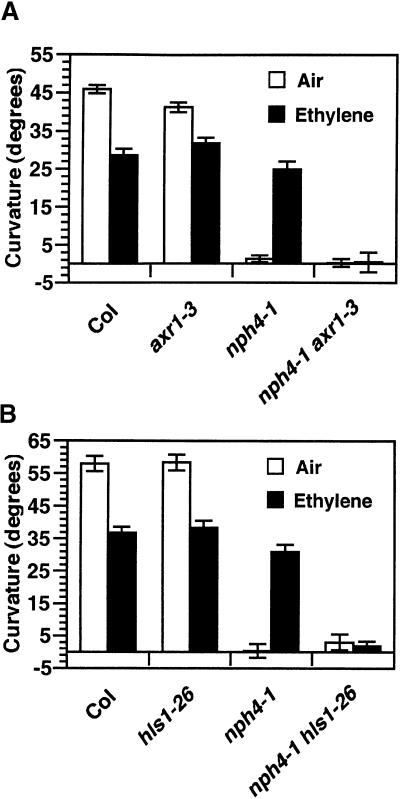
Effects of Auxin Response Mutations on Phototropism. (A) Phototropism in 3-day-old wild-type (Col), axr1-3, nph4-1, and nph4-1 axr1-3 double mutant seedlings grown in ambient air (open bars) or 50 μL/L ethylene (filled bars), then exposed to 8 hr of unilateral blue light (0.1 μmol m−2 sec−1). Data represent the mean response of at least 41 seedlings from at least two replicate experiments. Error bars indicate se. (B) Phototropism in 3-day-old Col, hls1-26, nph4-1, and nph4-1 hls1-26 double mutant seedlings treated the same as the seedlings in (A), except that 10 hr of unilateral blue light was given. Data represent the mean response of at least 26 seedlings from two replicate experiments. Error bars indicate se.
Figure 8.
Figure 8.
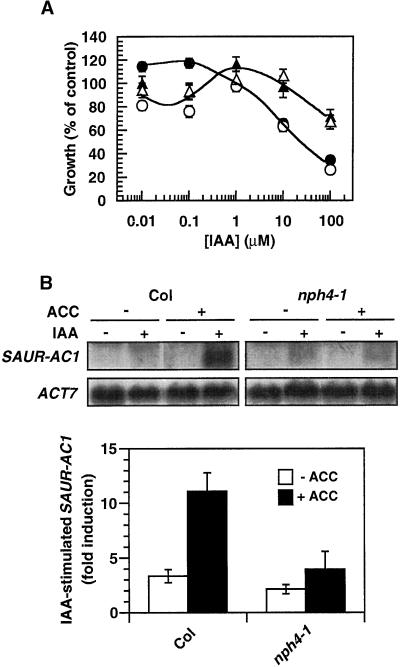
Effects of Ethylene on Auxin-Sensitive Growth and Gene Expression. (A) Dose–response curve for auxin-dependent hypocotyl growth inhibition of seedlings grown in ambient air (filled circles, wild type; filled triangles, nph4-1) or in the presence of 0.3 μM ACC (open circles, wild type; open triangles, nph4-1). Data represent the mean response of at least 29 seedlings from at least three replicate experiments. Error bars indicate se. (B) Effects of ethylene on auxin-induced SAUR-AC1 expression in wild-type (Col) and nph4-1 seedlings. Seedlings were grown and treated with IAA, and RNA was analyzed as described previously (Stowe-Evans et al., 1998), except that one set of seedlings was grown in the presence of 0.3 μM ACC. Representative RNA gel blots probed with SAUR-AC1 (Gil et al., 1994) and ACT7are shown at top. At bottom are quantitative data representing the mean response (n-fold induction by IAA relative to no IAA control) of three replicate RNA gel blots analyzed by densitometry. All data are normalized relative to an ACT7 control. Error bars indicate sd. Similar results were obtained with IAA6 and IAA13 (E.L. Stowe-Evans and E. Liscum, unpublished results). (–), no added hormone; (+), hormone added.

References

    1. Abel, S., and Theologis, A. (1996). Early genes and auxin action. Plant Physiol. 111, 9–17. - PMC - PubMed
    1. Alonso, J.M., Hirayama, T., Roman, G., Nourizadeh, S., and Ecker, J.R. (1999). EIN2, a bifunctional transducer of ethylene and stress responses in Arabidopsis. Science 284, 2148–2152. - PubMed
    1. Altschul, S.F., Madden, T.L., Schaffer, A.A., Zhang, J., Zhang, Z., Millar, W., and Lipman, D.J. (1997). Gapped BLAST and PSI-BLAST: A new generation of protein database search programs. Nucleic Acids Res. 25, 3389–3402. - PMC - PubMed
    1. Ausubel, F., Brent, R., Kingston, R.E., Moore, D.D, Seidman, J.G., Smith, J.A, and Struhl, K., eds (1995). Short Protocols in Molecular Biology. (New York: John Wiley).
    1. Bartel, B., and Fink, G.R. (1994). Differential regulation of an auxin-producing nitrilase gene family in Arabidopsis thaliana. Proc. Natl. Acad. Sci. USA 91, 6649–6653. - PMC - PubMed

Publication types