. 2000 Jun;68(6):3103-7.
doi: 10.1128/IAI.68.6.3103-3107.2000.

Adhesion molecule deficiencies increase Porphyromonas gingivalis-induced alveolar bone loss in mice

Affiliations

Adhesion molecule deficiencies increase Porphyromonas gingivalis-induced alveolar bone loss in mice

P J Baker et al. Infect Immun. 2000 Jun.

Abstract

Alveolar bone resorption can be induced in specific-pathogen-free mice by oral infection with Porphyromonas gingivalis (P. J. Baker, R. T. Evans, and D. C. Roopenian, Arch. Oral Biol. 39:1035-1040, 1994). Here we used a mouse strain, C57BL/6J, which is relatively resistant to P. gingivalis-induced bone loss to examine whether partial or complete deletion of various adhesion molecules would increase susceptibility. Complete deletion of P-selectin or nearly complete lack of expression of intercellular adhesion molecule 1 (ICAM-1) led to increased susceptibility to bone resorption after oral infection, while a hypomorphic defect in beta(2)-integrins did not. Both the total amount of bone lost and the number of sites at which there was significant loss were increased in mice deficient in either ICAM-1 or P-selectin. Each of the three adhesion molecule deficiencies was sufficient to decrease P. gingivalis-specific serum immunoglobulin G responses, but lower antibody titers did not lead to increased bone loss in partially beta(2)-integrin-deficient mice. In conclusion, P-selectin and ICAM-1 deficiencies increase susceptibility to and severity of alveolar bone loss after P. gingivalis infection. This finding underscores the importance of innate immunity in protection against P. gingivalis-induced alveolar bone resorption.


Figures
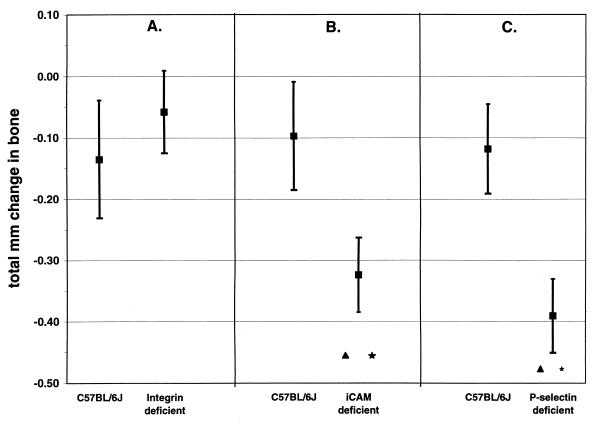
FIG. 1
FIG. 1
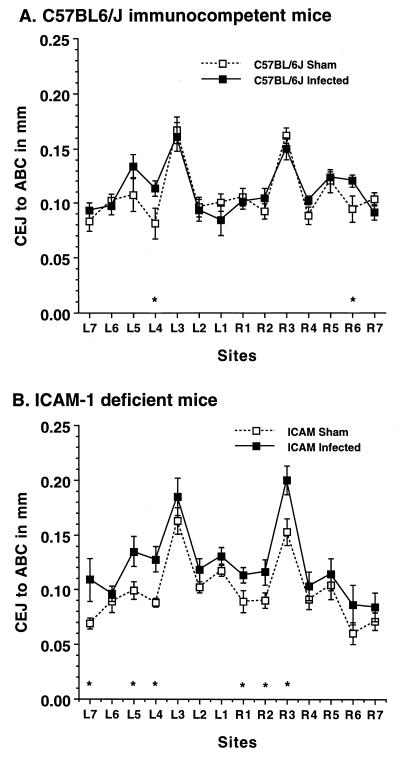
Deficiency of ICAM-1 or P-selectin, but not β2-integrin, increases susceptibility to alveolar bone loss after oral infection with P. gingivalis. Data are the means and 1 standard error of the mean (n = 8) of the number of millimeters of change in the CEJ-ABC at the total of 14 sites in infected mice compared to sham-infected mice. Panels A, B, and C show results of separate experiments. (A) Neither wild-type C57BL/6J control mice nor β2-integrin-deficient C57BL/6J mice lost bone after infection. Data shown for infected mice are not significantly different from those for sham-infected mice (P > 0.05). (B) Wild-type C57BL/6J mice did not lose bone after infection, but ICAM-1-deficient C57BL/6J mice did. (C) Wild-type C57BL/6J mice did not lose bone after infection, but P-selectin-deficient C57BL/6J mice did. ∗, infected mice were different from sham-infected mice (P < 0.05); ▴, infected mice lost significantly more bone than infected wild-type C57BL/6J mice did (P < 0.05).
FIG. 2
FIG. 2
ICAM-1-deficient mice show more sites with bone loss after P. gingivalis oral infection than do wild-type C57BL/6J mice. Data are the means and 1 standard error of the mean for eight mice. ∗, infected mice different from sham-infected mice (P < 0.05).
FIG. 3
FIG. 3
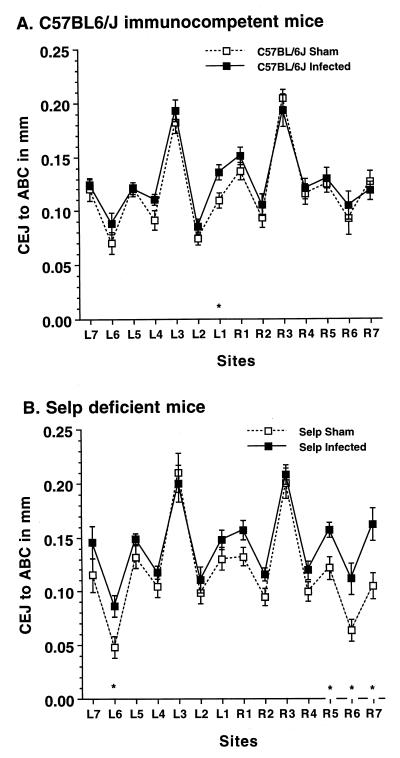
P-selectin (Selp)-deficient mice have more sites with bone loss after P. gingivalis oral infection than do wild-type C57BL/6J mice. Data are the means ± 1 standard error of the mean for eight mice. ∗, infected mice different from sham-infected mice (P < 0.05).
FIG. 4
FIG. 4
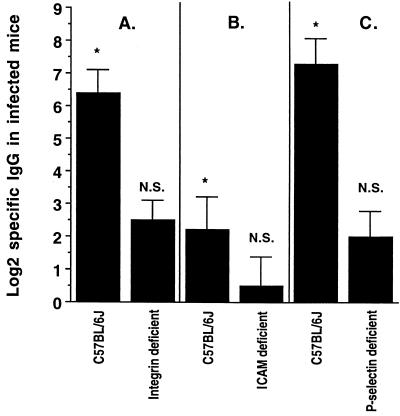
P. gingivalis-specific IgG titers in infected wild-type C57BL/6J mice and in adhesion molecule-deficient mice. Panels A, B, and C show results of separate experiments. Bars represent the means ± 1 standard error of the mean from the same eight mice as in Fig. 1 and 5. Titers were zero in sham-infected mice. *, titers in infected C57BL/6J mice are significantly greater (P < 0.05) than titers in sham-infected C57BL/6J mice and also significantly greater than titers in infected β2-integrin-deficient mice (A), ICAM-1-deficient mice (B), or P-selectin-deficient mice (C). Titers in infected adhesion molecule-deficient mice were not significantly different from the titers in sham-infected adhesion molecule-deficient mice (N.S., P > 0.05).
FIG. 5
FIG. 5
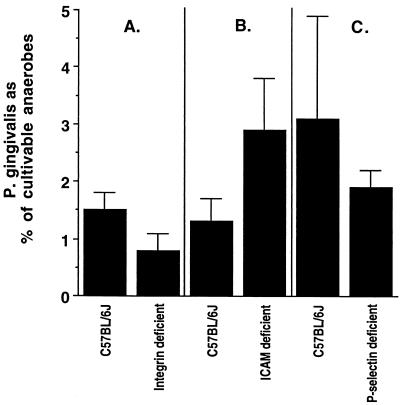
P. gingivalis in the oral cavities of immunocompetent C57BL/6J mice or adhesion molecule-deficient mice 42 days after the final infection. Panels A, B, and C show results of separate experiments. Bars represent the means ± 1 standard error of the mean from the same eight mice as in Fig. 1 and 4. No P. gingivalis was recovered from sham-infected mice. The percentage of P. gingivalis was not significantly different (P > 0.05) in C57BL/6J mice from that in β2-integrin-deficient mice (A), ICAM-1-deficient mice (B), or P-selectin-deficient mice (C).

References

    1. Anderson D C, Miller L J, Schmalstieg F C, Rothlein R, Springer T A. Contributions of the Mac-1 glycoprotein family to adherence dependent granulocyte functions: structure-function assessments employing subunit-specific monoclonal antibodies. J Immunol. 1986;137:15–27. - PubMed
    1. Baker P J, Evans R T, Roopenian D C. Oral infection with Porphyromonas gingivalis and induced alveolar bone loss in immunocompetent and severe combined immunodeficient mice. Arch Oral Biol. 1994;39:1035–1040. - PubMed
    1. Baker P J, Carter S, Dixon M, Evans R T, Roopenian D C. Serum antibody response to oral infection precedes but does not prevent Porphyromonas gingivalis-induced alveolar bone loss in mice. Oral Microbiol Immunol. 1999;14:194–196. - PubMed
    1. Baker P J, Evans R T, Roopenian D C. CD4+ T cells and the proinflammatory cytokines interferon gamma and interleukin-6 contribute to alveolar bone loss in mice. Infect Immun. 1999;67:2804–2809. - PMC - PubMed
    1. Bertolini D R, Nedwin T, Bringman T, Smith D, Mundy G R. Stimulation of bone resorption and inhibition of bone formation in vitro by human tumour necrosis factors. Nature. 1985;319:516–518. - PubMed

Publication types

MeSH terms

LinkOut - more resources