


A subdominant CD8(+) cytotoxic T lymphocyte (CTL) epitope from the Plasmodium yoelii circumsporozoite protein induces CTLs that eliminate infected hepatocytes from culture
- PMID: 10816491
- PMCID: PMC97612
- DOI: 10.1128/IAI.68.6.3403-3411.2000
A subdominant CD8(+) cytotoxic T lymphocyte (CTL) epitope from the Plasmodium yoelii circumsporozoite protein induces CTLs that eliminate infected hepatocytes from culture
Abstract
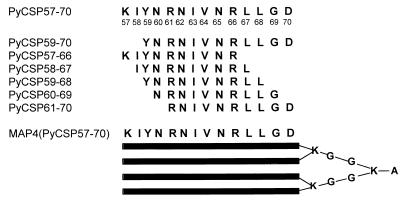
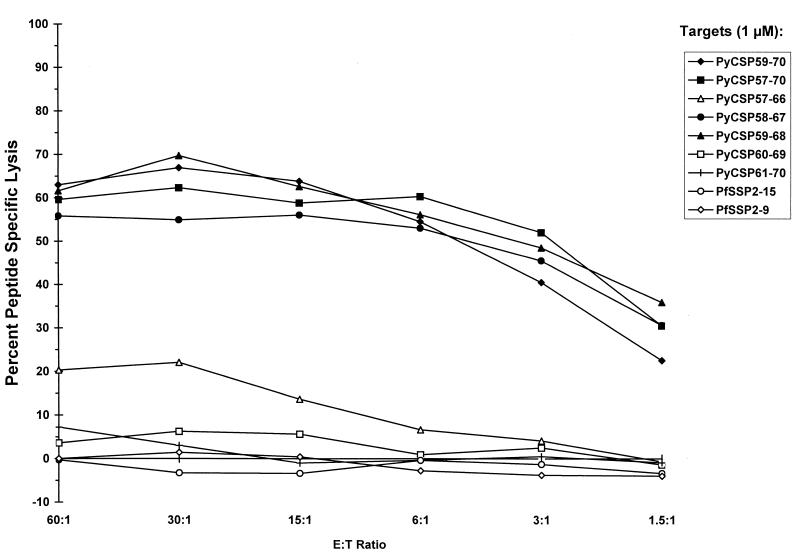
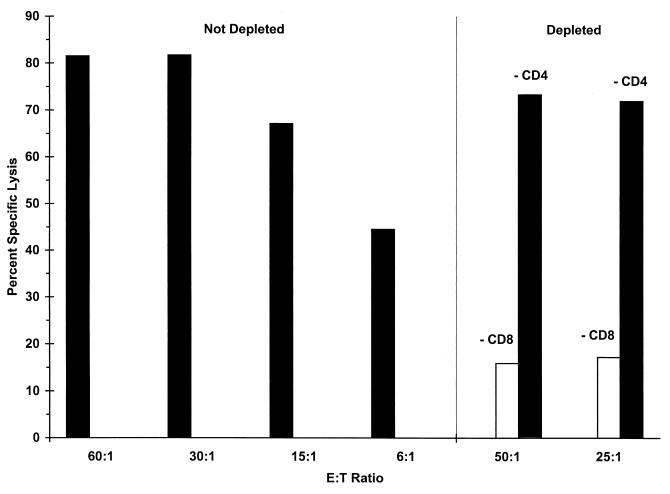
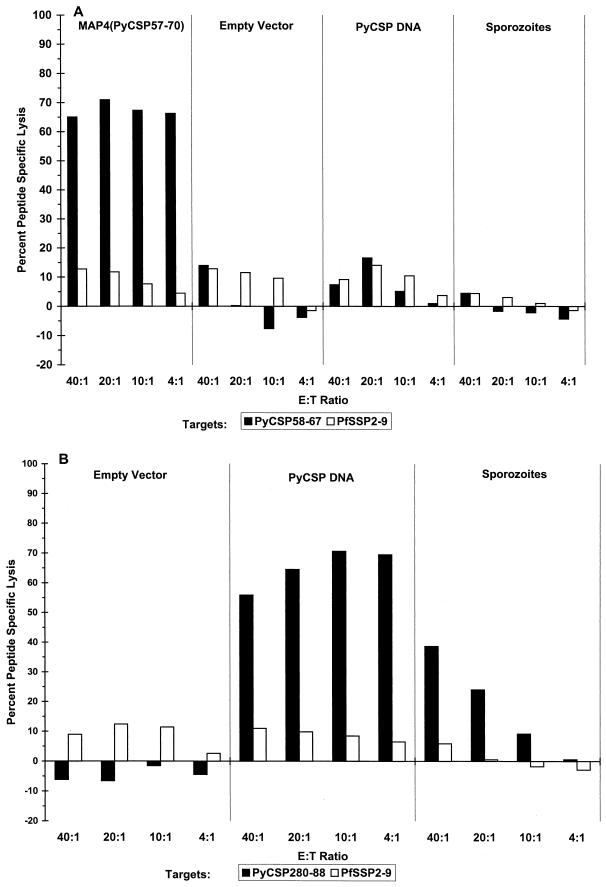
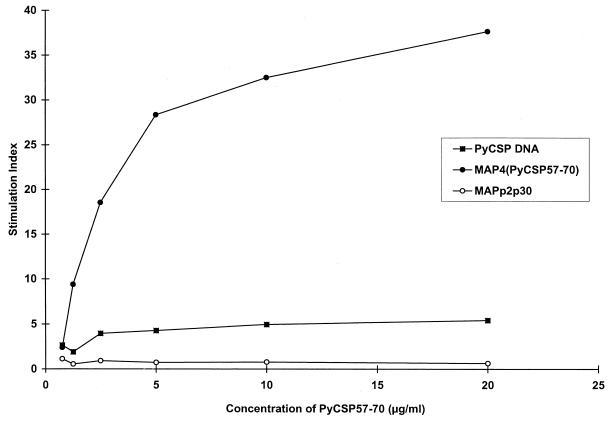
Previous studies indicated that the Plasmodium yoelii circumsporozoite protein (PyCSP) 57-70 region elicits T cells capable of eliminating infected hepatocytes in vitro. Herein, we report that the PyCSP58-67 sequence contains an H-2(d) binding motif, which binds purified K(d) molecules in vitro with low affinity (3, 267 nM) and encodes an H-2(d)-restricted cytotoxic T lymphocyte (CTL) epitope. Immunization of BALB/c mice with three doses of a multiple antigen peptide (MAP) construct containing four branches of amino acids 57 to 70 linked to a lysine-glycine core [MAP4(PyCSP57-70)] and Lipofectin as the adjuvant induced both T-cell proliferation and a peptide-specific CTL response that was PyCSP59-67 specific, H-2(d) restricted, and CD8(+) T cell dependent. Immunization with either DNA encoding the PyCSP or irradiated sporozoites demonstrated that this CTL epitope is subdominant since it is not recognized in the context of whole CSP immunization. The biological relevance of this CTL response was underlined by the demonstration that it could mediate genetically restricted, CD8(+)- and nitric-oxide-dependent elimination of infected hepatocytes in vitro, as well as partial protection of BALB/c mice against sporozoite challenge. These findings indicate that subdominant epitopes with low major histocompatibility complex affinity can be used to engineer epitope-based vaccines and have implications for the selection of epitopes for subunit-based vaccines.
Figures
References
-
- Bodmer J G, Marsh S G E, Albert E D, Bodmer W F, Dupont B, Erlich H A, Mach B, Mayr W R, Parham P, Sasazuki T, et al. Nomenclature for factors of the HLA system, 1994. Tissue Antigens. 1994;44:1–18. - PubMed
-
- Buus S, Sette A, Colon S M, Miles C, Grey H M. The relation between major histocompatibility complex (MHC) restriction and the capacity of Ia to bind immunogenic peptides. Science. 1987;235:1353–1358. - PubMed
-
- Celis E, Sette A, Grey H M. Epitope selection and development of peptide based vaccines to treat cancer. Semin Cancer Biol. 1995;6:329–336. - PubMed
-
- Charoenvit Y, Mellouk S, Sedegah M, Toyoshima T, Leef M F, De la Vega P, Beaudoin R L, Aikawa M, Fallarme V, Hoffman S L. Plasmodium yoelii: 17-kDa hepatic and erythrocytic stage protein is the target of an inhibitory monoclonal antibody. Exp Parasitol. 1995;80:419–429. - PubMed
-
- Del Giudice G, Grillot D, Renia L, Muller I, Corradin G, Louis J A, Mazier D, Lambert P H. Peptide-primed CD4+ cells and malaria sporozoites. Immunol Lett. 1990;25:59–64. - PubMed
Publication types
MeSH terms
Substances
LinkOut - more resources
Full Text Sources
Molecular Biology Databases
Research Materials
