


doi: 10.1128/IAI.68.6.3772-3775.2000.
A functional cra gene is required for Salmonella enterica serovar typhimurium virulence in BALB/c mice
Affiliations
- PMID: 10816546
- PMCID: PMC97677
- DOI: 10.1128/IAI.68.6.3772-3775.2000
Item in Clipboard
A functional cra gene is required for Salmonella enterica serovar typhimurium virulence in BALB/c mice
Infect Immun.
2000 Jun.
Abstract
A minitransposon mutant of Salmonella enterica serovar Typhimurium SR-11, SR-11 Fad(-), is unable to utilize gluconeogenic substrates as carbon sources and is avirulent and immunogenic when administered perorally to BALB/c mice (M. J. Utley et al., FEMS Microbiol. Lett., 163:129-134, 1998). Here, evidence is presented that the mutation in SR-11 Fad(-) that renders the strain avirulent is in the cra gene, which encodes the Cra protein, a regulator of central carbon metabolism.
Figures
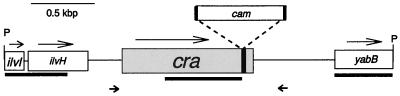
Genes present in the SR-11 Fad− 4.5-kb PstI DNA fragment that contains the chloramphenicol resistance gene (cam). Heavy lines below the genes denote regions in the fragment that were sequenced. Sequencing reactions were performed with the BigDye Terminator Cycle Sequencing Kit, and reactions were analyzed on the ABI PRISM 310 (PE Applied Biosystems, Forest City, Calif.). Nucleotide sequences were analyzed using Clone Manager and Align Plus 3 programs (Sci-Ed Software, Durham, N.C.). Arrows above the genes denote the direction of transcription. Arrows below the genes denote the positions of the forward and reverse primers used for PCR amplification of the wild-type and defective cra genes. P, PstI.
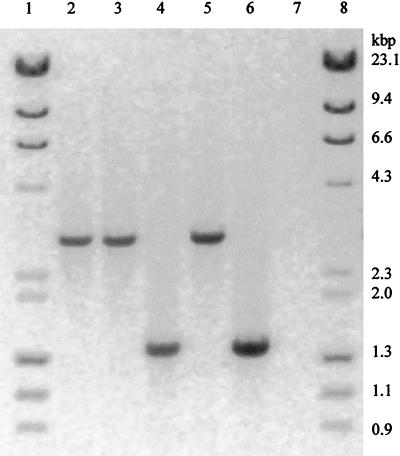
PCR amplification of the defective cra genes of serovar Typhimurium SR-11 Fad−, SR-11 Fad− AX-2, and UK-1 Fad− AX-1. Genomic DNA preparations were performed by standard techniques (13) or by following the manufacturer's instructions. Genomic DNA preparations of SR-11, SR-11 Fad−, SR-11 Fad− AX-2, UK-1, and UK-1 AX-1 were amplified by PCR using 5′-ATCGACTGCAGTGCGAAATCCGTGGTAACCCGG-3′ as the forward primer and 5′-TAGCTCTGCAGCCTGTTTAACGTGTGCGGTGCC-3′ as the reverse primer. PCR reaction mixtures contained 2.0 mM magnesium chloride and 5% dimethyl sulfoxide and were subjected to 25 cycles of 94°C for 30 s, followed by 65°C for 30 s, followed by 72°C for 2.5 min. Lane 1, kilobase ladder; lane 2, SR-11 Fad− AX-2; lane 3, SR-11 Fad−; lane 4, SR-11; lane 5, UK-1 Fad− AX-1; lane 6, UK-1; lane 7, no DNA added; lane 8, kilobase ladder.
References
-
- Allen A. The structure and function of gastrointestinal mucous. In: Boedecker E C, editor. Attachment of organisms to the gut mucosa. II. Boca Raton, Fla: CRC Press, Inc.; 1984. pp. 3–11.
-
- Balbas P, Soberon X, Merino E, Zurita M, Lomeli H, Valle F, Flores N, Bolivar F. Plasmid vector pBR322 and its special derivatives—a review. Gene. 1986;50:3–40. - PubMed
-
- Curtiss R, III, Porter S B, Munson M, Tinge S A, Hassan J O, Gentry-Weeks C, Kelly S M. Nonrecombinant and recombinant avirulent Salmonella live vaccines for poultry. In: Blankenship L C, Bailey J S, Cox N A, Stern N J, Meinersmann R J, editors. Colonization control of human bacterial enteropathogens in poultry. New York, N.Y: Academic Press, Inc.; 1991. pp. 169–198.
Publication types
MeSH terms
Substances
Grants and funding
LinkOut - more resources
Full Text Sources
Other Literature Sources
Research Materials
