. 2000 Jun 1;20(11):4120-8.
doi: 10.1523/JNEUROSCI.20-11-04120.2000.

Uncoupling of myelin assembly and schwann cell differentiation by transgenic overexpression of peripheral myelin protein 22

Affiliations

Uncoupling of myelin assembly and schwann cell differentiation by transgenic overexpression of peripheral myelin protein 22

S Niemann et al. J Neurosci. .

Abstract

We have generated previously transgenic rats that overexpress peripheral myelin protein 22 (PMP22) in Schwann cells. In the nerves of these animals, Schwann cells have segregated with axons to the normal 1:1 ratio but remain arrested at the promyelinating stage, apparently unable to elaborate myelin sheaths. We have examined gene expression of these dysmyelinating Schwann cells using semiquantitative reverse transcription-PCR and immunofluorescence analysis. Unexpectedly, Schwann cell differentiation appears to proceed normally at the molecular level when monitored by the expression of mRNAs encoding major structural proteins of myelin. Furthermore, an aberrant coexpression of early and late Schwann cell markers was observed. PMP22 itself acquires complex glycosylation, suggesting that trafficking of the myelin protein through the endoplasmic reticulum is not significantly impaired. We suggest that PMP22, when overexpressed, accumulates in a late Golgi-cell membrane compartment and uncouples myelin assembly from the underlying program of Schwann cell differentiation.


Figures
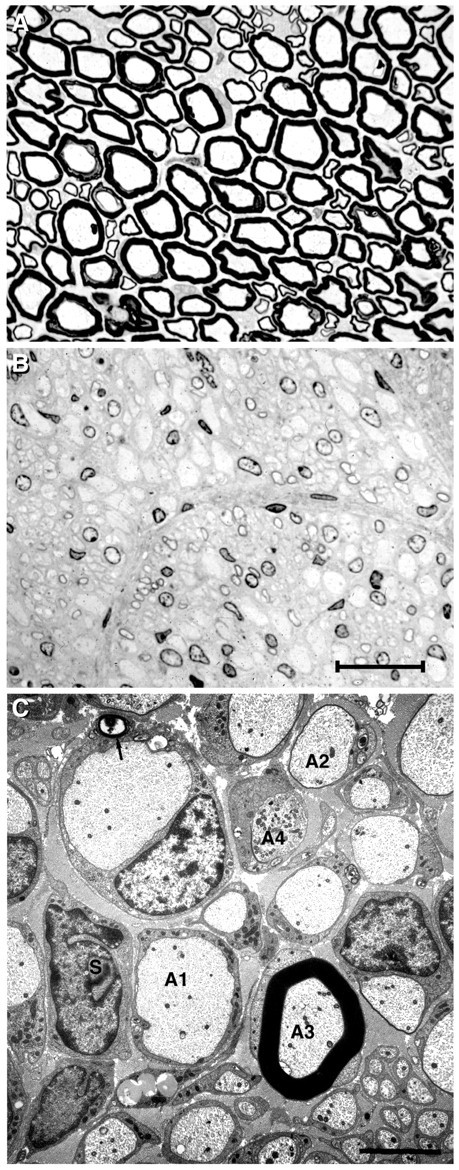
Fig. 1.
Fig. 1.
Absence of peripheral myelin is not a developmental delay in rats homozygous for the PMP22 transgene. Resin sections of sciatic nerves from 8-month-old wild-type (A) and PMP22 transgenic (B) animals were stained with methylene blue–azure II and photographed at the same magnification. In the absence of myelin, SC nuclear chromatin and nucleoli are prominently stained. Scale bar, 15 μm.C, PMP22 transgenic rats at 8 months of age. By electron microscopy, putative myelin-forming SCs of the sciatic nerve have segregated in a 1:1 manner with axons (A1) but reveal a block of myelination. Nearly all axons are surrounded by SC cytoplasm but not myelinated. Occasional axons (A2) have a very thin sheath of two or three lamellae. This field has been deliberately selected to also include the rare example of a myelinated axon (A3; frequency <1 in 1000) surrounded with a sheath of normal thickness. Another axon contains a collection of mitochondria (A4). Onion bulbs are absent, although occasional SCs (S) are unassociated with axons. Rare intracellular myelin figures are depicted with anarrow. The amount of endoneurial collagen is considerably increased. Unmyelinated fibers appear normal. Scale bar, 4 μm.
Fig. 2.
Fig. 2.
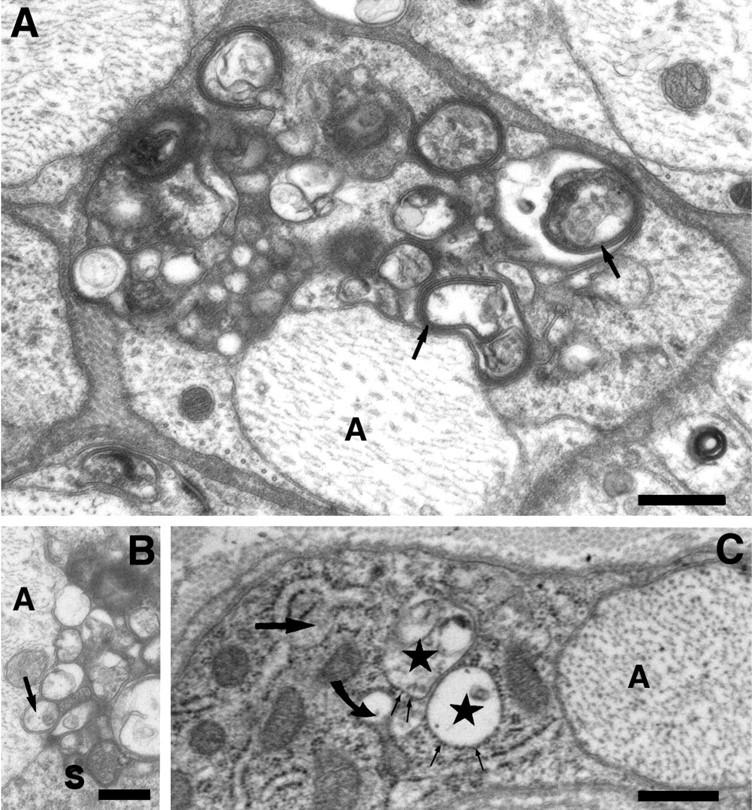
A, At higher magnification, intracellular myelin figures (arrows) are sometimes recognized, which are not associated with the axon (A). Scale bar, 0.5 μm. B, Other vesicular structures (arrow) within the Schwann cell (S) appear to be closely associated with adaxonal surface (A, axon). Scale bar, 0.5 μm.C, Schwann cell abnormalities occasionally include the ER, as suggested by ER cisternae distended by a moderately electron dense material (large straight arrow). Other profiles (stars), designated as rough ER by the presence of ribosomes on their surface, are vacuolated. A transition between the two forms is also evident (curved arrow). Scale bar, 0.5 μm. All electron micrographs were taken from a homozygous PMP22 transgenic rat at 8 months of age.
Fig. 3.
Fig. 3.
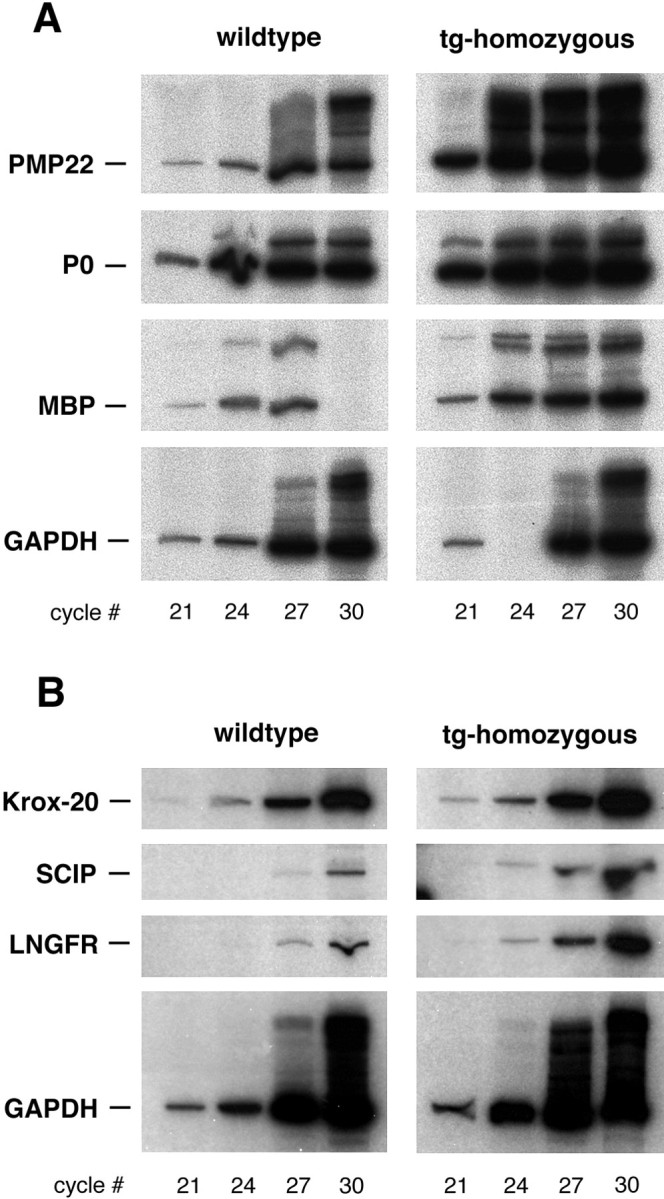
Normal transcription of myelin protein genes in sciatic nerves lacking myelin. Semiquantitative RT-PCR analysis was used to compare the steady-state levels of mRNAs encoding (A) the myelin proteins PMP22, P0 and MBP, (B) the glial transcription factors Krox-20, SCIP/Tst-1/Oct-6, and the receptor p75/LNGFR between homozygous PMP22 transgenic rats and wild-type controls (5 weeks of age). For quantitation, we used GAPDH mRNA as an internal standard. Within the linear range of this assay, PCR products for PMP22, P0, and MBP were at least twofold more abundant in homozygous transgenics. In the data set shown, two samples were lost before loading. Also, the expression of LNGFR and SCIP (but not of Krox-20) is higher in the unmyelinated nerves of homozygous transgenics (tg) than in wild-type controls.
Fig. 4.
Fig. 4.
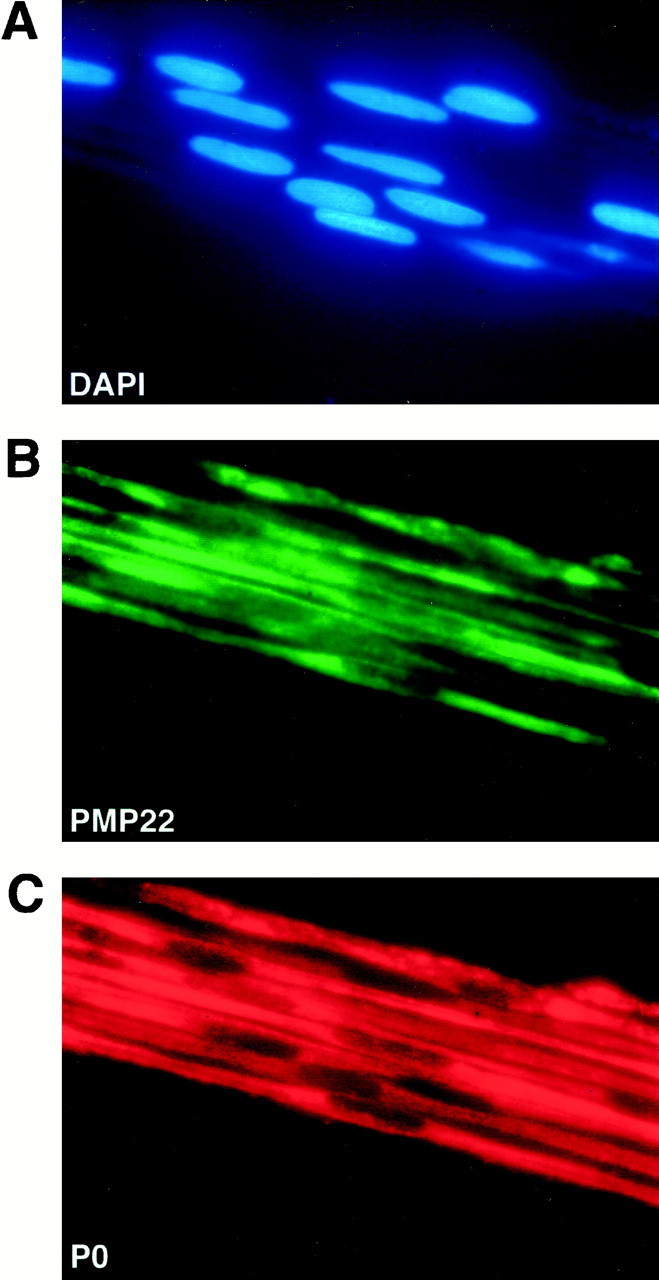
Immunolocalization of PMP22 and P0 in a myelinated sciatic nerves. Teased fibers were prepared from sciatic nerves of homozygous transgenic rats at the age of 5 weeks. By double-immunofluorescence staining, strong expression of PMP22 (B) and P0 (C) was confirmed at the protein level and colocalized to individual SCs.A, SC nuclei stained with DAPI.
Fig. 5.
Fig. 5.
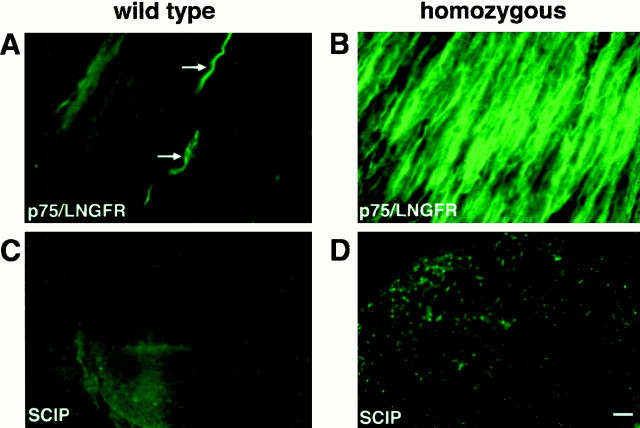
Expression of p75/LNGFR and SCIP/Tst-1/Oct-6 by SCs arrested at the promyelin stage. Longitudinal cryostat sections of sciatic nerves from 5-week-old wild-type (A,B) and homozygous PMP22-transgenic (C,D) rats were stained with antibodies against p75/LNGFR (A, C) and for SCIP/Tst-1/Oct-6 (B, D). In wild-type nerve, p75/LNGFR is expressed by only a few, presumably nonmyelinating SCs (arrows in A), and SCIP is not detectable (B). In contrast, the majority of SCs in the homozygous mutant express p75/LNGFR (C), and a fraction can be stained for SCIP (D). Scale bar (in D), 50 μm.
Fig. 6.
Fig. 6.
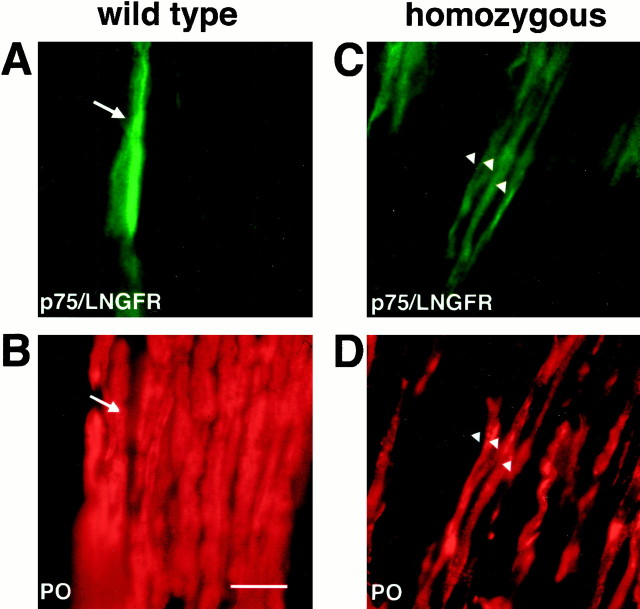
Abnormal coexpression of early and late Schwann cell markers at 5 weeks of age. Longitudinal cryostat sections of sciatic nerves from wild-type (A, B) and homozygous PMP22 transgenic (C, D) rats were stained for p75/LNGFR (A, C) and P0 (B, D). Note that, in wild-type rats, p75/LNGFR is expressed by cells that do not stain for P0 (arrows in A and B). In contrast, p75/LNGFR and P0 are clearly coexpressed by some transgenic SCs (arrowheads in C andD). Scale bar (in B), 20 μm.
Fig. 7.
Fig. 7.
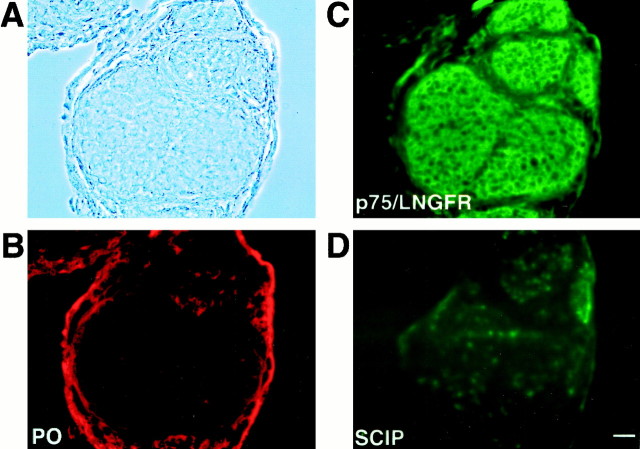
Promyelinating stage SCs in normal rat development. Transverse cryostat sections were taken from sciatic nerves of neonatal wild-type rat (when promyelinating SCs are prominent). Phase contrast is shown in A, and immunolabeling was with antibodies against P0 (B), p75/LNGFR (C), and SCIP (D). Virtually all SCs show staining for p75/LNGFR (C), whereas SCIP immunoreactivity is present in only a fraction of cells (D). The level of P0 immunoreactivity (B) is still very low, and the staining of epineurium is unspecific. Scale bar (inD), 20 μm.
Fig. 8.
Fig. 8.
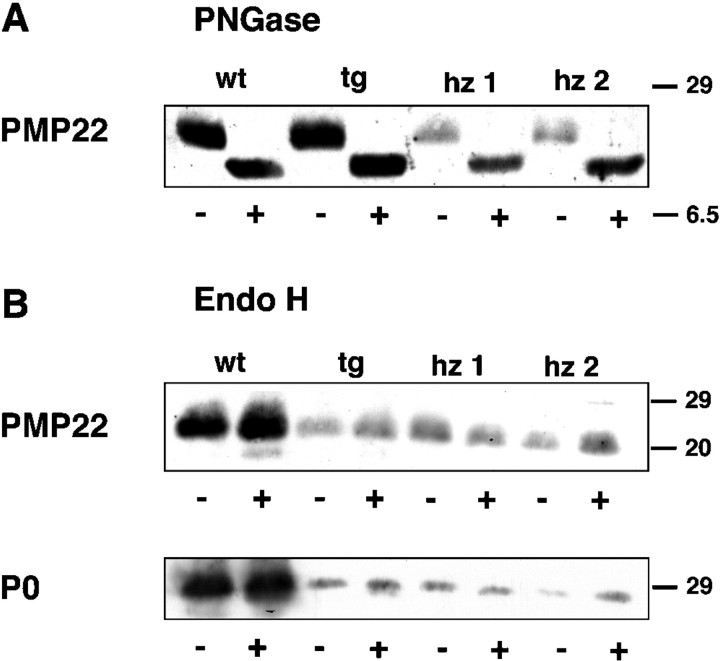
Intracellular processing of PMP22 in transgenic SCs proceeds normally. Deglycosylation profile and Western blot analysis demonstrate that virtually all PMP22 reaches the Golgi compartment of SCs, also when transgenically overexpressed. Protein extracts from sciatic nerves of 5-week-old wild-type (wt), hemizygous (tg), and homozygous (hz1, hz2) rats were treated with PNGase F (A) or EndoH (B). Protein detection was with antibodies against PMP22 and P0. Control samples (−) were incubated without the addition of enzyme.Lanes for the PNGase treatment contained 2.5 μg, andlanes for the EndoH treatment contained 10 μg of protein. Molecular weights are indicated to the right(in kilodaltons). Note that PMP22 and P0 are completely EndoH-resistant in overexpressing SCs, indicating that normal complex glycosylation has occurred and that PMP22 and P0 did not accumulate before the medial Golgi compartment.

References

    1. Adlkofer K, Martini R, Aguzzi A, Zielasek J, Toyka KV, Suter U. Hypermyelination and demyelinating peripheral neuropathy in PMP-22-deficient mice. Nat Genet. 1995;11:274–280. - PubMed
    1. Adlkofer K, Frei R, Neuberg DH, Zielasek J, Toyka KV, Suter U. Heterozygous peripheral myelin protein 22-deficient mice are affected by a progressive demyelinating tomaculous neuropathy. J Neurosci. 1997a;17:4662–4671. - PMC - PubMed
    1. Adlkofer K, Naef R, Suter U. Analysis of compound heterozygous mice reveals that the Trembler mutation can behave as a gain-of-function allele. J Neurosci Res. 1997b;49:671–680. - PubMed
    1. Anzini P, Neuberg DH, Schachner M, Nelles E, Willecke K, Zielasek J, Toyka KV, Suter U, Martini R. Structural abnormalities and deficient maintenance of peripheral nerve myelin in mice lacking the gap junction protein connexin 32. J Neurosci. 1997;17:4545–4551. - PMC - PubMed
    1. Archelos JJ, Roggenbuck K, Schneider-Schaulies J, Linington C, Toyka KV, Hartung HP. Production and characterization of monoclonal antibodies to the extracellular domain of P0. J Neurosci Res. 1993;35:46–53. - PubMed

Publication types

MeSH terms

LinkOut - more resources