. 2000 Jun 6;97(12):6896-901.
doi: 10.1073/pnas.120170197.

The Arabidopsis thaliana salt tolerance gene SOS1 encodes a putative Na+/H+ antiporter

Affiliations

The Arabidopsis thaliana salt tolerance gene SOS1 encodes a putative Na+/H+ antiporter

H Shi et al. Proc Natl Acad Sci U S A. .

Abstract

In Arabidopsis thaliana, the SOS1 (Salt Overly Sensitive 1) locus is essential for Na(+) and K(+) homeostasis, and sos1 mutations render plants more sensitive to growth inhibition by high Na(+) and low K(+) environments. SOS1 is cloned and predicted to encode a 127-kDa protein with 12 transmembrane domains in the N-terminal part and a long hydrophilic cytoplasmic tail in the C-terminal part. The transmembrane region of SOS1 has significant sequence similarities to plasma membrane Na(+)/H(+) antiporters from bacteria and fungi. Sequence analysis of various sos1 mutant alleles reveals several residues and regions in the transmembrane as well as the tail parts that are critical for SOS1 function in plant salt tolerance. SOS1 gene expression in plants is up-regulated in response to NaCl stress. This up-regulation is abated in sos3 or sos2 mutant plants, suggesting that it is controlled by the SOS3/SOS2 regulatory pathway.


Figures

Figure 1
Figure 1
Positional cloning of the SOS1 gene. (A) Genetic and physical mapping of SOS1. All of the SSLP markers shown except nga1145 were developed in this study based on sequence information of the BACs. The BAC contig was assembled based on information available at http://www.Arabidopsis.org/cgi-bin/maps. cM, centimorgan. (B) Structure of the SOS1 gene. Positions are relative to the initiation codon. Filled boxes indicate the ORF, and lines between boxes indicate introns.
Figure 2
Figure 2
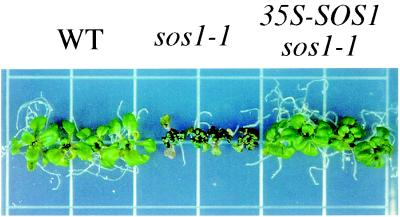
Complementation of sos1 by 35S-SOS1: 7-day-old seedlings grown on MS agar medium were transferred to MS medium supplemented with 100 mM NaCl. The picture was taken after 10 days of treatment on the NaCl medium. (Left) Wild-type plants (WT). (Center) sos1-1 mutant plants. (Right) Transgenic sos1-1 plants containing the wild-type SOS1 gene under control of the cauliflower mosaic virus 35S promoter. These plants did not show any difference when grown on MS medium without supplementation of NaCl (not shown).
Figure 3
Figure 3
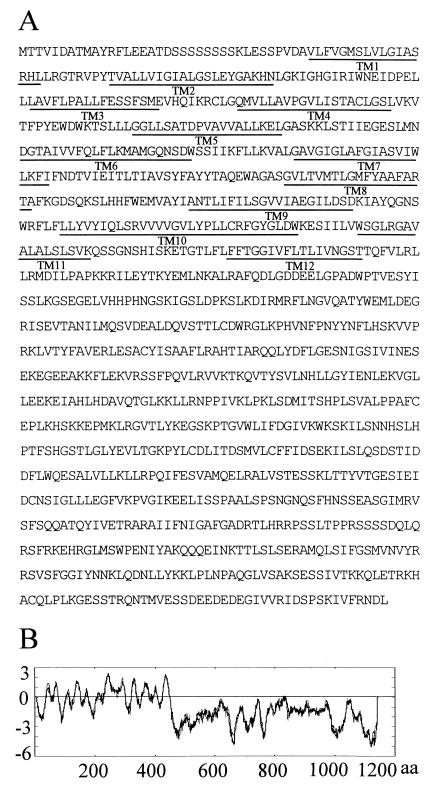
SOS1 is predicted to encode a transmembrane protein. (A) The deduced amino acid sequence of SOS1. The 12 putative transmembrane domains (TM) are underlined. (B) Hydrophobicity plot of SOS1. The hydrophobicity values were calculated by the program tmpred available at http://www.ch.embnet.org/software/TMPRED_form.html.
Figure 4
Figure 4
SOS1 is similar to Na+/H+ antiporters. (A) Alignment of SOS1 (accession number AF256224) with Na+/H+ antiporters NHE1 from Chinese hamster (P48761) and NhaP from Pseudomonas aeruginosa (BAA31695). The sequences were aligned by the program clustalw (http://dot.imgen.bcm.tmc.edu:9331/multialign/Options/clustalw.html). Amino acids identical in at least two proteins are highlighted in black, and conservative substitutions are highlighted in gray. Asterisks indicate conserved residues that were substituted in sos1 mutant alleles. (B) Phylogenetic analysis of SOS1 and other representative Na+/H+ antiporters. Multiple sequence alignment was performed with clustalw. The alignment is based on the N-terminal 450 amino acids of SOS1. Evolutionary distances were calculated by the neighbor joining method, and the phylogenetic tree was drawn by the program drawgram (http://bioweb.pasteur.fr/seqanal/phylogeny/phylip-uk.html). The accession numbers and sources of each of the other representative Na+/H+ antiporters are as follows: NHE1 (P19634), Homo sapiens; NHE2 (AAD41635), H. sapiens; NHE3 (P48764), H. sapiens; NHE4 (P26434), Rattus norvegicus; NHE5 (AAC98696.1), H. sapiens; NHE6 (NP_006350), H. sapiens; NHA1 (NP_013239), S. cerevisiae; NHX1 (NP_010744), S. cerevisiae; AtNHX1 (AAD16946.1), A. thaliana; SOD2 (CAA77796.1), S. pombe; NhaA (P13738), Escherichia coli; and NhaP (BAA31695.1), P. aeruginosa.
Figure 5
Figure 5
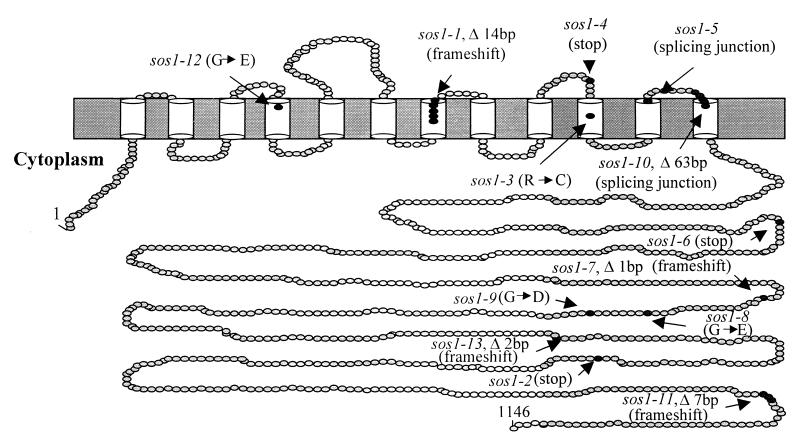
Diagramatic representation of SOS1 structure. The diagram was drawn based on the prediction of hydrophobicity profile of SOS1. Putative transmembrane helices are shown as cylinders. The positions of mutations in sos1 alleles are indicated.
Figure 6
Figure 6
SOS1 expression is up-regulated by NaCl stress and is under the control of the SOS3/SOS2 regulatory pathway. (A) SOS1 expression is specifically up-regulated by NaCl stress in wild-type Arabidopsis seedlings. (B) Up-regulation of SOS1 expression in roots and shoots of wild-type plants. (C) SOS1 expression in sos2-1 mutant seedlings. (D) SOS1 expression in sos3-1 mutant seedlings. The same RNA blots were hybridized successively with SOS1, RD29A, and actin cDNA probes. Actin was used as loading control, and RD29A was used as control for the stress treatments. C, unstressed control.

References

    1. Niu X, Bressan R A, Hasegawa P M, Pardo J M. Plant Physiol. 1995;109:735–742. - PMC - PubMed
    1. Jacoby B. In: Handbook of Plant and Crop Stress. Pessarakli M, editor. New York: Dekker; 1999. pp. 97–123.
    1. Rubio F, Gassman W, Schroeder J I. Science. 1995;270:1660–1663. - PubMed
    1. Schachtman D P, Kumar R, Schroeder J I, Marsh E L. Proc Natl Acad Sci USA. 1997;94:11079–11084. - PMC - PubMed
    1. Amtmann A, Sanders D. Adv Bot Res. 1998;29:76–112.

Publication types

Associated data