. 2000 May 23;97(11):6079-84.
doi: 10.1073/pnas.97.11.6079.

Oral administration of a corticotropin-releasing hormone receptor antagonist significantly attenuates behavioral, neuroendocrine, and autonomic responses to stress in primates

Affiliations

Oral administration of a corticotropin-releasing hormone receptor antagonist significantly attenuates behavioral, neuroendocrine, and autonomic responses to stress in primates

K E Habib et al. Proc Natl Acad Sci U S A. .

Abstract

We evaluated the effects of the lipophilic nonpeptide corticotropin-releasing hormone (CRH) type 1 receptor antagonist antalarmin on the behavioral, neuroendocrine, and autonomic components of the stress response in adult male rhesus macaques. After oral administration, significant antalarmin concentrations were detected in the systemic circulation and the cerebrospinal fluid by a mass spectrometry-gas chromatography assay developed specifically for this purpose. Pharmacokinetic and dose-response studies suggested that an oral dose of 20 mg/kg was optimal for behavioral and endocrine effects. We then administered this dose in a double-blind, placebo-controlled fashion to monkeys exposed to an intense social stressor: namely, placement of two unfamiliar males in adjacent cages separated only by a transparent Plexiglas screen. Antalarmin significantly inhibited a repertoire of behaviors associated with anxiety and fear such as body tremors, grimacing, teeth gnashing, urination, and defecation. In contrast, antalarmin increased exploratory and sexual behaviors that are normally suppressed during stress. Moreover, antalarmin significantly diminished the increases in cerebrospinal fluid CRH as well as the pituitary-adrenal, sympathetic, and adrenal medullary responses to stress. We conclude that CRH plays a broad role in the physiological responses to psychological stress in primates and that a CRH type 1 receptor antagonist may be of therapeutic value in human psychiatric, reproductive, and cardiovascular disorders associated with CRH system hyperactivity.


Figures
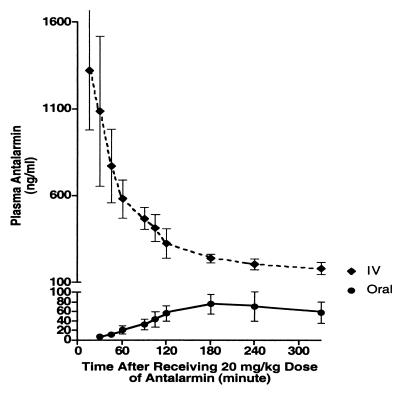
Figure 1
Figure 1
Pharmacokinetics of antalarmin in adult male rhesus macaques after the administration of 20 mg/kg orally and intravenously on two separate occasions. n = 8, mean ± SD. The total clearance of antalarmin was 4.46 liters/h⋅kg, the elimination half-life was 7.82 h, and its oral bioavailability was 19.3%, as determined by a three-compartmental module pharmacokinetic analysis aided by saam ii 1.1.1 software.
Figure 2
Figure 2
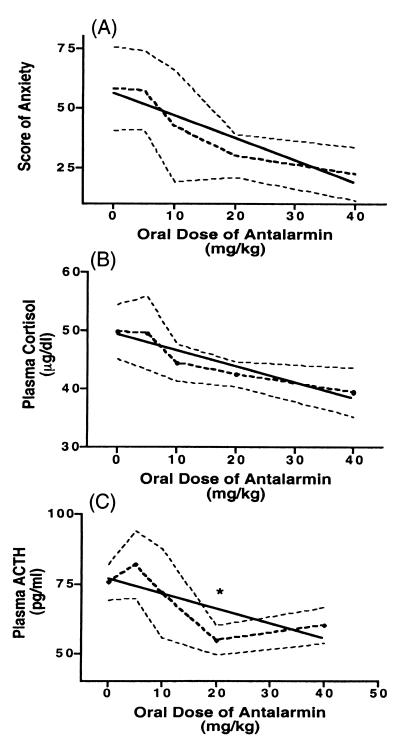
Effects of increasing doses of oral antalarmin treatment (0, 5, 10, 20, and 40 mg/kg) on adult male rhesus macaques' scores of anxiety (A) (r = −0.362, P = 0.08), plasma cortisol (B) (r = −0.379, P = 0.068), and plasma ACTH (C) (r = −0.375, P = 0.1) during introductions of two unfamiliar subjects in adjacent chambers separated only by a transparent screen for 30 min. n = 4, mean ± SE. *, P < 0.05.
Figure 3
Figure 3
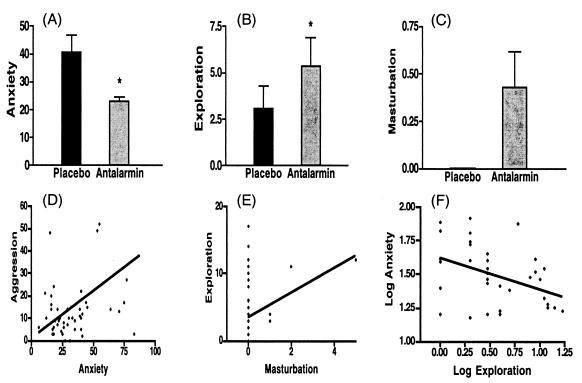
Effects of antalarmin treatment (20 mg/kg orally) on adult male macaques' behavior during introduction of two unfamiliar subjects in adjacent cages separated by a transparent Plexiglas plate for 30 min starting 150 min after receiving the drug or placebo in a blind fashion. Every animal was paired with all of the others, thus generating 30 sessions each. Anxiety score (A) totaled the number of occurrences over the 30-min stress period of fear grimacing, audible teeth grinding, body tremors, open mouth expressions, urination, and defecation. Exploration score (B) represented the total number of times an animal approached and played with a toy in his cage or expressed unapprehensive curiosity in the surrounding environment. Masturbation score (C) considered the total number of times a male monkey entertained by sexual manipulation of his penis. n = 6, mean ± SE. *, P < 0.05. Individual values of exploration significantly correlated with those of masturbation (E) (r = 0.409, P = 0.004), and individual aggression scores significantly correlated with those of anxiety (D) (r = 0.457, P = 0.001). After log transformation, the negative correlation between individual anxiety scores and individual exploration scores was statistically significant (F) (r = −0.41, P = 0.013).
Figure 4
Figure 4
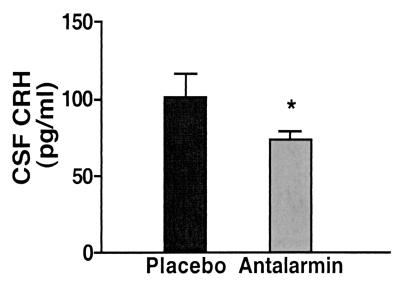
Effects of antalarmin treatment (20 mg/kg orally) on adult male macaques' CSF concentrations of CRH during introduction of two unfamiliar subjects in adjacent cages separated by a transparent Plexiglas plate for 30 min starting 150 min after receiving the drug or placebo in a blind fashion. *, P = 0.04.
Figure 5
Figure 5
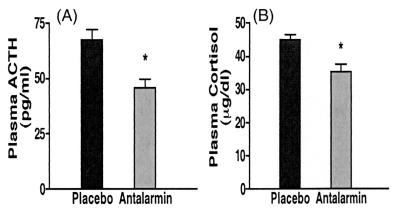
Effects of antalarmin treatment (20 mg/kg orally) on adult male macaques' plasma concentrations of ACTH (A) and cortisol (B) during introduction of two unfamiliar subjects in adjacent cages separated by a transparent Plexiglas plate for 30 min starting 150 min after receiving the drug or placebo in a blind fashion. *, P < 0.02.
Figure 6
Figure 6
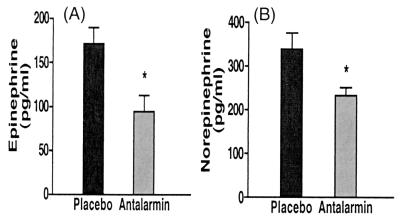
Effects of antalarmin treatment (20 mg/kg orally) on adult male macaques' plasma concentrations of epinephrine (A) and norepinephrine (B) during introduction of two unfamiliar subjects in adjacent cages separated by a transparent Plexiglas plate for 30 min starting 150 min after receiving the drug or placebo in a blind fashion. *, P < 0.03.

References

    1. Chrousos G P, Gold P W. J Am Med Assoc. 1992;267:1244–1252. - PubMed
    1. Behan D P, Grigoriadis D E, Lovenberg T, Chalmers D, Heinrichs S, Liaw C, De Souza E B. Mol Psychiatry. 1996;1:265–277. - PubMed
    1. Gold P W, Kling M A, Khan I, Calabrese J R, Kalogeras K, Post R M, Avgerinos P C, Loriaux D L, Chrousos G P. Adv Biochem Psychopharmacol. 1987;43:183–200. - PubMed
    1. Ghizzoni L, Vottero A, Street M E, Bernasconi S. J Clin Endocrinol Metab. 1996;81:1397–1400. - PubMed
    1. Barbarino A, Corsello S M, Della Casa S, Tofani A, Sciuto R, Rota C A, Bollanti L, Barini A. J Clin Endocrinol Metab. 1990;71:1368–1374. - PubMed

MeSH terms