


Aicardi-Goutières syndrome displays genetic heterogeneity with one locus (AGS1) on chromosome 3p21
- PMID: 10827106
- PMCID: PMC1287108
- DOI: 10.1086/302955
Aicardi-Goutières syndrome displays genetic heterogeneity with one locus (AGS1) on chromosome 3p21
Abstract
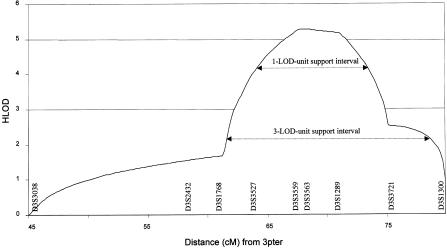
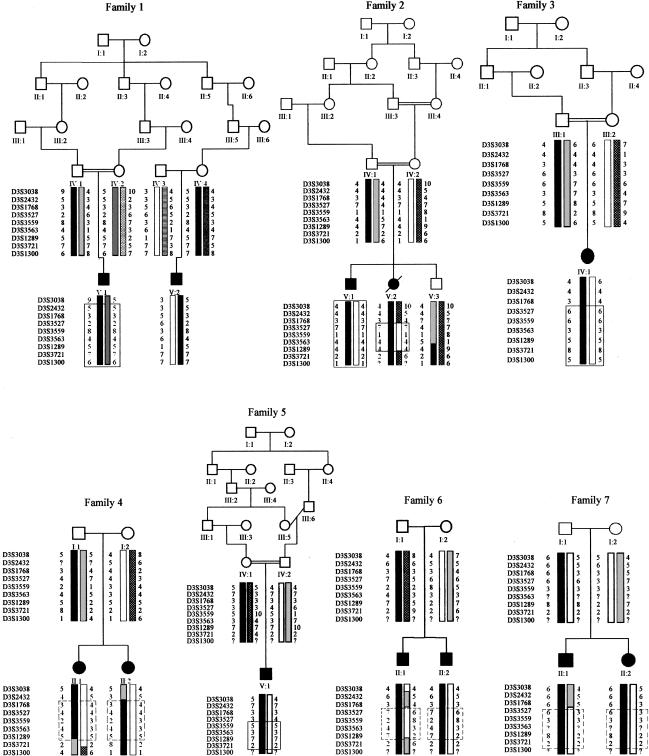
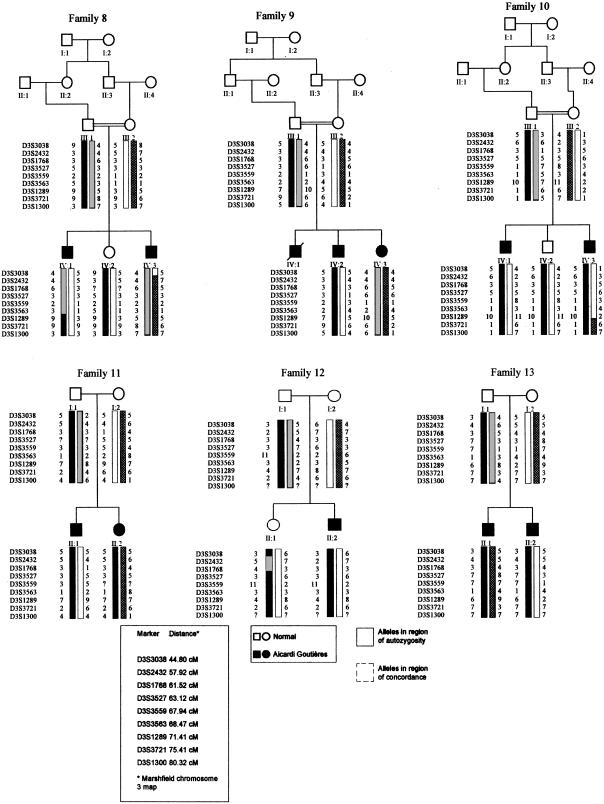
We have studied 23 children from 13 families with a clinical diagnosis of Aicardi-Goutières syndrome. Affected individuals had developed an early-onset progressive encephalopathy that was characterized by a normal head circumference at birth, basal ganglia calcification, negative viral studies, and abnormalities of cerebrospinal fluid comprising either raised white cell counts and/or raised levels of interferon-alpha. By means of genomewide linkage analysis, a maximum-heterogeneity LOD score of 5.28 was reached at marker D3S3563, with alpha=.48, where alpha is the proportion of families showing linkage. Our data suggest the existence of locus heterogeneity in Aicardi-Goutières syndrome and highlight potential difficulties in the differentiation of this condition from pseudo-TORCH (toxoplasmosis, rubella, cytomegalovirus, and herpes simplex virus types 1 and 2) syndrome.
Figures
References
Electronic-Database Information
-
- Center for Medical Genetics, Marshfield Medical Research Foundation, http://www.marshmed.org/genetics/ (for information regarding marker order and relative genetic distances)
-
- Genome Database, http://gdbwww.gdb.org/ (for information on polymorphic markers on chromosome 3p)
-
- Online Mendelian Inheritance in Man (OMIM), http://www.ncbi.nlm.nih.gov/Omim/ (for Aicardi-Goutières syndrome [MIM 225750] and pseudo-TORCH syndrome [MIM 251290])
References
-
- Aicardi J, Goutières F (1984) A progressive familial encephalopathy in infancy with calcifications of the basal ganglia and chronic cerebrospinal fluid lymphocytosis. Ann Neurol 15:49–54 - PubMed
-
- Akwa Y, Hassett DE, Eloranta ML, Sandberg K, Masliah E, Powell H, Whitton JL, et al (1998) Transgenic expression of IFN-α in the central nervous system of mice protects against lethal neurotropic viral infection but induces inflammation and neurodegeneration. J Immunol 161:5016–5026 - PubMed
-
- al-Dabbous R, Sabry MA, Farah S, al-Awadi SA, Simeonov S, Farag TI (1998) The autosomal recessive congenital intrauterine infection-like syndrome of microcephaly, intracranial calcification, and CNS disease: report of another Bedouin family. Clin Dysmorphol 7:127–130 - PubMed
-
- Bachmeyer C, Farge D, Gluckman E, Miclea JM, Aractingi S (1996) Raynaud's phenomenon and digital necrosis induced by interferon-alpha. Br J Dermatol 135:481–483 - PubMed
MeSH terms
Substances
LinkOut - more resources
Full Text Sources
Research Materials
Miscellaneous
