Relation between troponin T concentration and mortality in patients presenting with an acute stroke: observational study
- PMID: 10834890
- PMCID: PMC27391
- DOI: 10.1136/bmj.320.7248.1502
Relation between troponin T concentration and mortality in patients presenting with an acute stroke: observational study
Abstract
Objective: To assess whether a raised serum troponin T concentration would be an independent predictor of death in patients with an acute ischaemic stroke.
Design: Observational study.
Setting: Auckland Hospital, Auckland, New Zealand.
Subjects: All 181 patients with an acute ischaemic stroke admitted over nine months in 1997-8, from a total of 8057 patients admitted to the acute medical service.
Main outcome measures: Blood samples for measuring troponin T concentration were collected 12-72 hours after admission; other variables previously associated with severity of stroke were also recorded and assessed as independent predictors of inpatient mortality.
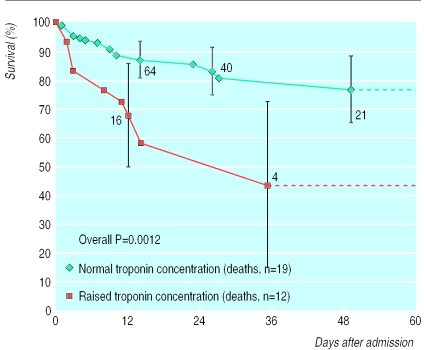
Results: Troponin T concentration was raised (>0.1 microgram/l) in 17% (30) of patients admitted with an acute ischaemic stroke. Thirty one patients died in hospital (12/30 (40%) patients with a raised troponin T concentration v 19/151 (13%) patients with a normal concentration (relative risk 3.2 (95% confidence 1.7 to 5. 8; P=0.0025)). Of 17 possible predictors of death, assessed in a multivariate stepwise model, only a raised troponin T concentration (P=0.0002), age (P=0.0008), and an altered level of consciousness at presentation (P=0.0074) independently predicted an adverse outcome.
Conclusions: Serum troponin T concentration at hospital admission is a powerful predictor of mortality in patients admitted with an acute ischaemic stroke.
Figures
References
-
- Bonita R, Beaglehole R. Cerebrovascular disease: explaining stroke mortality trends. Lancet. 1993;341:1510–1511. - PubMed
-
- Anderson NE, Bonita R, Broad JB. Early management and outcome of acute stroke in Auckland. Aust N Z Med J. 1997;27:561–567. - PubMed
-
- Brickner ME. Cardioembolic stroke. Am J Med. 1996;100:465–474. - PubMed
-
- Samuels MA. Neurally induced cardiac damage: definition of the problem. Neurol Clin. 1993;11:273–292. - PubMed
-
- Norris JW, Hachinski VC, Myers MG, Callow J, Wong T, Moore RW. Serum cardiac enzymes in stroke. Stroke. 1979;10:548–553. - PubMed
MeSH terms
Substances
LinkOut - more resources
Full Text Sources
Medical