. 2000 Jun 20;97(13):7172-7.
doi: 10.1073/pnas.120181197.

A downstream element in the human beta-globin promoter: evidence of extended sequence-specific transcription factor IID contacts

Affiliations

A downstream element in the human beta-globin promoter: evidence of extended sequence-specific transcription factor IID contacts

B A Lewis et al. Proc Natl Acad Sci U S A. .

Abstract

We describe here the identification and characterization of a functional downstream element in the human adult beta-globin promoter. The existence of this element was indicated by two mutations at +22 and +33 downstream of the beta-globin transcriptional start site in humans with beta-thalassemia. In vitro transcriptional analysis of these mutants, plus a third at +13, indicates that all three decrease transcription from the beta-globin promoter. Scanning mutagenesis from +10 to +45 indicates that this region contains a functional cis element(s) in vitro, and we designated this element the DCE (downstream core element). The DCE functions in concert with the beta-globin CATA box and initiator element, as well as in a heterologous, TATA-less context. A second set of mutants indicates that a particular geometry of the DCE and core promoter is necessary for promoter function. Lastly, DCE mutants show reduced affinity for transcription factor IID (TFIID). These data indicate that TFIID makes sequence-specific contacts to the DCE and that TFIID binding is necessary for DCE function.


Figures
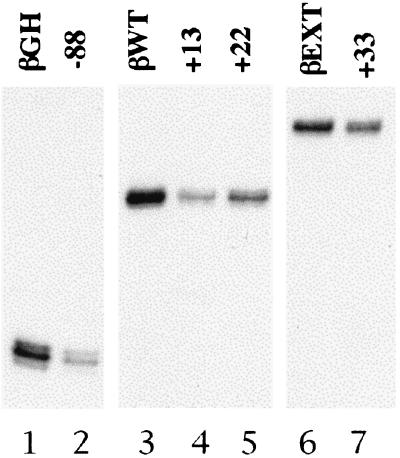
Figure 1
Figure 1
β-Thalassemia point mutations downstream of the transcriptional start site decrease transcription from the human β-globin promoter in vitro. Lanes 1–7 are primer extension assays of in vitro transcriptions using various β-globin promoter templates. The mutations are indicated above each lane. The templates in lanes 1 and 2, 3–5, and 6 and 7 are based on three wild-type promoter templates, βGH, βWT, and βEXT, extending to +18, +35, and +45, respectively.
Figure 2
Figure 2
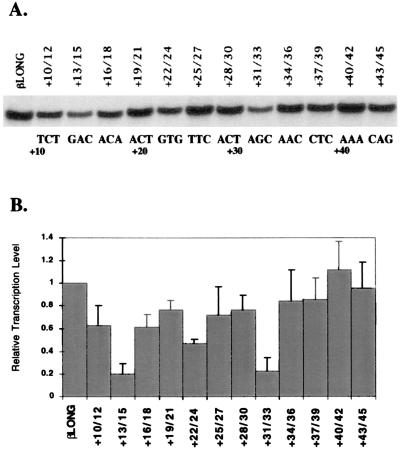
Scanning mutagenesis of the region downstream of the β-globin initiator element indicates the presence of a downstream core promoter element. (A) Representative in vitro transcriptional analysis of triplet mutations from +10 to +45 of the β-globin promoter. The sequence of the wild-type β-globin downstream region is indicated underneath the autoradiograph. (B) Graphical presentation of the scanning mutagenesis. Bars indicate the mean of three experiments with standard deviations indicated by error bars.
Figure 3
Figure 3
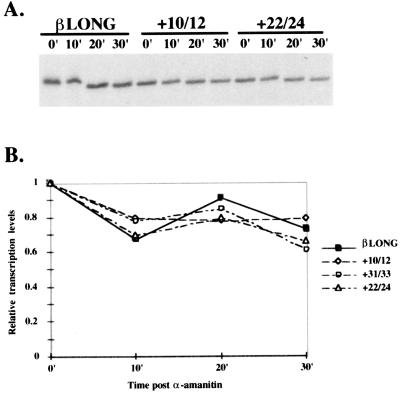
Degradation control assays indicate that DCE mutants do not significantly affect RNA stability. (A) Results of an in vitro transcription assay to analyze RNA stability of various DCE mutants at times after the addition of α-amanitin. (B) Graph of primer extension signal intensity relative to the 0 min data point. Each mutant template was normalized to a relative transcription level of 1. The data points in the graph are the mean of three experiments.
Figure 4
Figure 4
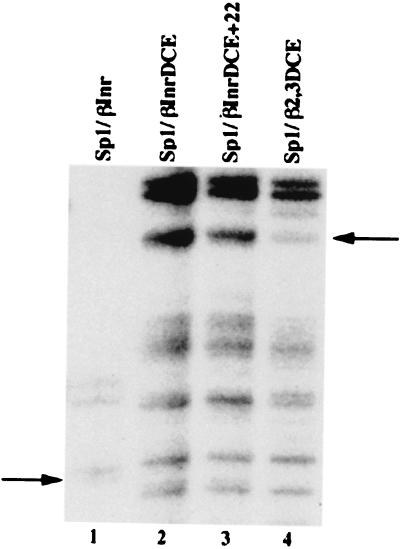
The DCE functions in a heterologous context to increase transcription from a βInr-dependent template. Lane 1 is primer extension analysis of an in vitro transcription assay using the Sp1/βInr described previously (24). The correctly initiated transcript is indicated by the arrow to the left of lane 1 (24). Lane 2 is an in vitro transcription assay using the longer Sp1/βInrDCE template extending to +40. In two experiments, it was expressed 3× and 8× higher than the Sp1/βInr template in lane 1. The template in lane 3 contains the β-thalassemia mutation at +22, and lane 4 contains a double point mutation in the βInr element (20). These templates are otherwise identical to Sp1/βInrDCE in lane 2. The arrow to the right of lane 4 indicates the position of the correctly initiated transcript.
Figure 5
Figure 5
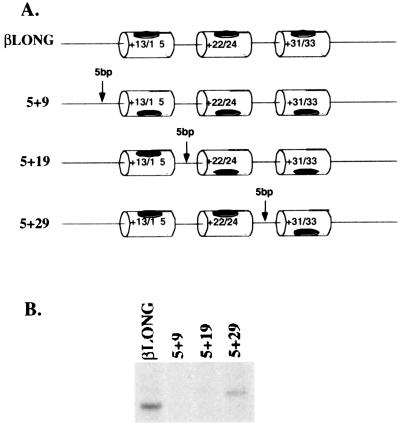
Five base pair insertions between DCE subelements severely disrupt β-globin transcription in vitro. (A) Schematic diagram showing the design of the spacing mutants. βLONG is the wild-type β-globin promoter. The three subelements are as indicated using a black patch to indicate their orientation relative to each other. The arrows indicate the position of the 5-bp insertion. This position is also indicated in the name of each template (i.e., the 5 + 9 mutant has a 5-bp insertion starting at position + 9 of the wild type promoter). (B) In vitro transcriptional analysis of the spacing mutants. Wild-type and mutant promoter templates were incubated with a MEL nuclear extract. The resulting RNA product was detected by primer extension analysis, was run on an 8% sequencing gel, and was autoradiographed.
Figure 6
Figure 6
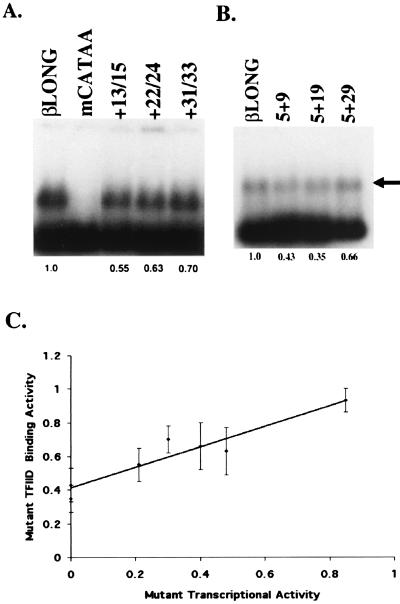
The TFIID complex shows a reduced affinity for DCE mutants; a linear correlation exists between DCE mutant transcriptional activity and TFIID binding activity. Binding of DCE mutants (A) or the spacing mutants (B) to TFIID was assayed by agarose gel electrophoresis using rTFIIA and immunopurified HA-tagged HeLa TFIID. The arrow indicates the position of the rTFIIA/TFIID complex. Free probe runs at the bottom of the gel. Probes extend from −110 to +100 of the β-globin promoter and were PCR amplified by using a 32P-labeled −110 primer to ensure that all probes had the same specific activity. Quantitation under each lane is relative to the wild-type βLONG TFIIA/TFIID complex and represents the mean of three to five experiments. (C) Regression analysis of the relationship between the transcriptional activity of the DCE mutants (+13/15, +22/24, +31/33, and +37/39 in Fig. 2), and the spacing mutants (Fig. 5), and their respective abilities to bind TFIID (Fig. 6 A and B).

References

    1. Smale S T. In: Transcription: Mechanisms and Regulation. Conaway R C, Conaway J W, editors. Vol. 3. New York: Raven; 1994.
    1. Smale S T, Baltimore D. Cell. 1989;57:103–113. - PubMed
    1. Weis L, Reinberg D. FASEB J. 1992;6:3300–3309. - PubMed
    1. Lewis E D, Manley J L. Mol Cell Biol. 1985;5:2433–2442. - PMC - PubMed
    1. Nakatani Y, Horikoshi M, Brenner M, Yamamoto T, Besnard F, Roeder R G, Freese E. Nature (London) 1990;348:86–88. - PubMed

Publication types

MeSH terms

LinkOut - more resources