. 2000 Jun 20;97(13):7482-7.
doi: 10.1073/pnas.120474397.

Peripheral infection with adenovirus causes unexpected long-term brain inflammation in animals injected intracranially with first-generation, but not with high-capacity, adenovirus vectors: toward realistic long-term neurological gene therapy for chronic diseases

Affiliations

Peripheral infection with adenovirus causes unexpected long-term brain inflammation in animals injected intracranially with first-generation, but not with high-capacity, adenovirus vectors: toward realistic long-term neurological gene therapy for chronic diseases

C E Thomas et al. Proc Natl Acad Sci U S A. .

Abstract

Although adenoviral vectors provide prolonged gene expression in the brain by comparison to peripheral organs, expression is eliminated by a severe inflammatory infiltration (i.e., activated macrophages/microglia and T-lymphocytes) after peripheral infection with adenovirus. Here, we demonstrate that high-capacity adenoviral (HC-Ad) vectors succeed in maintaining long-term transgene expression in the brain, even in the presence of an active peripheral immunization with adenovirus that completely eliminates expression from first-generation vectors within 60 days. Importantly, even 60 days after the peripheral infection, brains injected with first-generation vectors exhibited evidence of a chronic infiltration of CD8(+) cells, macrophage/microglial activation, and up-regulation of brain MHC-I expression. No inflammation was observed in the brains injected with the HC-Ad vector. Thus, these results demonstrate that HC-Ad vectors will allow safe, stable, and long-term transgene expression in the brain, even in the presence of peripheral infection with adenovirus. This markedly improves the prospects for the use of adenoviral vectors for long-term gene therapy of neurological disorders.


Figures

Figure 1
Figure 1
Transgene expression [β-galactosidase (β-gal)] and inflammatory responses (CD8, MHC I, ED1) in the brain, 21 days after intradermal injection of adenovirus. Rows ad show brains from animals injected intrastriatally with 1.3 × 10⁷ i.u. of RAd35 (rows a and b) or AdGS46 (rows c and d) at day 0, and intradermally with 5 × 10⁸ i.u. of RAdHPRT (rows a and c), or the equivalent number of particles of psoralen-inactivated RAdHPRT (ps-RAdHPRT, rows b and d) at day 60. Bold font indicates the vector used for the striatal injection and normal font indicates the vector used for the dermal injection. Perfused-fixed brains from animals killed 21 days after the intradermal injection (i.e., day 81 post-brain injection) were cut into serial 50-μm sections and were stained for β-galactosidase (shown at low magnification in the first column with boxed area at high magnification in the second column), CD8+ cells (third column), MHC class I (fourth column), and activated microglial cells and macrophages (ED1 immunoreactivity; fifth column). Red arrowheads indicate the needle track. [Bar = 1 mm (in row d of the first column; scale for entire first column) and 200 μm (in row d of the fifth column; scale for the second through fifth columns).]
Figure 2
Figure 2
Transgene expression [β-galactosidase (β-gal)] and inflammatory responses (CD8, MHC I, ED1) in the brain, 60 days after intradermal injection of adenovirus. Rows ad show brains from animals injected intrastriatally with 1.3 × 10⁷ i.u. of RAd35 (rows a and b) or AdGS46 (rows c and d) at day 0, and intradermally with 5 × 10⁸ i.u. of RAdHPRT (rows a and c), or the equivalent number of particles of psoralen-inactivated RAdHPRT (ps-RAdHPRT, rows b and d) at day 60 (i.e., day 120 postbrain injection). Scale bars and anatomical and immunohistochemical markers shown as for Fig. 1.
Figure 3
Figure 3
Quantification of the area of 50-μm brain sections occupied by β-galactosidase, ED1, CD8, and MHC I immunoreactivity. Error bars show the SEM value from the three animals in each experimental group. At 60 days post-intradermal injection, there was no β-galactosidase immunoreactivity remaining in any of the animals injected intracranially with RAd35 and peripherally with RAdHPRT.
Figure 4
Figure 4
Immunohistochemical detection of myelin antigens during chronic inflammation caused by peripheral immunization with adenovirus in animals injected with first generation vectors into the brain. No loss of myelin basic protein immunoreactivity in the ipsilateral subcortical white matter or striatum was detected at day 120 in animals injected intrastriatally with RAd35 at day 0, and intradermally at day 60 with RAdHPRT. Thus, the chronic inflammation is not accompanied by loss of myelin specific proteins. (Bar = 1 mm.)
Figure 5
Figure 5
Immunohistochemical detection of transgene expression and inflammatory responses in the brain, 3 and 30 days after intrastriatal injection of a single dose of adenovirus. Rows a (3 days postinfection) and b (30 days postinfection) show the immunohistochemical detection of transgene expression and inflammatory markers, after a single administration of the first-generation vector RAd35, or the high-capacity vector AdGS46 to the brains of naïve animals (n = 3 per virus, per time point). Adenovirus-induced brain infiltration of CD8+ cells, ED1+ macrophages, and up-regulation of MHC class I expression subsided within 30 days whereas levels of β-galactosidase expression remained stable. Red arrowheads indicate the needle track. [Bar = 1 mm (in row b of the first column; scale for the low magnification images) and 150 μm (in row b of the fifth column; scale for the higher magnification images).]
Figure 6
Figure 6
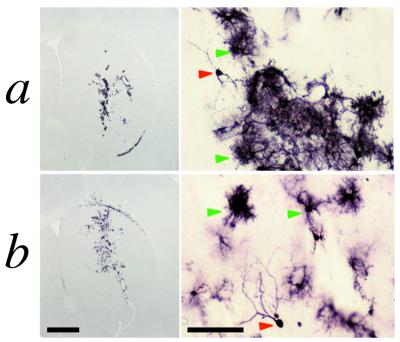
Expression of β-galactosidase seen 6 months after injection of RAd35 (row a) or AdGS46 (row b). Animals were injected with 1.3 × 10⁷ infectious units of vector and were left to survive for 6 months without re-exposure to adenovirus. Brains were subsequently analyzed by immunohistochemistry for β-galactosidase immunoreactivity. Red arrowheads delineate transduced cells with neuronal morphology and green arrowheads delineate astroglial-like cells (the predominant cell-type transduced). [Bar = 1 mm (low magnification images) and 100 μm (high magnification images).]

References

    1. Kaplan J M, Armentano D, Sparer T E, Wynn S G, Peterson P A, Wadsworth S C, Couture K K, Pennington S E, St. George J A, Gooding L R, Smith A E. Hum Gene Ther. 1997;8:45–56. - PubMed
    1. Yang Y, Su Q, Wilson J M. J Virol. 1996;70:7209–7212. - PMC - PubMed
    1. Yang Y, Jooss K U, Su Q, Ertl H C, Wilson J M. Gene Ther. 1996;3:137–144. - PubMed
    1. Dewey R A, Morrissey G, Cowsill C M, Stone D, Bolognani F, Dodd N J F, Southgate T D, Klatzmann D, Lassmann H, Castro M G, Löwenstein P R. Nat Med. 1999;5:1256–1263. - PubMed
    1. Le Gal La Salle G, Robert J J, Berrard S, Ridoux V, Stratford-Perricaudet L D, Perricaudet M, Mallet J. Science. 1993;59:988–990. - PubMed

Publication types