. 2000 Jun;105(11):1563-71.
doi: 10.1172/JCI9711.

Reduction of globotriaosylceramide in Fabry disease mice by substrate deprivation

Affiliations

Reduction of globotriaosylceramide in Fabry disease mice by substrate deprivation

A Abe et al. J Clin Invest. 2000 Jun.

Abstract

We used a potent inhibitor of glucosylceramide synthase to test whether substrate deprivation could lower globotriaosylceramide levels in alpha-galactosidase A (alpha-gal A) knockout mice, a model of Fabry disease. C57BL/6 mice treated twice daily for 3 days with D-threo-1-ethylendioxyphenyl-2-palmitoylamino-3-pyrrolidi no-propanol (D-t-EtDO-P4) showed a concentration-dependent decrement in glucosylceramide levels in kidney, liver, and spleen. A single intraperitoneal injection of D-t-EtDO-P4 resulted in a 55% reduction in renal glucosylceramide, consistent with rapid renal glucosylceramide metabolism. A concentration-dependent decrement in renal and hepatic globotriaosylceramide levels was observed in alpha-Gal A(-) males treated for 4 weeks with D-t-EtDO-P4. When 8-week-old alpha-Gal A(-) males were treated for 8 weeks with 10 mg/kg twice daily, renal globotriaosylceramide fell to below starting levels, consistent with an alpha-galactosidase A-independent salvage pathway for globotriaosylceramide degradation. Complications observed with another glucosylceramide synthase inhibitor, N-butyldeoxynojirimycin, including weight loss and acellularity of lymphatic organs, were not observed with D-t-EtDO-P4. These data suggest that Fabry disease may be amenable to substrate deprivation therapy.


Figures
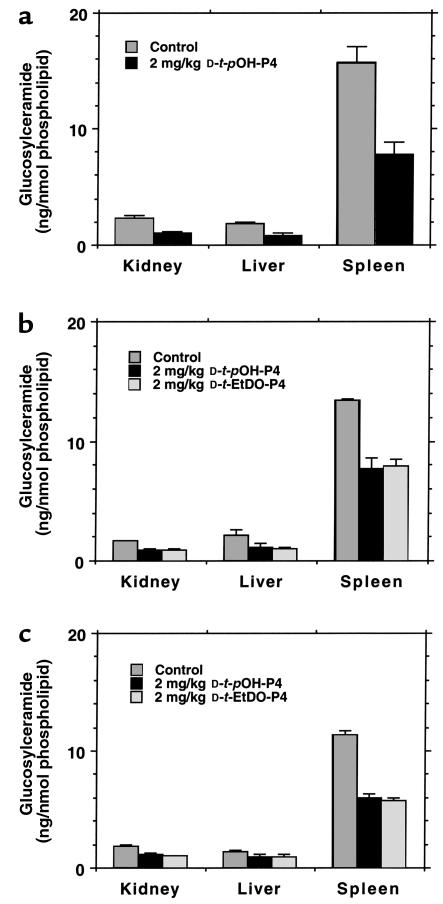
Figure 1
Figure 1
Organ levels of glucosylceramide using alternative vehicles for D-t-EtDO-P4 and D-t-pOH-P4 dispersion in C57BL/6 mice. (a) Corn oil; (b) delipidated mouse albumin; (c) DOPC liposomes. The data represent the mean ± SD (n = 3 for condition and determination). The differences for each inhibitor using each vehicle were significant at P < 0.01 with the exception of liver glucosylceramide levels for albumin and DOPC liposomes. In these cases, P < 0.05.
Figure 2
Figure 2
Concentration-dependent effects of D-t-EtDO-P4 on kidney, liver, and spleen glucosylceramide levels in C57BL/6 mice. The glucosylceramide synthase inhibitor was administered in a DOPC liposomal complex every 12 hours for 3 days. Mice were sacrificed 12 hours after the sixth injection (n = 3 for each time point).
Figure 3
Figure 3
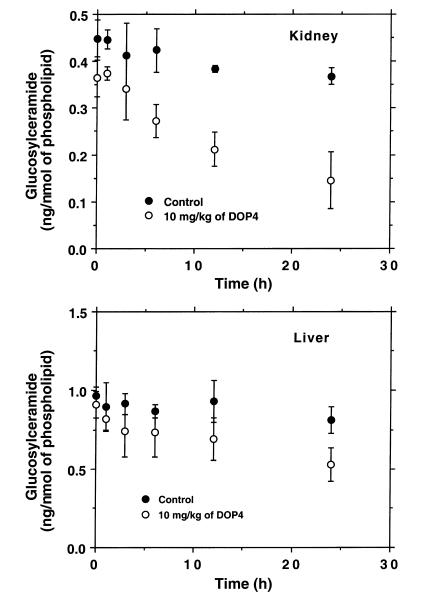
Time-dependent changes in glucosylceramide content of kidney and liver in C57BL/6 mice. A single intraperitoneal injection of DOPC liposomes or a D-t-EtDO-P4 (10 mg/kg) liposomal complex was administered intraperitoneally, and the mice were sacrificed at 1, 3, 6, 12, or 24 hours after injection (n = 3 for each point). For kidney measurements, P < 0.01 at 6, 12, and 24 hours by the paired t test. For liver measurements, P = 0.022 at 24 hours.
Figure 4
Figure 4
Age-dependent changes in Gb3 content of kidney, liver, and heart in α-Gal A males. Data represent Gb3 determinations in three to five per time point and are expressed as the mean ± SD.
Figure 5
Figure 5
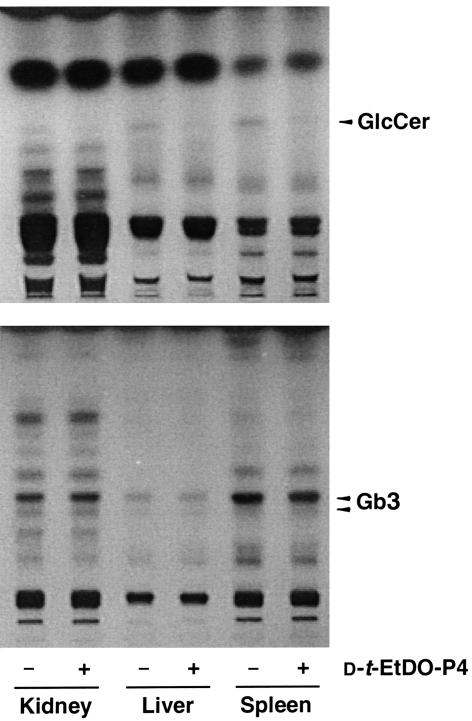
Effect of 3-day treatment with D-t-EtDO-P4 on glucosylceramide and Gb3 content in kidneys of α-Gal A males. Glucosylceramide (GlcCer) and Gb3 were extracted and separated by the two-step solvent systems detailed in Methods. Glucosylceramide levels are visually decreased in the liver and spleens of the mice; no change in Gb3 levels was observed.
Figure 6
Figure 6
(a) Representative thin layer chromatogram of renal glycosphingolipids in α-Gal A males treated for 4 weeks with 10 mg/kg of D-t-EtDO-P4 every 12 hours. (b) Concentration-dependent effects of D-t-EtDO-P4 on kidney and liver Gb3 content in α-glactosidase-A–deficient mice treated for 4 weeks. SM, sphingomyelin.
Figure 7
Figure 7
(a) Daily body weights of α-Gal A males treated with 10 mg/kg of D-t-EtDO-P4 every 12 hours for 8 weeks. (b) Organ weights of α-Gal A males treated with 10 mg/kg of D-t-EtDO-P4 every 12 hours for 8 weeks (n = 7).
Figure 8
Figure 8
Gb3 content of kidney of α-Gal A males treated for 4 or 8 weeks with 10 mg/kg of D-t-EtDO-P4 every 12 hours (n = 5 for 4-week treatments and n = 7 for 8-week treatments). P < 0.01 by paired t test for D-t-EtDO-P4–treated versus liposome-treated mice.
Figure 9
Figure 9
Electron micrographs of renal epithelial cells from α-Gal A males treated with 10 mg/kg of liposomes or D-t-EtDO-P4 every 12 hours for 8 weeks. Representative electron micrographs of renal proximal tubular epithelial cells are demonstrated. (a) Proximal tubular cells from liposome-treated animals contained small myeloid bodies clustered in the apical cytoplasm and less frequently noted elsewhere in the cell. (b) Large lipid-laden inclusions were prominent, particularly toward the basal aspect of the cell. (c) Proximal tubular epithelial cells from D-t-EtDO-P4–treated mice contained small lipid-rich inclusions in the apical cytoplasm immediately beneath the brush border and were virtually devoid of the large lamellated inclusion bodies. The original magnification of all photomicrographs is ×3,280.

References

    1. Desnick, R.J., Ioannou, Y.A., and Eng, C.M. 1995. α-Galactosidase A deficiency: Fabry disease. In The metabolic and molecular bases of inherited disease. 7th edition. C.R. Scriver, A.L. Beaudet, and W.S. Sly, editors. McGraw-Hill. New York, New York, USA. 2741–2784.
    1. Beutler E. Gaucher disease. Curr Opin Hematol. 1997;4:19–23. - PubMed
    1. Schiffmann R, et al. Infusion of alpha-galactosidase A reduces tissue globotriaosylceramide storage in patients with Fabry disease. Proc Natl Acad Sci USA. 2000;97:365–370. - PMC - PubMed
    1. Radin NS. Inhibitors and stimulators of glucocerebroside metabolism. Prog Clin Biol Res. 1982;95:357–383. - PubMed
    1. Ratner L, vander Heyden N, Dedera D. Inhibition of HIV and SIV infectivity by blockade of alpha-glucosidase activity. Virology. 1991;181:180–192. - PubMed

Publication types