. 2000 Jun 6;97(12):6619-24.
doi: 10.1073/pnas.97.12.6619.

Anopheles gambiae pilot gene discovery project: identification of mosquito innate immunity genes from expressed sequence tags generated from immune-competent cell lines

Affiliations

Anopheles gambiae pilot gene discovery project: identification of mosquito innate immunity genes from expressed sequence tags generated from immune-competent cell lines

G Dimopoulos et al. Proc Natl Acad Sci U S A. .

Abstract

Together with AIDS and tuberculosis, malaria is at the top of the list of devastating infectious diseases. However, molecular genetic studies of its major vector, Anopheles gambiae, are still quite limited. We have conducted a pilot gene discovery project to accelerate progress in the molecular analysis of vector biology, with emphasis on the mosquito's antimalarial immune defense. A total of 5,925 expressed sequence tags were determined from normalized cDNA libraries derived from immune-responsive hemocyte-like cell lines. The 3,242 expressed sequence tag-containing cDNA clones were grouped into 2,380 clone clusters, potentially representing unique genes. Of these, 1,118 showed similarities to known genes from other organisms, but only 27 were identical to previously known mosquito genes. We identified 38 candidate genes, based on sequence similarity, that may be implicated in immune reactions including antimalarial defense; 19 of these were shown experimentally to be inducible by bacterial challenge, lending support to their proposed involvement in mosquito immunity.


Figures
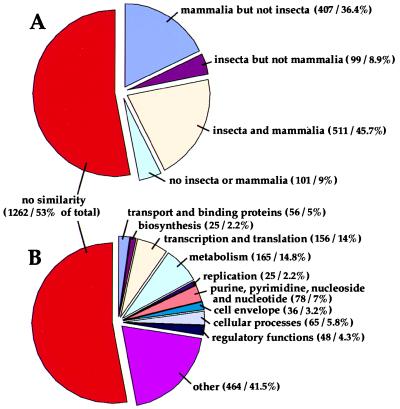
Figure 1
Figure 1
Distribution of clone clusters in gene classes based on blastx E values (24). Of the 2,380 clone clusters, 1,262 (53%) did not show significant similarity (E < 10−4) to genes in the nonredundant swissprot and sptrembl databases. The remaining 1,118 (47%) clone clusters with significant blastx E values are distributed in the gene classes based on their detected similarities. (A) Numbers and percentages of clone clusters with lowest blastx E values to genes from mammalia but not insecta, insecta but not mammalia, insecta and mammalia, and neither insecta nor mammalia. (B) Numbers and percentages of clone clusters with significant blastx E values to known genes belonging to the functional classes as defined earlier (25).
Figure 2
Figure 2
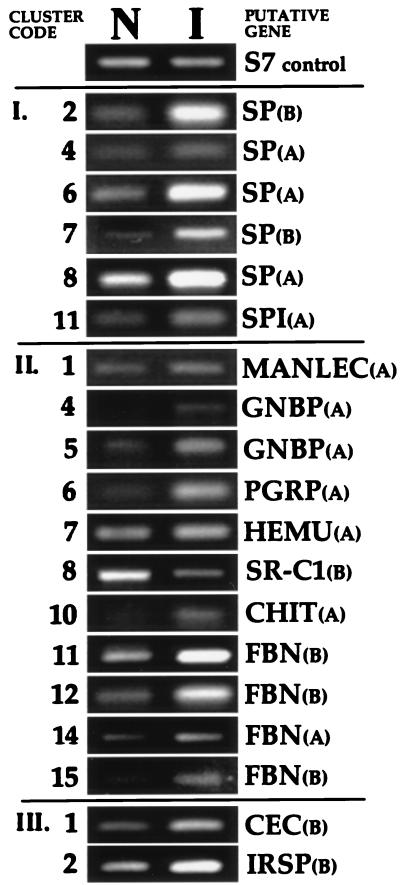
Reverse transcription–PCR expression assays of putative immunity genes in naïve and bacterially challenged cell lines. Expression levels of the 38 A. gambiae putative immunity genes (Tables 2–4) were assayed by reverse transcription–PCR on RNA extracted from a naïve cell line (N) and a cell line that had been incubated with heat-killed E. coli and Micrococcus luteus for 8 h (I) as described (15). The cell line cDNA templates were normalized for the expression of the ribosomal protein S7 gene (S7), and the numbers of PCR cycles were empirically estimated for each transcript to avoid overamplification; specific primers were used for optimal amplification of products ranging in length from 250 to 500 bp at an annealing temperature of 58°C. Of the 38 putative immunity genes, one previously known was shown to be inducible but is not shown (II.3); 18 others, as shown, are transcriptionally activated in the cell lines 4A-3A (A) and 4A-3B (B). One putative receptor (II.8) is repressed by immune challenge.

References

    1. Collins F H. Parasitol Today. 1994;10:370–371. - PubMed
    1. Curtis C F. Parasitol Today. 1994;10:371–374. - PubMed
    1. Ribeiro J M, Nussenzveig R H, Tortorella G. J Med Entomol. 1994;31:747–753. - PubMed
    1. Shen Z, Dimopoulos G, Kafatos F C, Jacobs-Lorena M. Proc Natl Acad Sci USA. 1999;96:6510–6515. - PMC - PubMed
    1. Arcà B, Lombardo F, de Lara Capurro Guimarães M, della Torre A, Dimopoulos G, James A A, Coluzzi M. Proc Natl Acad Sci USA. 1999;96:1516–1521. - PMC - PubMed

Publication types

Associated data