. 2000 Jun 15;20(12):4480-8.
doi: 10.1523/JNEUROSCI.20-12-04480.2000.

Regulation of phosphorylation of the GluR1 AMPA receptor in the neostriatum by dopamine and psychostimulants in vivo

Affiliations

Regulation of phosphorylation of the GluR1 AMPA receptor in the neostriatum by dopamine and psychostimulants in vivo

G L Snyder et al. J Neurosci. .

Abstract

The activation of cAMP-dependent protein kinase regulates the physiological activity of AMPA-type glutamate receptors. In this study, phosphorylation of the AMPA receptor subunit GluR1 at Ser(845) was increased in neostriatal slices by activation of D1-type dopamine receptors and by inhibitors of protein phosphatase 1/protein phosphatase 2A. In contrast, Ser(831), a residue which, when phosphorylated by protein kinase C or calcium/calmodulin-dependent kinase II, increases AMPA receptor channel conductance, was unaffected by either D1 or D2 receptor agonists in neostriatal slices. The phosphorylation of Ser(845), but not Ser(831), was strongly increased in neostriatum in vivo in response to the psychostimulants cocaine and methamphetamine. The effects of dopamine and psychostimulants on the phosphorylation of GluR1 were attenuated in dopamine and cAMP-regulated phosphoprotein M(r) 32 kDa (DARPP-32) knock-out mice. These results identify DARPP-32 and AMPA-type glutamate receptors as likely essential cellular effectors for psychostimulant actions.


Figures
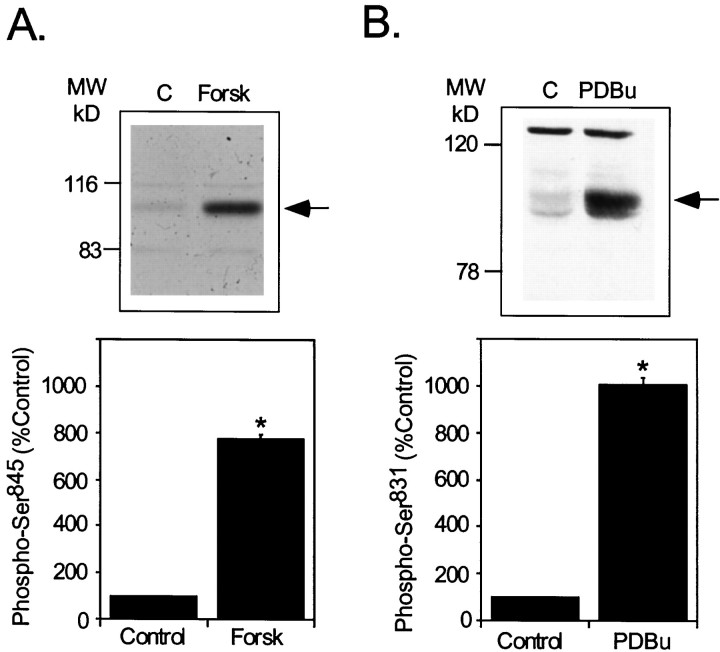
Fig. 1.
Fig. 1.
Effects of protein kinase activators on GluR1 phosphorylation in neostriatal slices. Neostriatal slices were prepared from normal C57BL/6 mice and incubated for 5 min in the absence (Control) or presence of the adenylyl cyclase activator forskolin (A) or the PKC activator PDBu (B). Levels of phospho-Ser845(A) or phospho-Ser831(B) were determined by SDS-PAGE and immunoblotting. Phospho-GluR1 levels were detected, quantitated by densitometry, and expressed as percentage of the level detected in control slices. Arrows (top panels) indicate the position of the phospho-GluR1 bands in representative autoradiograms. Data (bottom panels) are expressed as means ± SEM for three experiments (*p < 0.05 compared with control, Mann–WhitneyU test).
Fig. 2.
Fig. 2.
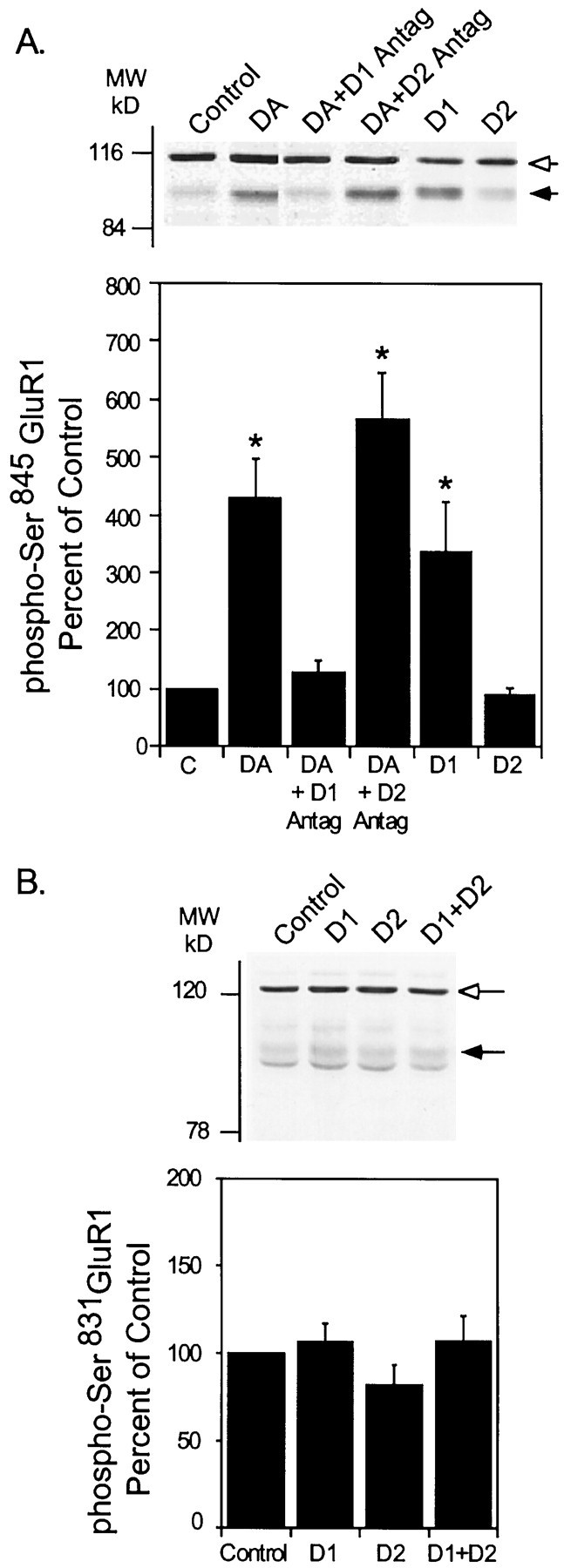
Effect of activation of D1-type or D2-type dopamine receptors on neostriatal GluR1 phosphorylation. Neostriatal slices were prepared from normal C57BL/6 mice. A, At time 0 slices were incubated in the absence or presence of the D1 receptor antagonist SCH23390 (1 μm; D1 Antag) or the D2 receptor antagonist sulpiride (1 μm; D2 Antag), as indicated. At 10 min slices were incubated in normal buffer alone (Control), with dopamine (DA) (100 μm) plus the dopamine uptake inhibitor nomifensine (10 μm), SKF81297 (1 μm) (D1) or quinpirole (1 μm) (D2), with or without SCH23390 or sulpiride for an additional 5 min. B, Slices were incubated with either normal buffer (Control) or with SKF81297 (1 μm) or quinpirole (1 μm) for 5 min. Thesolid arrows indicate the position of phospho-Ser845 GluR1 (A) or phospho-Ser831 GluR1 (B). Theopen arrows indicate cross-reactive bands detected by the phosphorylation state-specific antibody. The intensity of these bands did not change as a function of dopamine agonist or antagonist treatment. Phospho-Ser845 GluR1 (A) or phospho-Ser831 GluR1 (B) was detected in the samples, quantitated by densitometry, and expressed as percentage of the level in control slices. Data are presented as means ± SEM for three experiments (*p < 0.05 compared with control, Mann–Whitney U test).
Fig. 3.
Fig. 3.
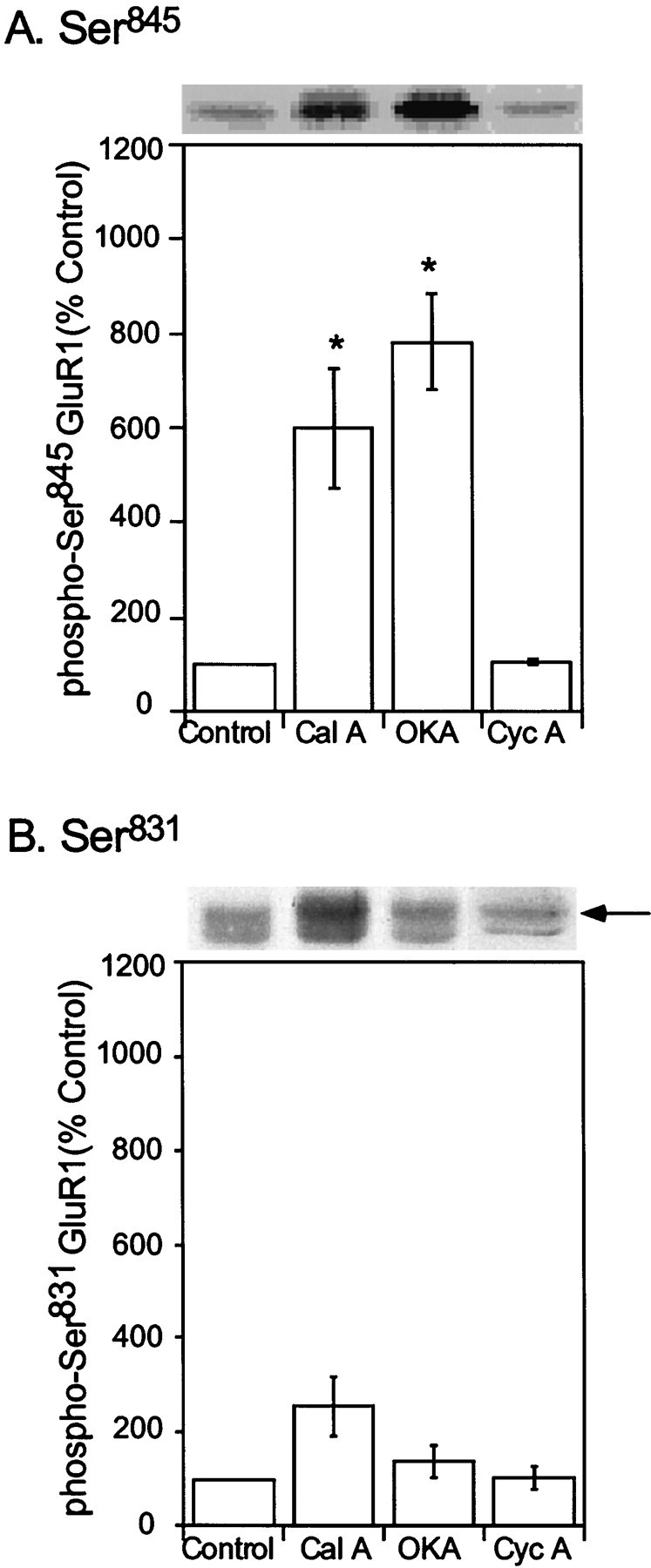
Effects of protein phosphatase inhibitors on the phosphorylation state of neostriatal GluR1 at Ser845and Ser831. Mouse neostriatal slices were incubated for 60 min in the absence (Control) or presence of either okadaic acid (1 μm) (OKA) or calyculin A (0.5 μm) (Cal A), inhibitors of PP1/PP2A, or cyclosporin A (5 μm) (Cyc A), an inhibitor of PP2B. Ser845phospho-GluR1 (A) and Ser831phospho-GluR1 (B) were detected, quantitated by densitometry, and expressed as percentage of the level in control slices. Data are expressed as means ± SEM for three experiments (*p < 0.05 compared with control, Mann–Whitney U test).
Fig. 4.
Fig. 4.
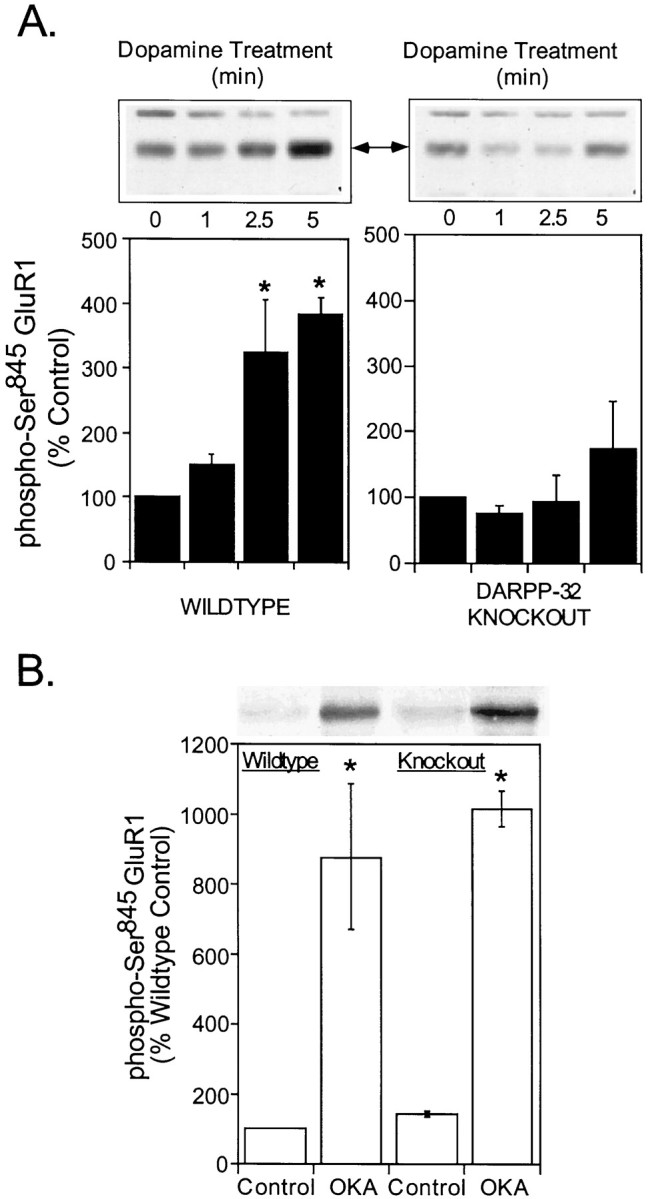
Role of DARPP-32 in the dopamine-induced phosphorylation of neostriatal GluR1 on Ser845.A, Mouse neostriatal slices prepared from wild-type mice (left) or DARPP-32 knock-out mice (right) were incubated in the absence or presence of dopamine (100 μm) plus nomifensine (10 μm) for the indicated times. Samples were immunoblotted for Ser845-phosphorylated GluR1. The level of phospho-GluR1 was quantitated by densitometry, and the data were expressed as percentage of either the wild-type or knock-out control level. The results are expressed as means ± SEM for five experiments (*p < 0.05 compared with 0 time, Mann–Whitney U test). B, Slices from wild-type or knock-out mice were incubated with a maximally effective concentration of the PP1/2A inhibitor, okadaic acid (OKA; 1 μm) for 60 min. The level of phospho-Ser845 GluR1 was quantitated by densitometry, and the data were expressed as percentage of the wild-type control level. Results are expressed as means± SEM for three experiments (*p < 0.05 compared with control, Mann–Whitney U test).
Fig. 5.
Fig. 5.
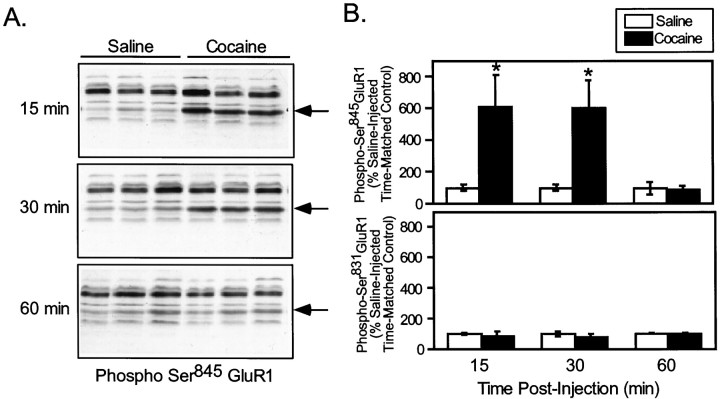
Effect of acute cocaine on neostriatal GluR1 phosphorylation at Ser845 and Ser831in vivo. Normal C57Bl/6 mice were injected (intraperitoneally) with vehicle alone (Saline) or with vehicle containing cocaine (20 mg/kg) and killed by focused microwave irradiation at 15, 30, or 60 min after injection. Neostriatum was dissected from each brain and analyzed for phospho-Ser845 and phospho-Ser831 GluR1. The arrowsindicate the position of GluR1, as verified by immunoblotting with an antibody against a C-terminal sequence of GluR1. A,Representative experiment showing immunoblots of phospho-Ser845 GluR1 from three individual animals for each treatment condition. B, Quantitation of phospho-Ser845 and phospho-Ser831in three experiments, each analyzed in triplicate (*p < 0.05, compared with saline; Mann–WhitneyU test).
Fig. 6.
Fig. 6.
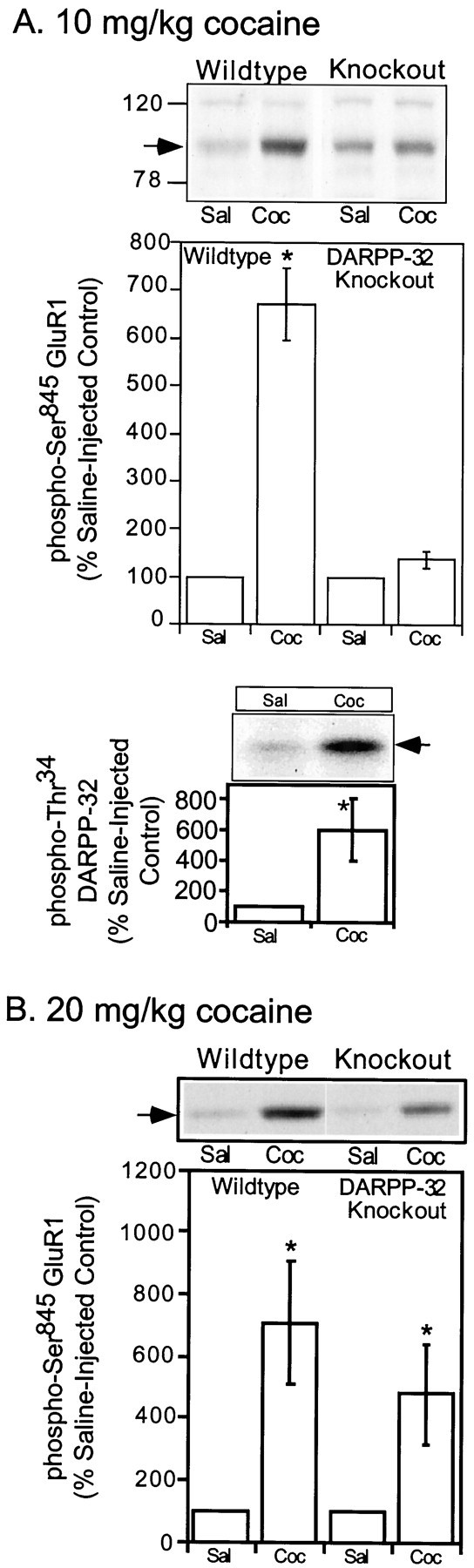
Effect of acute cocaine on in vivophosphorylation of GluR1 at Ser845: comparison of wild-type and DARPP-32 knock-out mice. Wild-type or DARPP-32 knock-out mice were injected (intraperitoneally) with saline vehicle (Sal) or with (10 mg/kg) (A) or (20 mg/kg) (B) cocaine (Coc) and killed by focused microwave irradiation 30 min later. The levels of phospho-Ser845 GluR1 and phospho-Thr34 DARPP-32 were detected in neostriatum by immunoblotting, and the data were quantitated by densitometry.Arrows indicate the position of phospho-GluR1 and phospho-DARPP-32 bands. A, Top, An autoradiogram of a representative experiment shows the level of phospho-GluR1 in saline-injected or cocaine-injected wild-type and DARPP-32 knock-out mice. The bar graph summarizes phospho-Ser845 GluR1 levels in the neostriatum of the wild-type and knock-out mice. Data are expressed as means ± SEM for eight mice per group (*p < 0.01 compared with saline-injected mice; Student's t test).A, Bottom, A typical autoradiogram shows the level of phospho-DARPP-32 in a saline-injected and a cocaine-injected wild-type mouse neostriatum. The bar graph shows phospho-Thr34DARPP-32 levels in the neostriata of mice. Data are expressed as means± SEM for four mice per group (*p< 0.05 compared with saline-injected mice; Mann–WhitneyU test). B, Data are expressed as means± SEM for 3–5 mice per group (*p< 0.05 compared with respective saline-injected controls; Mann–Whitney U test).
Fig. 7.
Fig. 7.
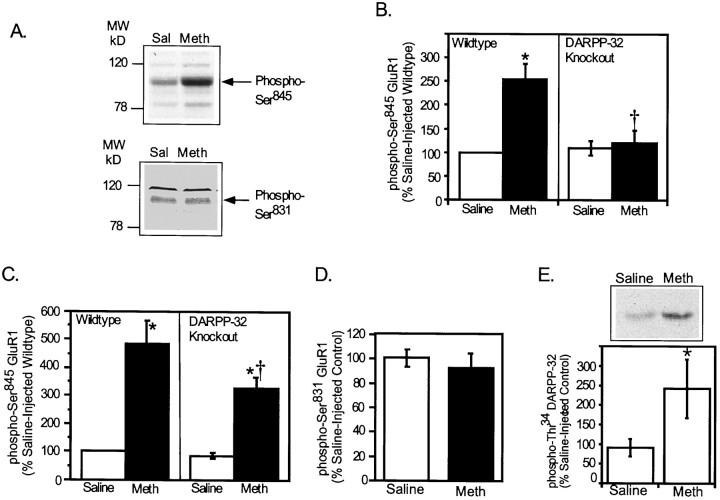
Effect of acute methamphetamine administration onin vivo phosphorylation of GluR1 at Ser845 and Ser831 in wild-type and DARPP-32 knock-out mice. Wild-type (A–E) or DARPP-32 knock-out (B, C) mice were injected with vehicle or methamphetamine (Meth) 20 mg/kg (subcutaneously) (B, D, E) or 30 mg/kg (A, C) and killed by focused microwave irradiation 30 min later. Neostriatal phospho-Ser845GluR1 (A–C) and phospho-Ser831 GluR1 (A, D) and phospho-Thr34 DARPP-32 (E) were detected by immunoblotting and quantitated by densitometry. Data are expressed as percentage of values for saline-injected wild-type mice and represent means ± SEM for nine (B, C), three (D), or eight animals (E) per group (*p < 0.05 compared with saline-injected mice; †p < 0.05, compared with wild-type Meth alone; Students' ttest).

References

    1. Allen PB, Ouimet CC, Greengard P. Spinophilin, a novel protein phosphatase 1 binding protein localized to dendritic spines. Proc Natl Acad Sci USA. 1997;94:9956–9961. - PMC - PubMed
    1. Barria A, Muller D, Derkach V, Griffith LC, Soderling TR. Regulatory phosphorylation of AMPA-type glutamate receptors by CaM-KII during long-term potentiation. Science. 1997;276:2042–2045. - PubMed
    1. Bibb JA, Snyder GL, Nishi A, Yan Z, Meijer L, Fienberg AA, Tsai L-H, Kwon YT, Girault J-A, Czernik AJ, Huganir RL, Hemmings HC, Jr, Nairn AC, Greengard P. Phosphorylation of DARPP-32 by Cdk5 modulates dopamine signalling in neurons. Nature. 1999;402:669–671. - PubMed
    1. Blackstone CD, Murphy TH, Moss SJ, Baraban JM, Huganir RL. Cyclic AMP and synaptic activity-dependent phosphorylation of AMPA-preferring glutamate receptors. J Neurosci. 1994;14:7585–7593. - PMC - PubMed
    1. Bliss TVP, Collingridge GL. Synaptic model of memory: long-term potentiation in the hippocampus. Nature. 1993;361:31–39. - PubMed

Publication types

MeSH terms

LinkOut - more resources