. 2000 Jul;20(13):4838-48.
doi: 10.1128/MCB.20.13.4838-4848.2000.

Bypass of a meiotic checkpoint by overproduction of meiotic chromosomal proteins

Affiliations

Bypass of a meiotic checkpoint by overproduction of meiotic chromosomal proteins

J M Bailis et al. Mol Cell Biol. 2000 Jul.

Abstract

The Saccharomyces cerevisiae zip1 mutant, which exhibits defects in synaptonemal complex formation and meiotic recombination, triggers a checkpoint that causes cells to arrest at the pachytene stage of meiotic prophase. Overproduction of either the meiotic chromosomal protein Red1 or the meiotic kinase Mek1 bypasses this checkpoint, allowing zip1 cells to sporulate. Red1 or Mek1 overproduction also promotes sporulation of other mutants (zip2, dmc1, hop2) that undergo checkpoint-mediated arrest at pachytene. In addition, Red1 overproduction antagonizes interhomolog interactions in the zip1 mutant, substantially decreasing double-strand break formation, meiotic recombination, and homologous chromosome pairing. Mek1 overproduction, in contrast, suppresses checkpoint-induced arrest without significantly decreasing meiotic recombination. Cooverproduction of Red1 and Mek1 fails to bypass the checkpoint; moreover, overproduction of the meiotic chromosomal protein Hop1 blocks the Red1 and Mek1 overproduction phenotypes. These results suggest that meiotic chromosomal proteins function in the signaling of meiotic prophase defects and that the correct stoichiometry of Red1, Mek1, and Hop1 is needed to achieve checkpoint-mediated cell cycle arrest at pachytene.


Figures
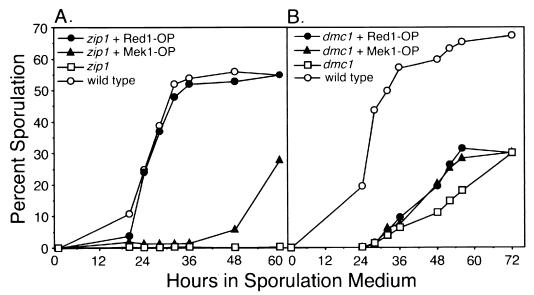
FIG. 1
FIG. 1
Sporulation of zip1 and dmc1 mutant strains overproducing Red1 or Mek1. (A) zip1 + Red1-OP, zip1 mutant overproducing Red1 (JM155); zip1 + Mek1-OP, zip1 mutant overproducing Mek1 (JM154); zip1, zip1 mutant carrying vector only (YEp352) (JM153); wild type, wild-type strain containing vector only (JM474). (B) dmc1 + Red1-OP, dmc1 mutant overproducing Red1 (JM161); dmc1 + Mek1-OP, dmc1 mutant overproducing Mek1 (JM160); dmc1, dmc1 mutant carrying vector only (YEp351) (JM159); wild type, wild-type strain containing vector only (JM152). Percent sporulation was calculated from triplicate cultures harvested at the times indicated; values shown are averages.
FIG. 2
FIG. 2
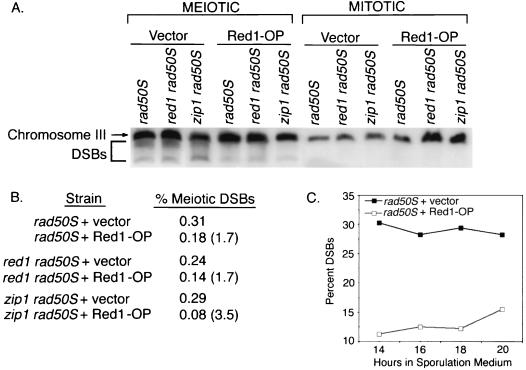
Effect of Red1 overproduction on DSB formation. (A) Mitotic (0 h) and meiotic (15 h) cells were analyzed for chromosome III DSBs by pulsed-field gel electrophoresis and Southern blotting. Mutant strains used were as follows: rad50S plus vector (JM446), red1 rad50S plus vector (JM442), zip1 rad50S plus vector (JM438), rad50S overproducing Red1 (Red1-OP) (JM447), red1 rad50S overproducing Red1 (JM443), and zip1 rad50S overproducing Red1 (JM439). DSBs migrate below the position of the full-length chromosome III. Both a discrete band (representing the fragment from the end of the chromosome to the THR4 hot spot) and fragments corresponding to the products of cleavage at other DSB sites are observed. (B) Quantitation of the results shown in panel A. % Meiotic DSBs, the amount of chromosome III DNA in broken molecules as a percent of the total amount of chromosome III DNA. Numbers in parentheses indicate the fold decrease in percent DSBs of strains overproducing Red1 compared to strains carrying vector only. (C) DSBs in rad50S strains carrying either vector (JM446) or overproducing Red1 (JM447) were analyzed at several time points during meiosis. Percent DSBs, the amount of chromosome III DNA in broken molecules as a percent of the total amount of chromosome III DNA.
FIG. 3
FIG. 3
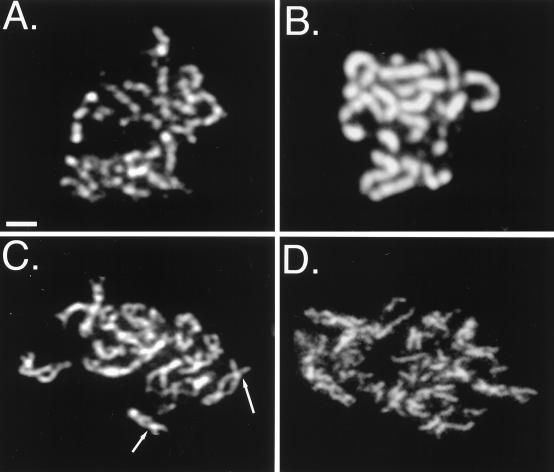
Red1 overproduction alters meiotic chromosome morphology. (A) Spread nucleus from a wild-type strain carrying the YEp352 vector (JM152). (B) Spread nucleus from a wild-type strain overproducing Red1 (BS354). (C) Spread nucleus from the zip1 mutant carrying the YEp352 vector only (JM153); arrows indicate examples of axial associations. (D) Spread nucleus from a zip1 mutant overproducing Red1 (JM155). Scale bar, 1 μm.
FIG. 4
FIG. 4
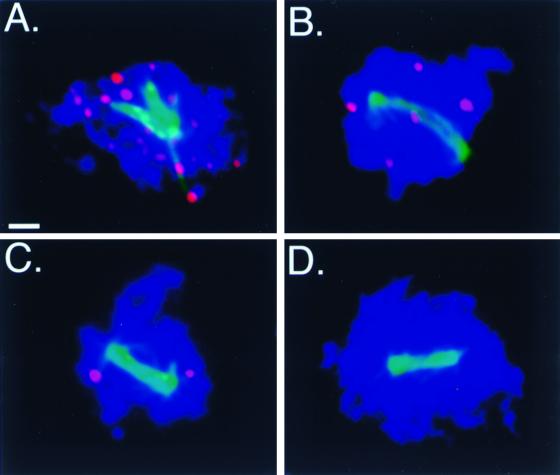
Most DSBs are repaired when the checkpoint is bypassed. Meiotic chromosomes were surface spread and then labeled in situ with Tdt (red) to detect DSBs. Antitubulin antibody (green) was used to visualize meiotic spindles (indicating that cells are no longer arrested at pachytene). Strains tested were as follows: (A) zip1 mutant carrying vector only (YEp352) (JM152), (B) zip1 mutant overproducing Red1 (JM155), (C) zip1 mutant overproducing Mek1 (JM154), (D) wild-type strain carrying vector only (YEp352) (JM152). Scale bar, 1 μm.
FIG. 5
FIG. 5
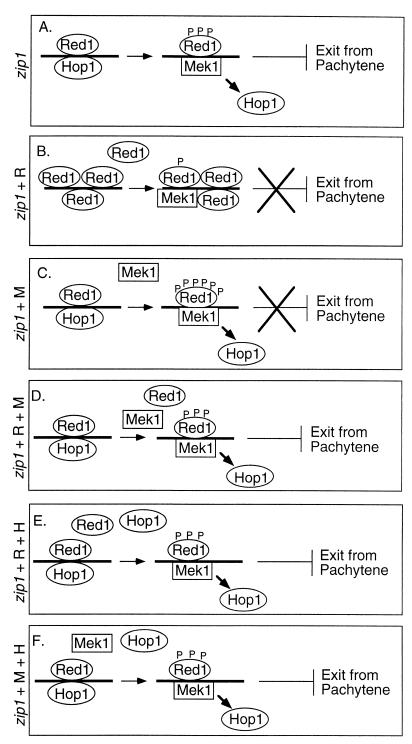
Model for bypass of checkpoint-mediated arrest by overproduction of Red1 or Mek1. (A) In the zip1 mutant, continued Red1 phosphorylation serves as an inhibitory signal that prevents pachytene exit. (B) When Red1 is overproduced in the zip1 mutant, the excess Red1 protein may be inefficiently phosphorylated, resulting in little or no detectable signal to the checkpoint. (C) Overproduction of Mek1 in the zip1 mutant may result in excess or inappropriate phosphorylation of Red1, such that Red1 is not properly detected by the checkpoint machinery. (D) Cooverproduction of Mek1 and Red1 restores the appropriate phosphorylation of Red1, allowing proper checkpoint function. (E) Cooverproduction of Hop1 and Red1 may promote interaction between Red1 and Mek1, leading to Red1 phosphorylation. (F) Cooverproduction of Hop1 and Mek1 also may promote correct phosphorylation of Red1. P, phosphate group; R, Red1 overproduction; M, Mek1 overproduction; H, Hop1 overproduction.

References

    1. Alani E, Padmore R, Kleckner N. Analysis of wild-type and rad50 mutants of yeast suggests an intimate relationship between meiotic chromosome synapsis and recombination. Cell. 1990;61:419–436. - PubMed
    1. Bailis J M, Roeder G S. Synaptonemal complex morphogenesis and sister-chromatid cohesion require Mek1-dependent phosphorylation of a meiotic chromosomal protein. Genes Dev. 1998;22:3551–3563. - PMC - PubMed
    1. Bailis J M, Roeder G S. Pachytene exit controlled by reversal of Mek1-dependent phosphorylation. Cell. 2000;101:211–221. - PubMed
    1. Bishop D, Park D, Xu L, Kleckner N. DMC1: a meiosis-specific yeast homolog of E. coli recA required for recombination, synaptonemal complex formation, and cell cycle progression. Cell. 1992;69:439–456. - PubMed
    1. Bishop D K. RecA homologs Dmc1 and Rad51 interact to form multiple nuclear complexes prior to meiotic chromosome synapsis. Cell. 1994;79:1081–1092. - PubMed

Publication types

MeSH terms