


doi: 10.1128/JB.182.12.3590-3592.2000.
In vivo splicing and functional characterization of Mycobacterium leprae RecA
Affiliations
- PMID: 10852894
- PMCID: PMC101971
- DOI: 10.1128/JB.182.12.3590-3592.2000
Item in Clipboard
In vivo splicing and functional characterization of Mycobacterium leprae RecA
J Bacteriol.
2000 Jun.
Abstract
The RecA proteins from Mycobacterium tuberculosis and Mycobacterium leprae contain inteins. In contrast to the M. tuberculosis RecA, the M. leprae RecA is not spliced in Escherichia coli. We demonstrate here that M. leprae RecA is functionally spliced in Mycobacterium smegmatis and produces resistance toward DNA-damaging agents and homologous recombination.
Figures
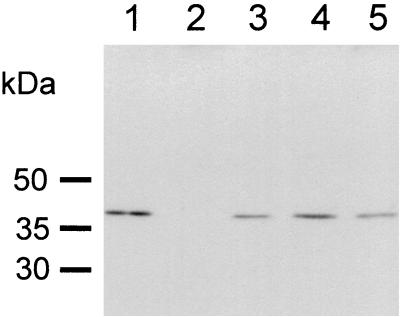
Detection of mycobacterial RecA protein in extracts from M. smegmatis. Lane 1, mc2 155 SMR5; lane 2, KS recA::aph; lane 3, KS recA::aph/recA+ (M. smegmatis); lane 4, KS recA::aph/recA+ (M. tuberculosis); lane 5, KS recA::aph/recA+ (M. leprae L58a). Approximately 10 μg of protein was loaded on a 12.5% sodium dodecyl sulfate gel, electroblotted, and developed following incubation with antiserum raised against M. tuberculosis RecA. The antiserum cross-reacts with the RecA proteins from M. leprae, M. tuberculosis, and M. smegmatis.
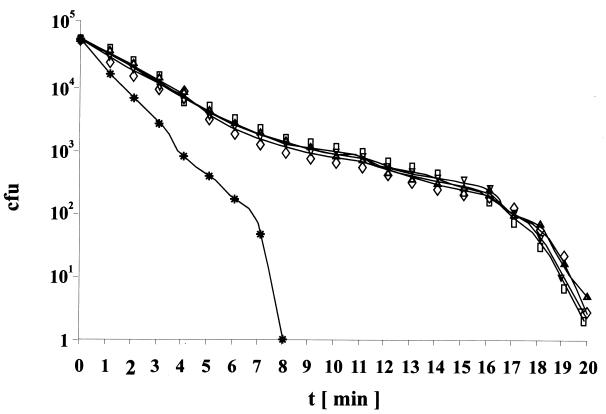
UV resistance of M. smegmatis recA mutant complemented with recA from M. smegmatis, M. tuberculosis, and M. leprae. Symbols: triangles, M. smegmatis mc2 155 SMR5; stars, KS recA::aph; diamonds, KS recA::aph/recA+ (M. smegmatis); inverted triangles, KS recA::aph/recA+ (M. tuberculosis); rectangles, KS recA::aph/recA+ (M. leprae L58a). The ability to form colonies after UV irradiation was determined by plating dilutions on 7H10 agar plates. The number of CFU was calculated after 3 days of incubation at 37°C.
References
-
- Colston M J, Davis E O. The ins and outs of protein splicing elements. Mol Microbiol. 1994;12:359–363. - PubMed
-
- Davis E O, Jenner P J, Brooks P C, Colston M J, Sedgwick S G. Protein splicing in the maturation of M. tuberculosis RecA protein: a mechanism for tolerating a novel class of intervening sequence. Cell. 1992;71:201–210. - PubMed
-
- Frischkorn K, Sander P, Scholz M, Teschner K, Prammananan T, Böttger E C. Investigation of mycobacterial recA function: protein introns in the RecA of pathogenic mycobacteria do not affect competency for homologous recombination. Mol Microbiol. 1998;29:1203–1214. - PubMed
Publication types
MeSH terms
Substances
LinkOut - more resources
Full Text Sources
