


doi: 10.1128/JB.182.12.3602-3606.2000.
First evidence for existence of an uphill electron transfer through the bc(1) and NADH-Q oxidoreductase complexes of the acidophilic obligate chemolithotrophic ferrous ion-oxidizing bacterium Thiobacillus ferrooxidans
Affiliations
- PMID: 10852897
- PMCID: PMC101977
- DOI: 10.1128/JB.182.12.3602-3606.2000
Item in Clipboard
First evidence for existence of an uphill electron transfer through the bc(1) and NADH-Q oxidoreductase complexes of the acidophilic obligate chemolithotrophic ferrous ion-oxidizing bacterium Thiobacillus ferrooxidans
J Bacteriol.
2000 Jun.
Abstract
The energy-dependent electron transfer pathway involved in the reduction of pyridine nucleotides which is required for CO(2) fixation to occur in the acidophilic chemolithotrophic organism Thiobacillus ferrooxidans was investigated using ferrocytochrome c as the electron donor. The experimental results show that this uphill pathway involves a bc(1) and an NADH-Q oxidoreductase complex functioning in reverse, using an electrochemical proton gradient generated by ATP hydrolysis. Based on these results, a model is presented to explain the balance of the reducing equivalent from ferrocytochrome c between the exergonic and endergonic electron transfer pathways.
Figures
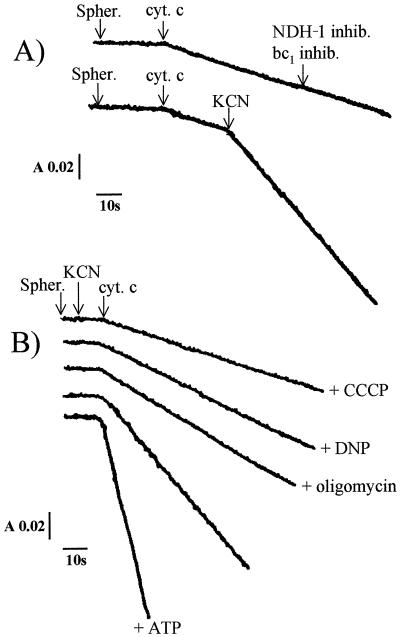
(A) Oxidation of ferrocytochrome c (cyt. c) (10 μM) measured at 550-540 nm with T. ferrooxidans spheroplasts (spher.). Effects of the various bc1 (antimycin, HQNO, funiculosin, myxothiazol, and stigmatellin) and NDH-1 (rotenone, amobarbital, and atabrine) complex inhibitors (inhib.) and of KCN addition are shown. (B) Oxidation of ferrocytochrome c (10 μM) measured at 550-540 nm with T. ferrooxidans spheroplasts in the presence of KCN. Effects of protonophores (CCCP and DNP), oligomycin, and ATP are shown. The protein (4 mg/ml) was suspended in 20 mM β-alanine–H2SO4 buffer, pH 3.5. See the text for inhibitor, ATP, and uncoupler concentrations. A, absorbance; s, seconds.
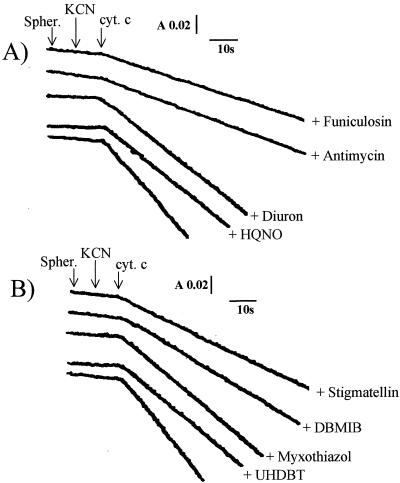
The uphill electron transfer chain in T. ferrooxidans. Effects of the various bc1 complex inhibitors on the oxidation of ferrocytochrome c (cyt. c) in spheroplasts (spher.), in the presence of KCN, are shown. (A) Qn site inhibitors; (B) Qp site inhibitors. Experimental conditions are as described in the legend to Fig. 1 and in the text. Protein concentration, 5 mg/ml. A, absorbance; s, seconds.
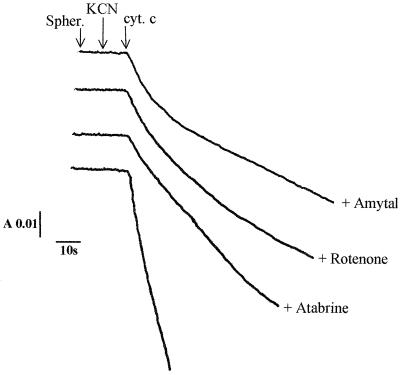
The uphill electron transfer chain in T. ferrooxidans. Effects of the various NDH-1 complex inhibitors on the oxidation of ferrocytochrome c (cyt. c) in spheroplasts (spher.), in the presence of KCN, are shown. Experimental conditions are as described in the legend to Fig. 1 and in the text. Protein concentration, 5 mg/ml. A, absorbance; s, seconds.
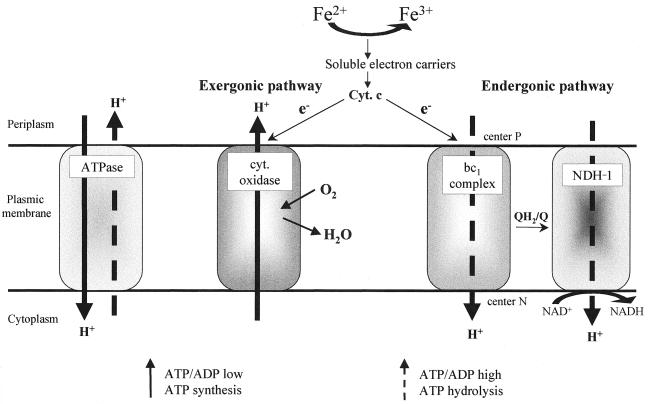
Model for the balance of reducing equivalents from ferrocytochrome c between the exergonic cytochrome oxidase and the endergonic bc1 and NDH-1 pathways. The Qp (center P) and Qn (center N) sites are defined in the text.
References
-
- Aleem M I H, Lees H, Nicholas D J D. ATP dependent reduction of NAD+ by ferrocytochrome c in chemoautotrophic bacteria. Nature. 1963;200:759–761. - PubMed
-
- Aleem M I H. Generation of reducing power in chemosynthesis. II. Energy linked reduction of pyridine nucleotides in chemoautotroph Nitrosomonas europaea. Biochim Biophys Acta. 1966;113:216–224. - PubMed
-
- Aleem M I H. Coupling of energy with electron transfer reactions in chemolithotrophic bacteria. Symp Soc Gen Microbiol. 1977;27:351–381.
-
- Arnold S, Kadenbach B. Cell respiration is controlled by ATP, an allosteric inhibitor of cytochrome-c oxidase. Eur J Biochem. 1997;249:350–354. - PubMed
MeSH terms
Substances
LinkOut - more resources
Full Text Sources
