. 2000 Jun;12(6):901-15.
doi: 10.1105/tpc.12.6.901.

Repression of shoot growth, a bZIP transcriptional activator, regulates cell elongation by controlling the level of gibberellins

Affiliations

Repression of shoot growth, a bZIP transcriptional activator, regulates cell elongation by controlling the level of gibberellins

J Fukazawa et al. Plant Cell. 2000 Jun.

Abstract

Cell expansion, a developmental process regulated by both endogenous programs and environmental stimuli, is critically important for plant growth. Here, we report the isolation and characterization of RSG (for repression of shoot growth), a transcriptional activator with a basic leucine zipper (bZIP) domain. To examine the role of RSG in plant development, we generated transgenic tobacco plants expressing a dominant-negative form of RSG, which repressed the activity of full-length RSG. In transgenic plants, this expression severely inhibited stem internode growth, specifically cell elongation. These plants also had less endogenous amounts of the major active gibberellin (GA) in tobacco, GA(1). Applying GAs restored the dwarf phenotypes of transgenic tobacco plants that expressed the dominant-negative form of RSG. To investigate the function of RSG in the regulation of the endogenous amounts of GAs, we identified a target for RSG. RSG bound and activated the promoter of Arabidopsis GA3, one of the genes encoding enzymes involved in GA biosynthesis. Moreover, the dominant-negative form of RSG decreased expression of the GA3 homolog in transgenic tobacco plants. Our results show that RSG, a bZIP transcriptional activator, regulates the morphology of plants by controlling the endogenous amounts of GAs.


Figures
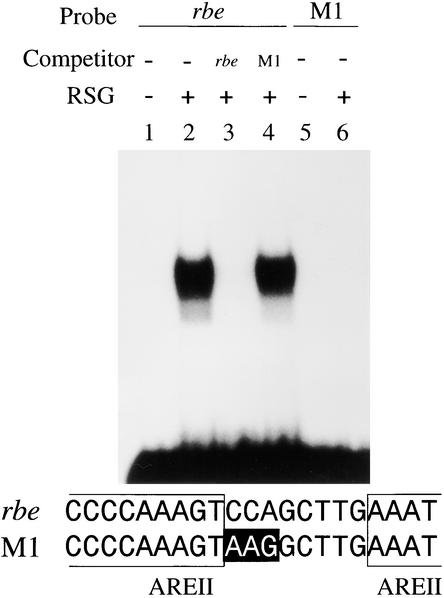
Figure 1.
Figure 1.
Sequence-Specific Binding of RSG. Recombinant RSG was used in a gel retardation assay. rbe was used as a probe for lanes 1 to 4, and M1 was used as a probe for lanes 5 and 6. The DNA sequences of oligonucleotides used as probes are shown. The mutated bases in M1 are highlighted. rbe was generated in the process of dimerizing AREII. The sequences from AREII are boxed. (+), addition to the reaction mixtures; (−), omission from the reaction mixtures.
Figure 2.
Figure 2.
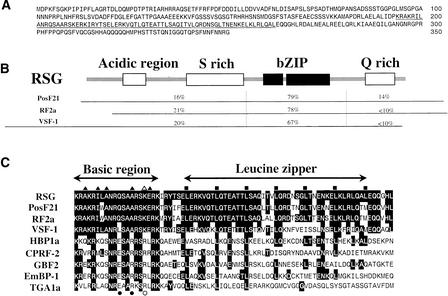
Predicted Amino Acid Sequence and Domain Structure of RSG. (A) Deduced amino acid sequence of RSG. The bZIP domain is underlined. The GenBank accession number of RSG cDNA is AB040471. (B) Schematic domain structure of RSG. The amino acid sequence identities with PosF21, RF2a, and VSF-1 are also indicated. (C) Alignment of amino acid sequences in the bZIP region. Sequences of the bZIP domain of RSG were compared with those of PosF21 (Aeschbacher et al., 1991), RF2a (Yin et al., 1997), VSF-1 (Torres-Schumann et al., 1996), HBP1a (Tabata et al., 1989), CPRF-2 (Weisshaar et al., 1991), GBF2 (Schindler et al., 1992b), EmBP-1 (Guiltinan et al., 1990), and TGA1a (Katagiri et al., 1989). Highlighted residues indicate amino acids that are identical to those of RSG. Squares indicate the position of leucine residues conserved in the bZIP proteins. Triangles indicate the amino acid residues specifically conserved among RSG, PosF21, RF2a, and VSF-1 in the basic region. Circles indicate the amino acid residues conserved among other plant bZIP proteins in the basic region. The open triangles and circles indicate the amino acid residues at position −10 relative to the first leucine residue in the leucine zipper region, which are important for DNA binding specificity.
Figure 3.
Figure 3.
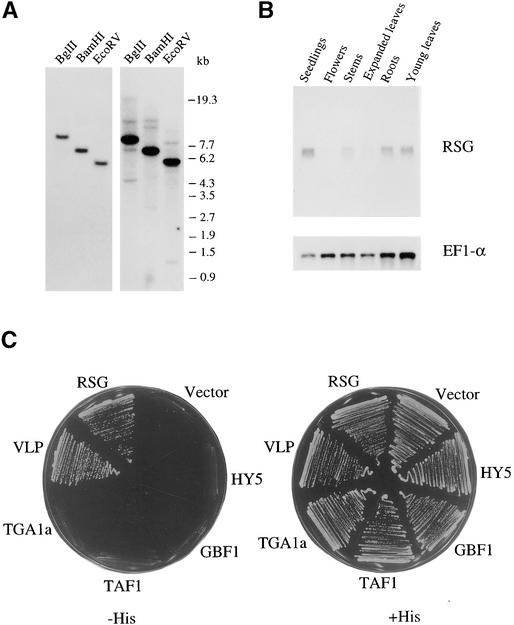
Genomic Organization and Expression of RSG. (A) DNA gel blot analysis of RSG. Ten micrograms of genomic DNA was digested with the indicated enzymes and probed with a 32P-labeled DNA fragment corresponding to the bZIP domain of RSG. At left, under stringent hybridization conditions; at right, under less stringent hybridization conditions. Length markers are indicated at right in kilobases. (B) RNA gel blot analysis of RSG mRNA. One microgram of poly(A)+ RNA isolated from the indicated organs was used for gel blot analysis under stringent hybridization conditions. The blot was hybridized with radiolabeled RSG cDNA and then reprobed with EF1-α cDNA as a loading control. (C) Specificity of dimerization of RSG. Interactions between RSG and other plant bZIP proteins were assayed by using the yeast two-hybrid system. Yeast cells HF7c were simultaneously transformed with a plasmid expressing a GAL4 DNA binding domain fused to the bZIP domain of RSG and with plasmids expressing the GAL4 activation domain fused to the bZIP domains of the indicated RSG, VLP (a RSG-related protein), TGA1a, TAF1, GBF1, HY5, or a control vector. Cells containing both plasmids were streaked on the plates with (+His) or without (−His) histidine but with 0.2 mM 3-aminotriazole.
Figure 4.
Figure 4.
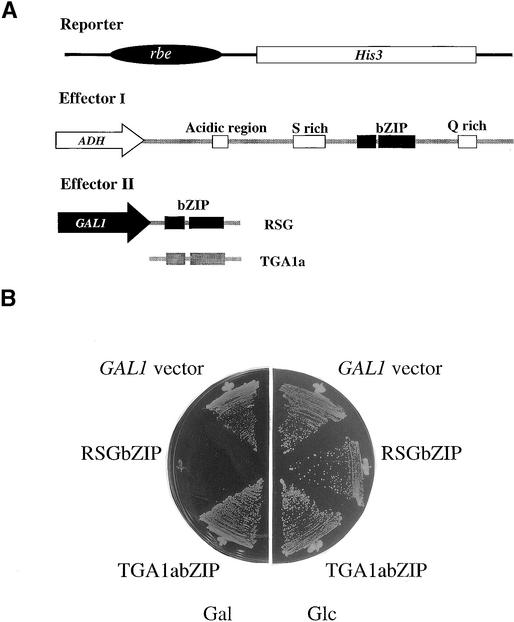
Dominant-Negative Effect of the bZIP Domain of RSG in Yeasts. (A) Schematic representation of the structures of the reporter and effectors. Effector I expresses full-length RSG. Effector II expresses the bZIP domain of RSG or TGA1a. (B) Inhibition of full-length RSG by the bZIP domain of RSG in yeasts. The plasmids pLysGAL1bZIPRSG (encoding the bZIP domain of RSG), pLysGAL1bZIPTGA1a (encoding the bZIP domain of TGA1a), or pLysGAL1 (for a control vector) were transformed with pLeuGADHRSG, which expressed the full-length RSG under the control of an ADH promoter, and selected on a medium without lysine or leucine. Yeast strain YPH499 carrying AREII × 2-HIS3 was used as a host. The transformants were streaked on media without histidine, lysine, or leucine but with 0.2 mM 3-aminotriazole containing galactose (Gal; left) or glucose (Glc; right).
Figure 5.
Figure 5.
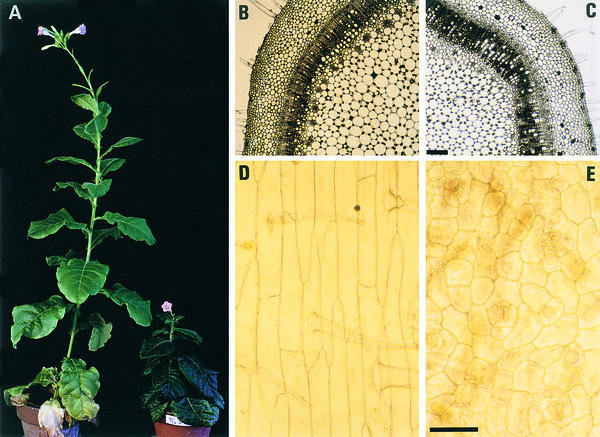
Phenotypes of Transgenic Tobacco Plants Expressing the bZIP Domain of RSG. (A) Comparison of SR1 tobacco (left) and the transgenic tobacco harboring the 35S:RSGbZIP construct (right). (B) Transverse section of the eighth internode of control SR1 tobacco. (C) Transverse section of the eighth internode of the transgenic tobacco harboring the 35S:RSGbZIP construct. (D) Morphology of epidermal cells of the seventh internode of SR1 tobacco. (E) Morphology of epidermal cells of the seventh internode of the transgenic tobacco harboring the 35S:RSGbZIP construct. formula image; formula image.
Figure 6.
Figure 6.
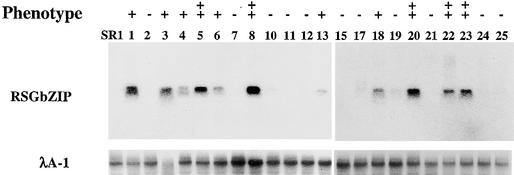
RNA Gel Blot Analysis of Transgenic Tobacco Plants Harboring the 35S:RSGbZIP Construct. Ten micrograms of total RNA extracted from an expanded leaf was subjected to electrophoresis, transferred to Biodyne B (Pall, East Hills, NY) membrane, and hybridized with the DNA corresponding to the bZIP domain (amino acids 164 to 286) and λA-1 encoding one of the rRNAs as a control. +, transgenic tobacco plants showing altered morphology; ++, transgenic tobacco plants showing severe phenotypes (i.e., internode length <20% of control SR1); − , transgenic tobacco plants showing no altered morphology.
Figure 7.
Figure 7.
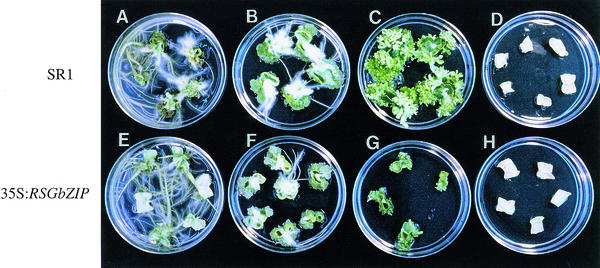
Growth of Organs of Transgenic Tobacco Plants Expressing the bZIP Domain of RSG. The squares of leaves from the R1 35S:RSGbZIP transgenic tobacco (line 8) and SR1 tobacco were cut into 10 × 10-mm squares and cultured for 4 weeks on Murashige and Skoog medium (Murashige and Skoog, 1962). (A) and (E) Plates containing 2 mg/L IAA and 0.02 mg/L kinetin for the root. (B) and (F) Plates containing 2 mg/L IAA and 0.20 mg/L kinetin for the callus. (C) and (G) Plates containing 0.02 mg/L IAA and 2 mg/L kinetin for the shoot. (D) and (H) Plates containing no hormone as a control. Plates (A) to (D) were used for leaves from control SR1 tobacco plants. Plates (E) to (H) were used for leaves from the transgenic tobacco expressing the bZIP domain of RSG. All plates contained 250 mg/L vancomycin and 100 mg/L carbenicillin.
Figure 8.
Figure 8.
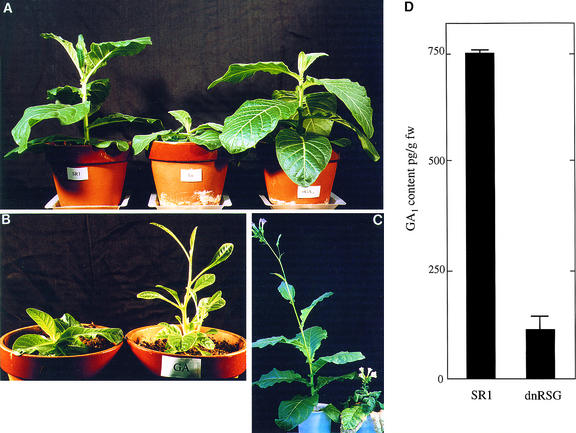
Decrease in Endogenous GAs in the 35S:RSGbZIP Transformants. (A) GAs restored the phenotype of 35S:RSGbZIP–transformed tobacco plants. The control SR1 tobacco is at left, the 35S:RSGbZIP transformant is center, and the GA-treated 35S:RSGbZIP plant is at right. The 35S:RSGbZIP–transformed tobacco plant at right was sprayed with a solution of 10−4 M GA9, and the plant at center was sprayed with water once weekly for 4 weeks. (B) 35S:RSGbZIP plants overdosed with GA3. After the 35S:RSGbZIP plant at left was sprayed with water and the 35S:RSGbZIP plant at right with 10−4 M GA3 every day for 2 weeks, plants were grown without spraying for 1 week. (C) The effect of uniconazole P on the growth of tobacco. The SR1 tobacco plant at right received 250 mL of 10 mg/L uniconazole P; the SR1 tobacco plant at left received only water. (D) GA1 contents in 35S:RSGbZIP plants. Each column represents the mean ±se of four plants. fw, fresh weight.
Figure 9.
Figure 9.
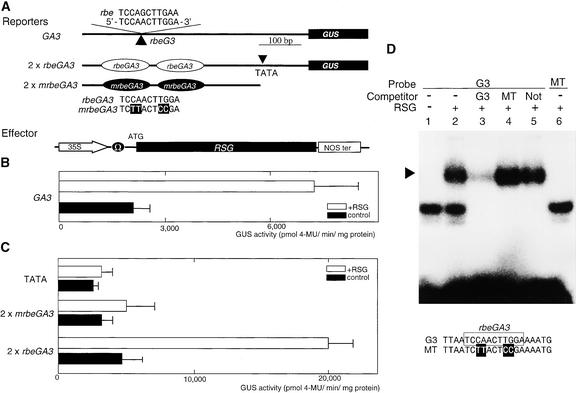
RSG Regulates the Arabidopsis GA3 ent-Kaurene Oxidase Gene. (A) Schematic representation of the reporters and the effector. The 528 bp of the Arabidopsis GA3 promoter was fused to the GUS gene (GA3). The 11-bp dimers of the rbe-related sequence in the GA3 gene (2 × rbeGA3) and of the mutated sequence (2 × mrbeGA3) were fused to the TATA box of parB driving GUS. The mutagenized nucleotides in the mrbeGA3 are highlighted. The effector plasmid expressed the full-length RSG under the control of 35S promoter with a viral translation enhancer (Ω). The empty effector vector was used as the control. NOS ter indicates the polyadenylation signal of the gene for nopaline synthetase. (B) Activation of GA3 promoter by RSG. The reporter construct (GA3, 7 μg) and the effector construct (35S-RSG, 3 μg) were cotransfected to tobacco mesophyll protoplasts. The open bar represents GUS activity of protoplasts transfected with the effector expressing RSG; the closed bar represents GUS activity of protoplasts transfected with the control vector. Each assay was done in triplicate. The error bars indicate sd. (C) Activation of rbeGA3 by RSG. Transfections were performed with tobacco mesophyll protoplasts, with 7 μg of the reporter constructs and 3 μg of the effector construct. TATA indicates the parB TATA box–GUS construct. The open bars represent GUS activity of protoplasts transfected with the effector expressing RSG; the closed bars represent GUS activity of protoplasts transfected with the control vector. Each assay was done in triplicate. The error bars indicate sd. (D) Gel retardation assay using recombinant RSG. The specific RSG–DNA complexes are indicated by an arrowhead. Oligonucleotides containing rbeGA3 (G3, lanes 1 to 5) or mrbeGA3 (MT, lane 6) were used as the probes. The rbeGA3 sequence is boxed, and the mutated bases are highlighted. For lane 3, G3 was the competitor. For lane 4, MT, a mutated version of G3, was the competitor. For lane 5, the NotI linker (Not) was used as an unrelated competitor. The lower shifted bands in lanes 1, 2, and 6 are nonspecific DNA–protein complexes. (+), present; (−), absent. 4-MU, 4-methylumbelliferone.
Figure 10.
Figure 10.
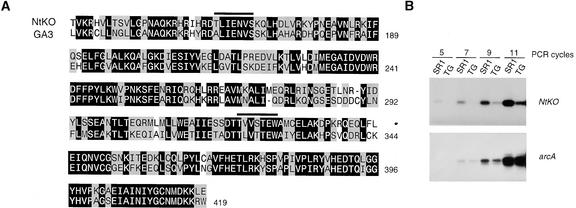
Predicted Amino Acid Sequence and the Expression of NtKO. (A) Comparison of the partial amino acid sequences of NtKO (tobacco) and GA3 (Arabidopsis). Identical amino acids are highlighted, and similar amino acids are marked with gray boxes. Numbers at right indicate amino acid positions from the first methionine of GA3 (Arabidopsis). The regions corresponding to the primer sequences used for RT-PCR are shown by lines above the sequence. GenBank accession number of NtKO is AB040485. (B) Comparison of NtKO mRNA contents by RT-PCR. Amplifications were performed for five, seven, nine, or 11 cycles, and the products were detected by DNA gel blot hybridization. Tobacco arcA was amplified in the same reaction and used as an internal control of RT-PCR. SR1, control SR1 tobacco plants; TG, 35S:RSGbZIP transgenic tobacco plants.

References

    1. Aeschbacher, R.A., Schrott, M., Potrykas, I., and Saul, M.W. (1991). Isolation and molecular characterization of PosF21, an Arabidopsis thaliana gene which shows characteristics of a bZIP class transcription factor. Plant J. 1, 303–316. - PubMed
    1. Aukerman, M.J., Schmidt, R.J., Burr, B., and Burr, F.A. (1991). An arginine to lysine substitution in the bZIP domain of an opaque2 mutant in maize abolishes specific DNA binding. Genes Dev. 5, 310–320. - PubMed
    1. Babiychuk, E., Fuangthong, M., Van Montagu, M., Inzé, D., and Kushnir, S. (1997). Efficient gene tagging in Arabidopsis thaliana using a gene trap approach. Proc. Natl. Acad. Sci. USA 94, 12722–12727. - PMC - PubMed
    1. Baluška, F., Parker, J.S., and Barlow, P.W. (1993). A role for gibberellic acid in orienting microtubules and regulating cell growth polarity in the maize root cortex. Planta 191, 149–157.
    1. Chiang, H.-H., Hwang, I., and Goodman, H.M. (1995). Isolation of the Arabidopsis GA4 locus. Plant Cell 7, 195–201. - PMC - PubMed

Publication types

MeSH terms

Associated data

LinkOut - more resources