. 2000 Jun;12(6):963-77.
doi: 10.1105/tpc.12.6.963.

cDNA-AFLP reveals a striking overlap in race-specific resistance and wound response gene expression profiles

Affiliations

cDNA-AFLP reveals a striking overlap in race-specific resistance and wound response gene expression profiles

W E Durrant et al. Plant Cell. 2000 Jun.

Abstract

The tomato Cf-9 gene confers resistance to races of the fungal pathogen Cladosporium fulvum expressing the Avr9 gene. cDNA amplified fragment length polymorphism analysis was used to display transcripts whose expression is rapidly altered during the Avr9- and Cf-9-mediated defense response in tobacco cell cultures. Diphenyleneiodonium was used to abolish the production of active oxygen species during gene induction. Of 30,000 fragments inspected, 290 showed altered abundance, of which 263 were induced independently of active oxygen species. cDNA clones were obtained for 13 ACRE (for Avr9/Cf-9 rapidly elicited) genes. ACRE gene induction occurred in the presence of cycloheximide. Avr9 induced ACRE gene expression in leaves. Surprisingly, ACRE genes were also rapidly but transiently induced in leaves in response to other stresses. The amino acid sequences of some ACRE proteins are homologous to sequences of known proteins such as ethylene response element binding protein transcription factors, the N resistance protein, a calcium binding protein, 13-lipoxygenase, and a RING-H2 zinc finger protein. Rapid induction of ACRE genes suggests that they play a pivotal role during plant defense responses.


Figures

Figure 1.
Figure 1.
cDNA-AFLP Display of Avr9/Cf-9–Dependent Changes in Gene Expression. (A) Cf9 tobacco cells were treated with IF(Avr9+) or IF(Avr9) or pretreated for 5 min with DPI before addition of IF(Avr9+). Cells were harvested after 30 min. Lanes are in groups of three: each group was amplified with a different pair of selective AFLP primers. (+) indicates Avr9 or DPI added; (−) indicates Avr9 or DPI not added. (B) Enlarged view of the boxed area in (A). The arrows indicate repressed (1) and induced fragments (2) and a fragment whose induction is inhibited by DPI (3). (+) indicates Avr9 or DPI added; (−) indicates Avr9 or DPI not added. (C) Induction requires both Cf-9 and Avr9. Cell cultures of Cf9 and nontransformed tobacco (PG) were analyzed 30 min after elicitation with IF(Avr9+) (+), IF(Avr9) (−), or chemically synthesized Avr9 (syn.) and compared with untreated Cf9 cells (0).
Figure 2.
Figure 2.
Expression Patterns of 18 Induced Genes. Cf9 tobacco cells were treated with IF(Avr9+) for the times indicated above the gels (in hours) before harvesting. Expression was examined by using cDNA-AFLP analysis. Each gel is labeled with the number of the AFLP fragment, and the corresponding band is labeled with an arrow.
Figure 3.
Figure 3.
CHX Treatment Does Not Block Avr9-Dependent Gene Induction, but It Induces Expression in the Absence of Avr9. Cf9 tobacco cells were pretreated with 5 μg/mL CHX or ethanol for 1 hr, and then IF(Avr9+) or IF(Avr9) was added; cells were harvested after another 30 min. Expression was examined by using cDNA-AFLP analysis. (+) indicates Avr9 or CHX added; (−) indicates Avr9 or CHX not added. Each gel is labeled with the number of the AFLP fragment, and the corresponding band is labeled with an arrow.
Figure 4.
Figure 4.
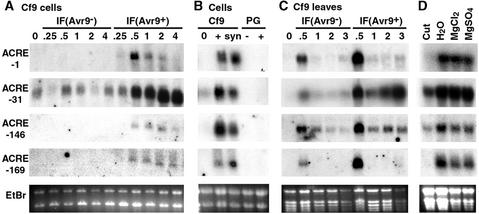
RNA Gel Blot Analysis Confirms ACRE Gene Induction in Cf9 Cell Cultures. ACRE genes are also induced in leaves by Avr9 and infiltration of fluids. Total RNA (5 to 10 μg) extracted from cell cultures or leaves was used for RNA gel blot analysis. Loading of gels is shown by ethidium bromide (EtBr) staining. The same blots were probed with four ACRE cDNAs. (A) and (C) Cf9 cell cultures (A) or leaves (C) were treated with IF(Avr9+) or IF(Avr9) for the times indicated (given above blots in hours). (B) Cf9 or nontransformed (PG) cell cultures were analyzed 30 min after treatment with IF(Avr9+) (+), IF(Avr9) (−), or chemically synthesized Avr9 (syn) and compared with untreated Cf9 cells (0). (D) Tobacco leaves were cut with a razor blade and either injected with water (H20), MgCl2, or MgSO4 or not injected (Cut) and harvested after 30 min.
Figure 5.
Figure 5.
ACRE Genes Are Induced in Leaves by Avr9 and Infiltration of Fluids. Tobacco leaves were cut with a razor blade and either injected with water (H20) or MgCl2 or not injected (Cut), harvested after 30 min and compared with untreated leaves (0). Expression was examined by using cDNA-AFLP analysis. Each gel is labeled with the number of the AFLP fragment, and the corresponding band is labeled with an arrow.
Figure 6.
Figure 6.
Hin1, Hsr203J, and EREBP-1 Expression Is Induced by Avr9/Cf-9 and Infiltration of Fluids into Leaves. Total RNA (5 to 10 μg) extracted from cell cultures or leaves was used for RNA gel blot analysis. Loading of gels is shown by ethidium bromide staining. (A) and (B) Cf9 cell cultures (A) and leaves (B) were treated with IF(Avr9+) or IF(Avr9) for the times indicated (given above blots in hours). (C) Tobacco leaves were cut with a razor blade and either injected with water (H2O), MgCl2, or MgSO4 or not injected (Cut) and harvested after 30 min.
Figure 7.
Figure 7.
Model for the Role of ACRE Genes in Plant Stress Responses. Upward pointing arrows indicate elevated protein levels. The double-headed arrow indicates a possible interaction between the Cf-9 and Avr9 proteins.

References

    1. Altschul, S.F., Madden, T.L., Schaffer, A.A., Zhang, J.H., Zhang, Z., Miller, W., and Lipman, D.J. (1997). Gapped BLAST and PSI-BLAST: A new generation of protein database search programs. Nucleic Acids Res. 25, 3389–3402. - PMC - PubMed
    1. Bachem, C.W.B., van der Hoeven, R.S., de Bruijn, S.M., Vreugdenhil, D., Zabeau, M., and Visser, R.G.F. (1996). Visualization of differential gene expression using a novel method of RNA fingerprinting based on AFLP: Analysis of gene expression during potato tuber development. Plant J. 9, 745–753. - PubMed
    1. Bachem, C.W.B., Oomen, R.J.F.J., and Visser, R.G.F. (1998). Transcript imaging with cDNA-AFLP: A step-by-step protocol. Plant Mol. Biol. Rep. 16, 157–173.
    1. Baldwin, D., Crane, V., and Rice, D. (1999). A comparison of gel-based, nylon filter and microarray techniques to detect differential RNA expression in plants. Curr. Opin. Plant Biol. 2, 96–103. - PubMed
    1. Bassett, D.E., Jr., Eisen, M.B., and Boguski, M.S. (1999). Gene expression informatics—It's all in your mine. Nature Genet. 21, 51–55. - PubMed

Publication types

MeSH terms

LinkOut - more resources