. 2000 Jun 20;97(13):7621-6.
doi: 10.1073/pnas.130181897.

A substance P-opioid chimeric peptide as a unique nontolerance-forming analgesic

Affiliations

A substance P-opioid chimeric peptide as a unique nontolerance-forming analgesic

S E Foran et al. Proc Natl Acad Sci U S A. .

Abstract

To elucidate mechanisms of acute and chronic pain, it is important to understand how spinal excitatory systems influence opioid analgesia. The tachykinin substance P (SP) represents the prototypic spinal excitatory peptide neurotransmitter/neuromodulator, acting in concert with endogenous opioid systems to regulate analgesic responses to nociceptive stimuli. We have synthesized and pharmacologically characterized a chimeric peptide containing overlapping NH(2)- and COOH-terminal functional domains of the endogenous opioid endomorphin-2 (EM-2) and the tachykinin SP, respectively. Repeated administration of the chimeric molecule YPFFGLM-NH(2), designated ESP7, into the rat spinal cord produces opioid-dependent analgesia without loss of potency over 5 days. In contrast, repeated administration of ESP7 with concurrent SP receptor (SPR) blockade results in a progressive loss of analgesic potency, consistent with the development of tolerance. Furthermore, tolerant animals completely regain opioid sensitivity after post hoc administration of ESP7 alone, suggesting that coactivation of SPRs is essential to maintaining opioid responsiveness. Radioligand binding and signaling assays, using recombinant receptors, confirm that ESP7 can coactivate mu-opioid receptors (MOR) and SPRs in vitro. We hypothesize that coincidental activation of the MOR- and SPR-expressing systems in the spinal cord mimics an ongoing state of reciprocal excitation and inhibition, which is normally encountered in nociceptive processing. Due to the ability of ESP7 to interact with both MOR and SPRs, it represents a unique prototypic, anti-tolerance-forming analgesic with future therapeutic potential.


Figures
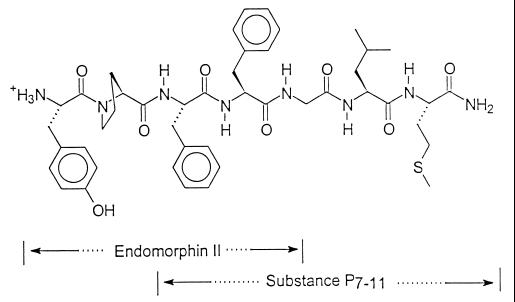
Figure 1
Figure 1
Sequence and two-dimensional structure of ESP7. The amino acid sequence of ESP7 at the N terminus corresponds to that of EM-2 (Tyr-Pro-Phe-Phe-NH2), and the overlapping sequence of ESP7 at the C terminus corresponds to that of SP (–11) (SP = H-Arg-Pro-Lys-Pro-Gln-Gln-Phe-Phe-Gly-Leu-Met-NH2). The drawing illustrates ESP7 (Tyr-Pro-Phe-Phe-Gly-Leu-Met-NH2) with its overlapping opioid and SP moieties.
Figure 2
Figure 2
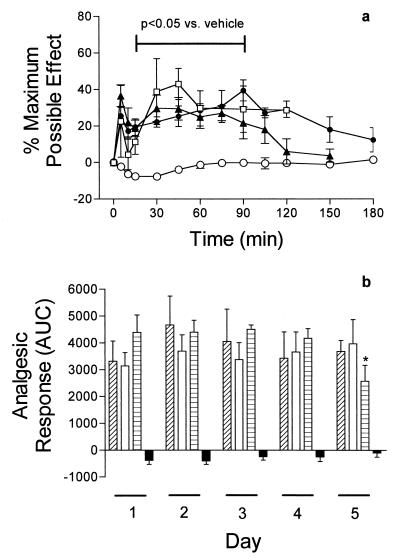
(a) Time-dependent analgesic responses after intrathecal administration of 0.05 μg of ESP7 (●), 0.2 μg ESP7 (▴), 1 μg of ESP7 (□), or 1 μg of β-CD (○). Ordinal values represent tail-flick latency measurements normalized as %MPE (means ± SEM; n = 6 for 0.05 μg ESP7; n = 8 for 0.2 μg ESP7; n = 5 for both 1 μg of ESP7 and 1 μg of β-CD). All doses of ESP7 produce a modest analgesic response, which plateaus at ≈20–40% and remains effective for ≈1.5–2 h. The peptide vehicle, β-CD, alone has no analgesic efficacy. As indicated by the bar, all doses of ESP7 produced a significantly higher effect than the vehicle between 15 and 90 min of treatment (P < 0.05). (b) Repeated daily intrathecal administration of 0.05 μg of ESP7 (horizontally lined bars), 0.2 μg ESP7 (open bars), 1 μg of ESP7 (rising right-lined bars), or 1 μg of β-CD (filled bars). Ordinal values represent the daily analgesic response, as expressed by the AUC, calculated from experiments with a parallel design to that shown in Fig. 2a (means ± SEM; n = 6 for 0.05 μg ESP7; n = 8 for 0.2 μg ESP7; n = 5 for both 1 μg of ESP7 and 1 μg of β-CD). No tolerance develops to the analgesia produced by 0.2 or 1 μg of ESP7 in the tail-flick test for 5 days (P > 0.05); however, tolerance does develop to the 0.05-μg dose on day 5 (*, P < 0.05). One microgram of β-CD vehicle has no analgesic efficacy, and the effect of ESP7 is statistically different from baseline at all doses and on all days of treatment.
Figure 3
Figure 3
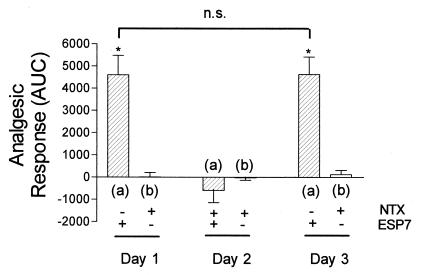
Effect of intrathecal NTX administration. ESP7 (1 μg) was injected daily for 3 days. On day 2, 1 μg of NTX was injected 10 min before ESP7 (lane a). On days 1, 2, and 3, 1 μg of NTX was given alone as a control (lane b). Ordinal values represent the analgesic response as expressed by the AUC (means ± SEM; n = 3 for 1 μg of ESP7; n = 5 for 1 μg of NTX control) for each day of analgesic testing. ESP7 alone triggered significant analgesic effects vs. the baseline defined in untreated animals (*, P < 0.05). NTX blocks the analgesic effects of ESP7 on day 2 with slight hyperalgesia (not statistically significant, P > 0.05). A level of ESP7-induced analgesia similar to day 1 is recovered on day 3, when no antagonist is present (n.s.; P > 0.05). The effects of NTX alone are not significantly different from baseline.
Figure 4
Figure 4
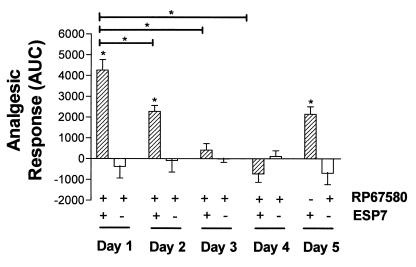
Effect of intrathecal RP67580 administration. RP67580 (250 pmol), a high affinity SP antagonist, was injected intrathecally 10 min before 1 μg of ESP7 for 4 days (rising right-lined bars). On day 5, no RP67580 was given. RP67580 (250 pmol) was administered intrathecally alone for 5 days as a control (open bars). Ordinal values represent the daily analgesic response as expressed by the AUC (means ± SEM; n = 6 for treated group; n = 5 for control). After preinjection of RP67580, the analgesic effect of ESP7 is only significantly different from baseline on days 1 and 2 (*, P < 0.05), suggesting tolerance development. Tolerance begins to develop to the analgesic effects of ESP7 on day 2, as indicated by the bars, (*, P < 0.05 vs. effect of ESP7 on day 1) with complete tolerance or a return to baseline on day 3. Slight hyperalgesia is present on day 4, suggesting a withdrawn state, although the effect is not statistically significant from baseline. On day 5, RP67580 was not delivered and significant analgesia was regained (*, P < 0.05). RP67580 alone has no effect on analgesia and is not statistically different from baseline (P > 0.05).
Figure 5
Figure 5
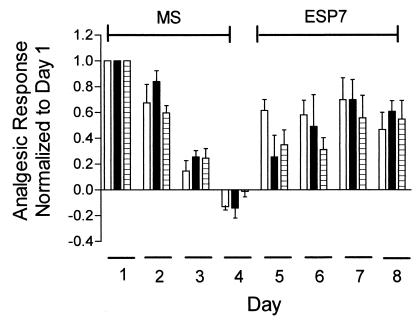
MS tolerance reversal by ESP7. MS (5.0 μg) was given intrathecally to three groups of rats on days 1–4 to induce tolerance. On days 5–8, the rats were administered 0.05 (open bars), 0.2 (filled bars), or 1 μg of ESP7 (horizontally lined bars) intrathecally. Analgesia was measured each day for 60 min after drug injection using the tail-flick assay. Ordinal values represent daily analgesic responses measured as the AUC and normalized to respective values on day 1 [means ± SEM; n = 6 for MS (days 1–4); n = 6 for all doses of ESP7 (days 5–8)]. Tolerance begins to develop to MS by day 2 and no analgesia is present by day 4 to indicate complete tolerance or a return to baseline. Administration of any dose of ESP7 on days 5–8 recovers 40–60% of the analgesic response of MS on day 1, with all analgesic responses significantly different from in tolerant animals (day 4) (P < 0.001). All doses of ESP7 produce similar levels of analgesia. Furthermore, no tolerance develops to ESP7 analgesia during the 4-day treatment.
Figure 6
Figure 6
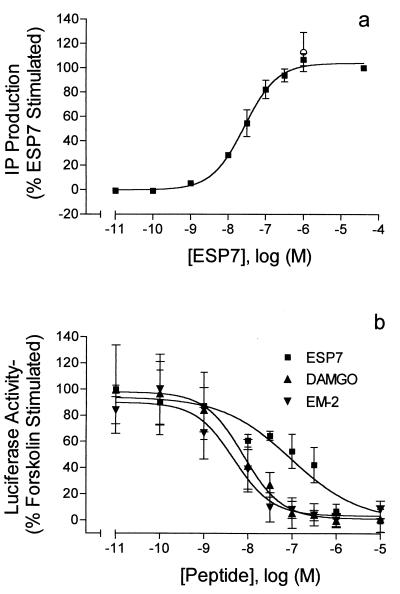
(a) ESP7 and SP induced IP production in COS-7 cells expressing a recombinant rat substance P receptor. Data points represent means ± SEM of three independent experiments. SP (1 μM; ○), a saturating concentration, was used to define maximal stimulation by a full agonist. ESP7 (■) induces a concentration-dependent increase in IP production (EC50, 27 nM; 95% CI = 19–38 nM). IP stimulation by the two highest concentrations of ESP7 is not significantly different from the stimulation by the full agonist, SP (P > 0.05). (b) Inhibition of forskolin-stimulated CRE luciferase activity (a marker of cAMP-mediated effect) by DAMGO, EM-2, and ESP7 in HEK293 cells transiently expressing the rat MOR. Data points represent means ± SEM of three experiments done in triplicate, each normalized to the effect of forskolin alone (10 μM = 100%) and unstimulated luciferase activity (= 0%). DAMGO (▴), EM-2 (▾), and ESP7 (■) produce concentration-dependent inhibition of forskolin-stimulated, cAMP-dependent luciferase activity. The IC50s for DAMGO, EM-2, and ESP7 are 8.0 nM (95% CI = 2.1–31.1 nM), 4.8 nM (95% CI = 1.2–18.7 nM), and 94.8 nM (95% CI = 21.6–415 nM), respectively. ESP7 acts as a strong agonist at the rMOR with a 10-fold lower potency than DAMGO and EM-2.

References

    1. Go V L W, Yaksh T L. J Physiol (London) 1987;391:141–167. - PMC - PubMed
    1. Kar S, Quirion R. J Comp Neurol. 1995;354:253–281. - PubMed
    1. Minami M, Maekawa K, Yabuuchi K, Satoh M. Mol Brain Res. 1995;30:203–210. - PubMed
    1. LaMotte C B, Pert C B, Synder S H. Brain Res. 1976;112:407–412. - PubMed
    1. Duggan A W, Hendry I A, Morton C R, Hutchinson W D, Zhao Z Q. Brain Res. 1988;451:261–273. - PubMed

Publication types