. 2000 Jul;68(7):4108-16.
doi: 10.1128/IAI.68.7.4108-4116.2000.

Molecular cloning and expression of a gene encoding Cryptosporidium parvum glycoproteins gp40 and gp15

Affiliations

Molecular cloning and expression of a gene encoding Cryptosporidium parvum glycoproteins gp40 and gp15

A M Cevallos et al. Infect Immun. 2000 Jul.

Abstract

Cryptosporidium parvum is a significant cause of diarrheal disease worldwide. The specific molecules that mediate C. parvum-host cell interactions and the molecular mechanisms involved in the pathogenesis of cryptosporidiosis are unknown. In this study we have shown that gp40, a mucin-like glycoprotein, is localized to the surface and apical region of invasive stages of the parasite and is shed from its surface. gp40-specific antibodies neutralize infection in vitro, and native gp40 binds specifically to host cells, implicating this glycoprotein in C. parvum attachment to and invasion of host cells. We have cloned and sequenced a gene designated Cpgp40/15 that encodes gp40 as well as gp15, an antigenically distinct, surface glycoprotein also implicated in C. parvum-host cell interactions. Analysis of the deduced amino acid sequence of the 981-bp Cpgp40/15 revealed the presence of an N-terminal signal peptide, a polyserine domain, multiple predicted O-glycosylation sites, a single potential N-glycosylation site, and a hydrophobic region at the C terminus, a finding consistent with what is required for the addition of a GPI anchor. There is a single copy of Cpgp40/15 in the C. parvum genome, and this gene does not contain introns. Our data indicate that the two Cpgp40/15-encoded proteins, gp40 and gp15, are products of proteolytic cleavage of a 49-kDa precursor protein which is expressed in intracellular stages of the parasite. The surface localization of gp40 and gp15 and their involvement in the host-parasite interaction suggest that either or both of these glycoproteins may serve as effective targets for specific preventive or therapeutic measures for cryptosporidiosis.


Figures
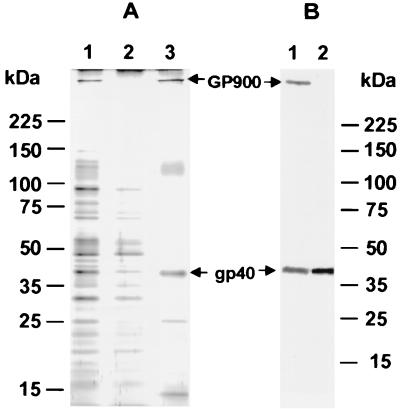
FIG. 1
FIG. 1
Isolation of αGalNAc-containing glycoproteins by HPA affinity chromatography. (A) Aliquots of starting lysate (lane 1), effluent (lane 2), and GalNAc eluate (lane 3) were separated by 5 to 15% gradient SDS-PAGE and stained with silver. (B) Immunoblot of the GalNAc eluate separated by 5 to 15% gradient SDS-PAGE and probed with MAb 4E9 (lane 1) and anti-gp40 antisera (lane 2). The positions of gp40 and GP900 are indicated with arrows.
FIG. 2
FIG. 2
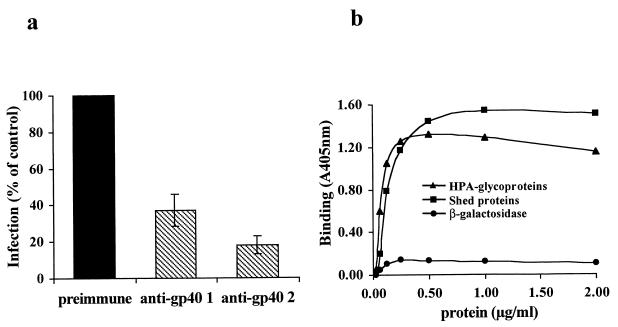
(a) Effect of gp40-specific antisera on C. parvum infection of Caco-2A cells. Oocysts were preincubated with preimmune sera or gp40-specific antisera obtained from two different mice and allowed to infect Caco-2A cells. Infection was quantified by ELISA. The results are expressed as a percentage of the control (respective preimmune sera from each of the mice). (b) Binding of gp40 to intestinal epithelial cells. Increasing concentrations of HPA-isolated glycoproteins and shed proteins containing the indicated concentrations of gp40 were incubated with live Caco-2A cells, and gp40 binding was quantified by ELISA using gp40-specific antisera. The results are expressed as the absorbance at 405 nm. β-Galactosidase was used as a control.
FIG. 3
FIG. 3
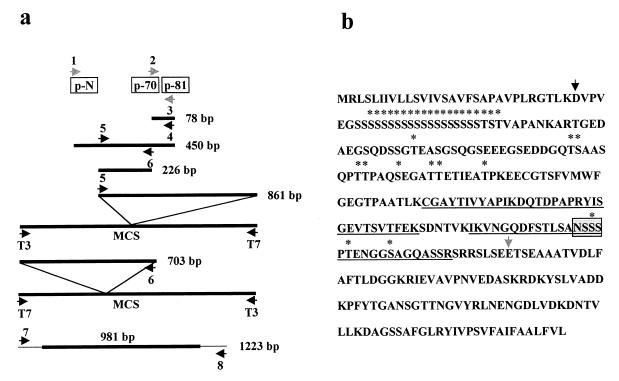
(a) Sequential PCR steps used for cloning of Cpgp40/15 gene. Peptides pN, p-70, and p-81 and primers 1 to 8 are described in Table 1. MCS, multiple cloning site. The degenerate primers are indicated by stippled arrows. (b) Deduced amino acid sequence of Cpgp40/15 ORF. The N termini of gp40 (solid arrow) and gp15 (shaded arrow) are shown. The single potential N-glycosylation site is indicated with a stippled box. The predicted sites of mucin-type O-glycosylation are indicated with stars. The amino acid residues of contiguous peptides identified by MS/MS analysis are underlined.
FIG. 4
FIG. 4
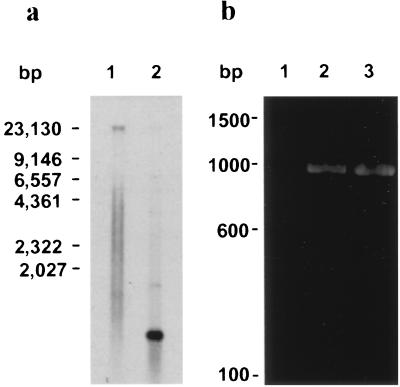
(a) Southern blot analysis of Cpgp40/15 locus. Genomic DNA was digested with EcoRI (lane 1) and HindIII and EcoRI (lane 2) and probed with an 856-bp Cpgp40/15 probe. (b) RT-PCR analysis of C. parvum RNA. RNA was extracted from Caco-2A cells (lane 1) or Caco-2A cells infected with C. parvum (lane 2) and analyzed by RT-PCR using gene-specific primers 9 and 10 (Table 1). Lane 3 shows the product obtained by PCR of genomic DNA using the same primers.
FIG. 5
FIG. 5
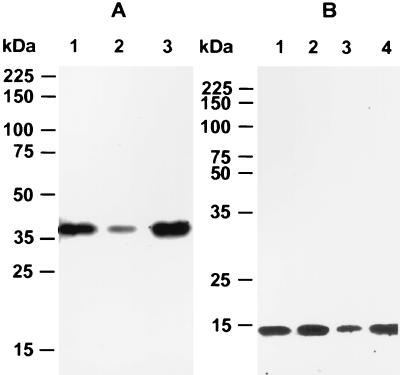
Immunoblot of native gp40 and gp15. C. parvum oocysts (lanes 1), sporozoites (lanes 2), shed proteins (lanes 3), and HPA-isolated glycoproteins (panel B, lane 4) were separated by SDS-PAGE on a 5 to 15% gel, transferred to nitrocellulose, and probed with anti-gp40 antisera (A) or MAb CrA1 (B).
FIG. 6
FIG. 6
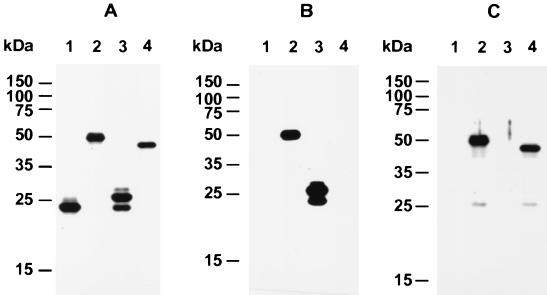
Immunoblot of recombinant gp40 and gp15 fusion proteins. Control insert (lane 1), pAMC40/15 (lane 2), pAMC15 (lanes 3), and pAMC40 (lane 4) were cloned into pET-32 LIC/Xa and expressed in E. coli AD494(DE3). Bacterial lysates were separated by SDS–10% PAGE, transferred to nitrocellulose, and probed with S-Protein (A), MAb CrA1 (B), and anti-gp40 (C) antisera.
FIG. 7
FIG. 7
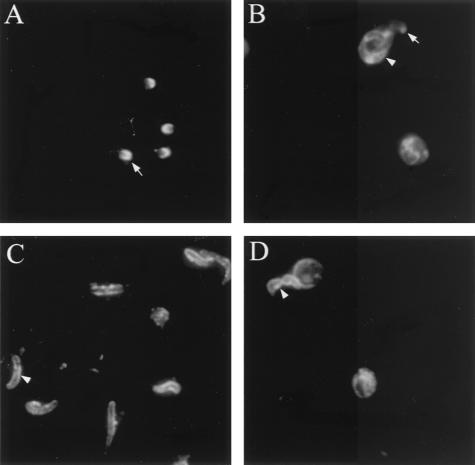
Localization of gp40 and gp15 in C. parvum invasive stages by IF. The reactivity of anti-gp40 antisera (A and B) and MAb CrA1 (C and D) with purified sporozoites (A and C) and merozoites (B and D) in infected Caco-2A cells is shown. Apical and surface forms of localization are indicated with arrows and arrowheads, respectively.
FIG. 8
FIG. 8
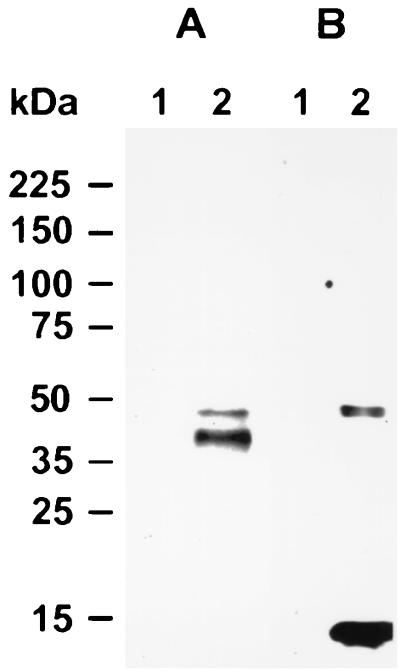
Identification of gp40 and gp15 precursor in infected Caco-2A cells. αGalNAc-containing glycoproteins were first isolated from uninfected Caco-2A cells (lane 1) or Caco-2A cells infected with C. parvum for 18 h (lane 2), then separated by SDS-PAGE on a 5 to 15% gel, and finally transferred to nitrocellulose and probed with anti-gp40 antisera (A) and MAb CrA1 (B).

References

    1. Altschul S F, Madden T L, Schaffer A A, Zhang J, Zhang Z, Miller W, Lipman D J. Gapped BLAST and PSI-BLAST: a new generation of protein database search programs. Nucleic Acids Res. 1997;25:3389–3402. - PMC - PubMed
    1. Barnes D A, Bonnin A, Huang J X, Gousset L, Wu J, Gut J, Doyle P, Dubremetz J F, Ward H, Petersen C. A novel multi-domain mucin-like glycoprotein of Cryptosporidium parvum mediates invasion. Mol Biochem Parasitol. 1998;96:93–110. - PubMed
    1. Blackman M, Holder A. Secondary processing of the Plasmodium falciparum merozoite surface protein (MSP-1) by a calcium-dependent membrane bound serine protease: shedding of MSP-133 as a non-covalently associated complex with other fragments of MSP-1. Mol Biochem Parasitol. 1992;50:307–316. - PubMed
    1. Bradley P J, Boothroyd J C. Identification of the pro-mature processing site of Toxoplasma ROP1 by mass spectrometry. Mol Biochem Parasitol. 1999;100:103–109. - PubMed
    1. Eng J, McCormack A L, Yates J R., III An approach to correlate tandem mass spectral data of peptides with amino acid sequences in a protein database. J Am Soc Mass Spectrom. 1994;5:976–989. - PubMed

Publication types

MeSH terms

LinkOut - more resources