. 2000 Jul;44(7):1818-24.
doi: 10.1128/AAC.44.7.1818-1824.2000.

Role of antibiotic penetration limitation in Klebsiella pneumoniae biofilm resistance to ampicillin and ciprofloxacin

Affiliations
Free PMC article

Role of antibiotic penetration limitation in Klebsiella pneumoniae biofilm resistance to ampicillin and ciprofloxacin

J N Anderl et al. Antimicrob Agents Chemother. 2000 Jul.
Free PMC article

Abstract

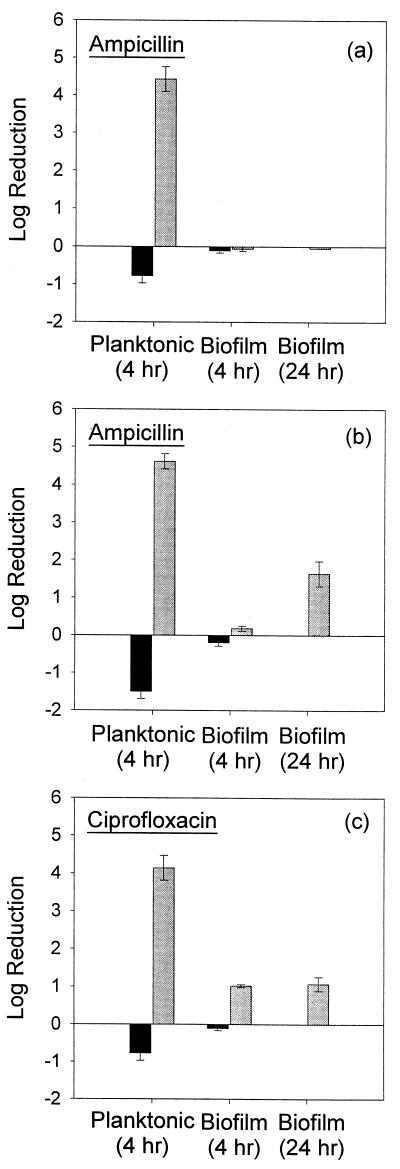
The penetration of two antibiotics, ampicillin and ciprofloxacin, through biofilms developed in an in vitro model system was investigated. The susceptibilities of biofilms and corresponding freely suspended bacteria to killing by the antibiotics were also measured. Biofilms of Klebsiella pneumoniae were developed on microporous membranes resting on agar nutrient medium. The susceptibilities of planktonic cultures and biofilms to 10 times the MIC were determined. Antibiotic penetration through biofilms was measured by assaying the concentration of antibiotic that diffused through the biofilm to an overlying filter disk. Parallel experiments were performed with a mutant K. pneumoniae strain in which beta-lactamase activity was eliminated. For wild-type K. pneumoniae grown in suspension culture, ampicillin and ciprofloxacin MICs were 500 and 0.18 microgram/ml, respectively. The log reductions in the number of CFU of planktonic wild-type bacteria after 4 h of treatment at 10 times the MIC were 4.43 +/- 0.33 and 4.14 +/- 0.33 for ampicillin and ciprofloxacin, respectively. Biofilms of the same strain were much less susceptible, yielding log reductions in the number of CFU of -0.06 +/- 0.06 and 1.02 +/- 0.04 for ampicillin and ciprofloxacin, respectively, for the same treatment. The number of CFU in the biofilms after 24 h of antibiotic exposure was not statistically different from the number after 4 h of treatment. Ampicillin did not penetrate wild-type K. pneumoniae biofilms, whereas ciprofloxacin and a nonreactive tracer (chloride ion) penetrated the biofilms quickly. The concentration of ciprofloxacin reached the MIC throughout the biofilm within 20 min. Ampicillin penetrated biofilms formed by a beta-lactamase-deficient mutant. However, the biofilms formed by this mutant were resistant to ampicillin treatment, exhibiting a 0.18 +/- 0.07 log reduction in the number of CFU after 4 h of exposure and a 1.64 +/- 0.33 log reduction in the number of CFU after 24 h of exposure. Poor penetration contributed to wild-type biofilm resistance to ampicillin but not to ciprofloxacin. The increased resistance of the wild-type strain to ciprofloxacin and the mutant strain to ampicillin and ciprofloxacin could not be accounted for by antibiotic inactivation or slow diffusion since these antibiotics fully penetrated the biofilms. These results suggest that some other resistance mechanism is involved for both agents.


Figures
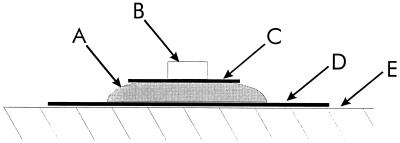
FIG. 1
FIG. 1
Schematic depiction of the experimental system used to track the penetration of antibiotics through the biofilms. The biofilm (A) was developed on a 25-mm-diameter microporous polycarbonate membrane (D) resting on agar culture medium. A 13-mm-diameter microporous polycarbonate membrane (C) was placed on top of the biofilm. A moistened concentration disk (B) was placed on top of the 13-mm-diameter membrane. The entire unit, components A through D, was transferred to antibiotic-containing agar (E) with sterile forceps.
FIG. 2
FIG. 2
Susceptibilities of planktonic cultures and biofilms to antibiotics as the observed log reduction in the number of CFU after exposure to 5,000 μg of ampicillin per ml (a and b) or 1.8 μg of ciprofloxacin per ml (c). (a and c) Susceptibility of Kp1 to ampicillin and ciprofloxacin, respectively. (b) Ampicillin treatment of Kp102M. █, untreated controls; formula image, antibiotic-challenged cultures. Error bars reflect ±1 standard error of the mean.
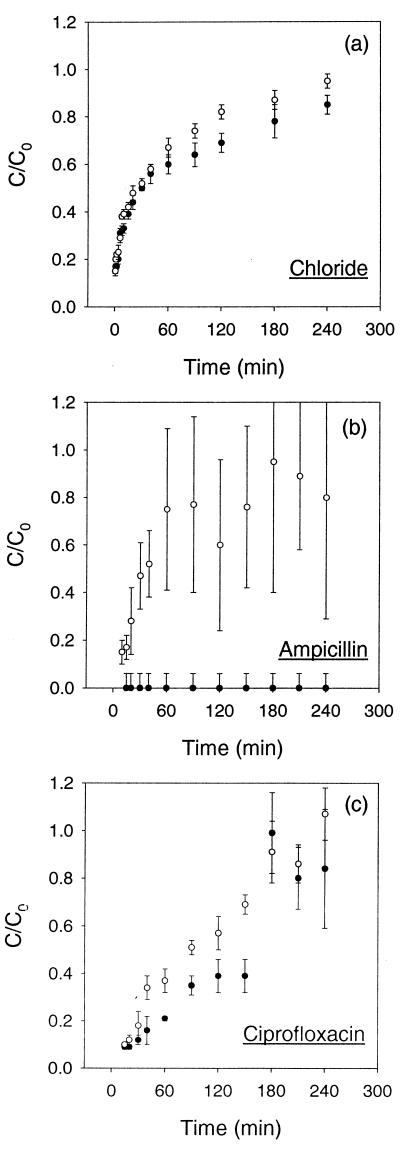
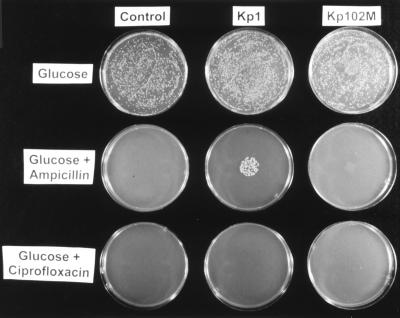
FIG. 3
FIG. 3
Solute transport through the biofilms as the measured fraction of bulk chloride (a), ampicillin (b), and ciprofloxacin (c) that penetrated Kp1 (●) and Kp102M (○) biofilms. Error bars reflect ±1 standard error of the mean. The relatively large error bars in panel b were due to the poor sensitivity of the bioassay above an ampicillin concentration of 1,000 μg/ml. C, concentration on distal edge of biofilm; C0, applied concentration.
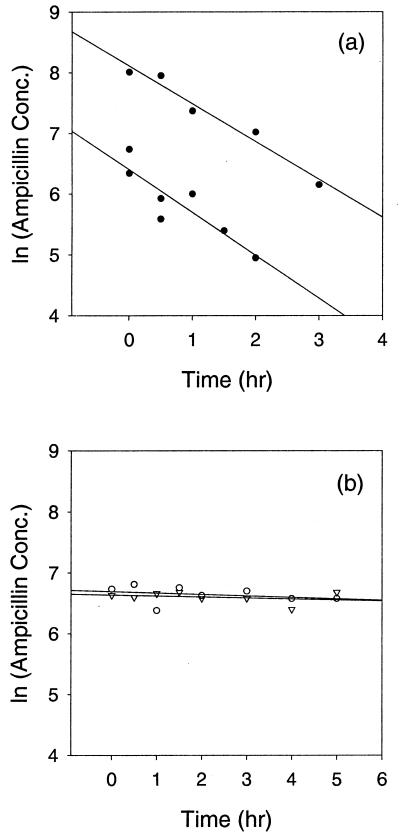
FIG. 4
FIG. 4
Antibiotic depletion in agar plates. The plates in the left column (Control) were not exposed to biofilms. The plates in the middle and right columns were exposed to wild-type and mutant biofilms, respectively, placed in the center of each plate for 24 h. The plates in the top row were agar culture medium plates without antibiotics. The plates in the middle and bottom rows contained 500 μg of ampicillin per ml and 0.18 μg of ciprofloxacin per ml, respectively. All plates were spread with a lawn of Kp1 bacteria. A spot of growth on the ampicillin-amended plate exposed to a Kp1 biofilm (center plate) indicated local neutralization of the ampicillin.
FIG. 5
FIG. 5
Ampicillin degradation rate in planktonic cultures. Kp1 (●) cultures that contained ∼109 CFU/ml degraded ampicillin at a rate statistically different from zero (a). The top series in panel a illustrates the degradation of ampicillin with an initial concentration of 5,000 μg/ml. Least-squares linear regression estimated a degradation rate of 0.63 h−1 with a correlation coefficient (R2) of 0.967. The bottom series in panel a depicts degradation of ampicillin with an initial concentration of 1,000 μg/ml. Linear least-squares regression predicted a degradation rate of 0.83 h−1 with a correlation coefficient (R2) of 0.922. The two rates were averaged to provide an estimated ampicillin degradation rate of 0.73 h−1 for Kp1. The ampicillin degradation rates for Kp102M cultures (○) and the sterile control (▿) were not statistically different from zero (b).

References

    1. American Public Health Association, American Water Works Association, and Water and Environment Federation. Standard methods for the examination of water and wastewater. Washington, D.C.: American Public Health Association; 1995.
    1. Anwar H, Strap J L, Costerton J W. Establishment of aging biofilms: possible mechanism of bacterial resistance to antimicrobial therapy. Antimicrob Agents Chemother. 1992;36:1347–1351. - PMC - PubMed
    1. Anwar H, Strap J L, Costerton J W. Kinetic interaction of biofilm cells of Staphylococcus aureuswith cephalexin and tobramycin in a chemostat system. Antimicrob Agents Chemother. 1992;36:890–893. - PMC - PubMed
    1. Bailey J E, Ollis D F. Biochemical engineering fundamentals. New York, N.Y: McGraw-Hill Book Co.; 1986.
    1. Blaser J, Vergeres P, Widmer A F, Zimmerli W. In vivo verification of in vitro model of antibiotic treatment of device-related infection. Antimicrob Agents Chemother. 1995;39:1134–1139. - PMC - PubMed

Publication types

LinkOut - more resources