


Deletion of the nitrate reductase N-terminal domain still allows binding of 14-3-3 proteins but affects their inhibitory properties
- PMID: 10859205
- PMCID: PMC59043
- DOI: 10.1104/pp.123.2.757
Deletion of the nitrate reductase N-terminal domain still allows binding of 14-3-3 proteins but affects their inhibitory properties
Abstract
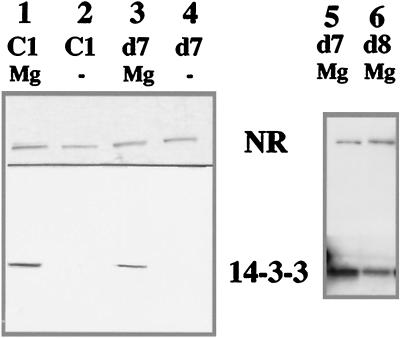
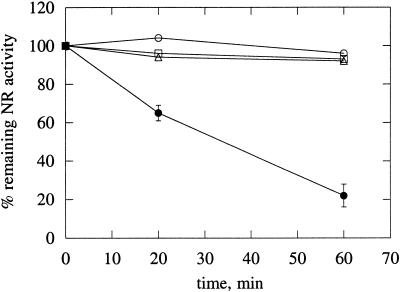
Nitrate reductase (NR) is post-translationally regulated by phosphorylation and binding of 14-3-3 proteins. Deletion of 56 amino acids in the amino-terminal domain of NR was previously shown to impair this type of regulation in tobacco (Nicotiana plumbaginifolia) (L. Nussaume, M. Vincentez, C. Meyer, J.-P. Boutin, M. Caboche [1995] Plant Cell 7: 611-621), although both full-length NR and deleted NR (DeltaNR) appeared to be phosphorylated in darkness (C. Lillo, S. Kazazaic, P. Ruoff, C. Meyer [1997] Plant Physiol 114: 1377-1383). We show here that in the presence of Mg(2+) and phosphatase inhibitors, NR and endogenous 14-3-3 proteins copurify through affinity chromatography. Assay of NR activity and western blots showed that endogenous 14-3-3 proteins copurified with both NR and DeltaNR. Electron transport in the heme-binding domain of DeltaNR was inhibited by Mg(2+)/14-3-3, whereas this was not the case for NR. This may indicate a different way of binding for 14-3-3 in the DeltaNR compared with NR. The DeltaNR was more labile than NR, in vitro. Lability was ascribed to the molybdopterin binding domain, and apparently an important function of the 56 amino acids is stabilization of this domain.
Figures
References
-
- Aryan AP, Wallace W. Reversible inactivation of wheat leaf nitrate reductase by NADH, involving superoxide ions generated by oxidation of thiols and FAD. Biochim Biophys Acta. 1985;827:215–220.
-
- Athwal GS, Huber JL, Huber SC. Biological significance of divalent metal ion binding to 14-3-3 proteins in relationship to nitrate reductase inactivation. Plant Cell Physiol. 1998;39:1065–1072. - PubMed
-
- Bachmann M, Huber JL, Athwal GS, Wu K, Ferl RJ, Huber SC. 14-3-3 proteins associate with the regulatory phosphorylation site of spinach leaf nitrate reductase in an isoform-specific manner and reduce dephosphorylation of Ser-543 by endogenous protein phosphatases. FEBS Lett. 1996a;398:26–30. - PubMed
Publication types
MeSH terms
Substances
LinkOut - more resources
Full Text Sources
