. 2000 Jun 20;97(13):7102-6.
doi: 10.1073/pnas.97.13.7102.

Osmoregulated ABC-transport system of Lactococcus lactis senses water stress via changes in the physical state of the membrane

Affiliations

Osmoregulated ABC-transport system of Lactococcus lactis senses water stress via changes in the physical state of the membrane

T van der Heide et al. Proc Natl Acad Sci U S A. .

Abstract

An osmoregulated ABC transporter (OpuA) with novel structural features has been identified that responds to water stress. This glycine betaine transport system consists of an ATP-binding/hydrolyzing subunit (OpuAA) and a protein (OpuABC) that contains both the translocator and the substrate-binding domain. The components of OpuA have been overexpressed, purified, and functionally incorporated into liposomes with an ATP-regenerating system in the vesicle lumen. A transmembrane osmotic gradient (outside hyperosmotic relative to the inside) of both ionic and nonionic compounds was able to osmotically activate OpuA in the proteoliposomal system. Hypoosmotic medium conditions inhibited the basal activity of the system. The data show that OpuAA and OpuABC are sufficient for osmoregulated transport, indicating that OpuA can act both as osmosensor and osmoregulator. Strikingly, OpuA could also be activated by low concentrations of cationic and anionic amphipaths, which interact with the membrane. This result indicates that activation by a transmembrane osmotic gradient is mediated by changes in membrane properties/protein-lipid interactions.


Figures
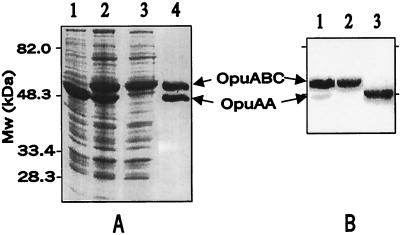
Figure 1
Figure 1
Amplified expression and purification of OpuA. (A) SDS/PAGE gel (12% polyacrylamide) showing membranes (Coomasie brilliant blue stained) containing OpuAA (lane 1; 120 μg of protein), OpuA (lane 2; 120 μg of protein), OpuABC (lane 3; 120 μg of protein), and purified OpuA (silver stained) (lane 4; 15 μg of protein). (B) Immunoblot of membranes with overexpressed OpuA (lane 1; 120 μg protein), OpuABC (lane 2; 120 μg protein), and OpuAA (lane 3; 250 μg protein).
Figure 2
Figure 2
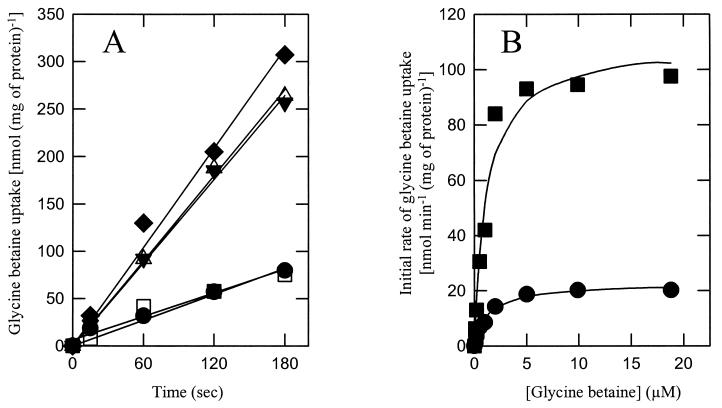
Osmotic activation of membrane reconstituted OpuA. (A) Uptake of [14C]glycine betaine (final concentration of 170 μM) was assayed in 90 mM KPi, pH 7.0, under isoosmotic (●) and hyperosmotic conditions; the latter were effected by the addition of 200 mM KCl (▿), 10.5% sucrose (♦), 2.5% glycerol (□), or 2.5% glycerol + 200 mM KCl (Δ). The hyperosmotic conditions correspond to 530 mosmal/kg for each of the additives. (B) Uptake of [14C]glycine betaine was assayed in 90 mM KPi, pH 7.0, with (■) or without (●) 200 mM KCl. The uptake was stopped after 15 seconds, and further handling was as described under Experimental Procedures. The curves were fitted with the Michaelis–Menten equation.
Figure 3
Figure 3
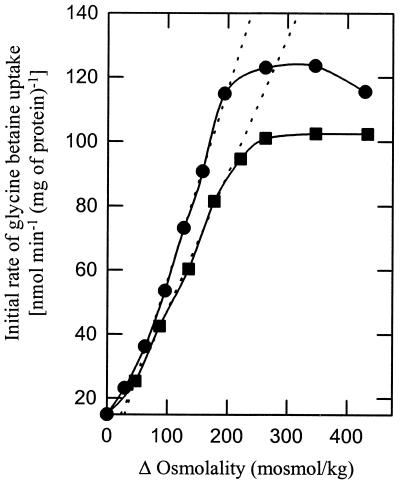
Threshold value for the transmembrane osmotic gradient needed to activate OpuA. Uptake of [14C]glycine betaine (final concentration of 80 μM) was assayed in 90 mM KPi, pH 7.0, in the presence of KCl (■) or sucrose (●). ▵ Osmolality refers to the difference in external and internal osmolality.
Figure 4
Figure 4
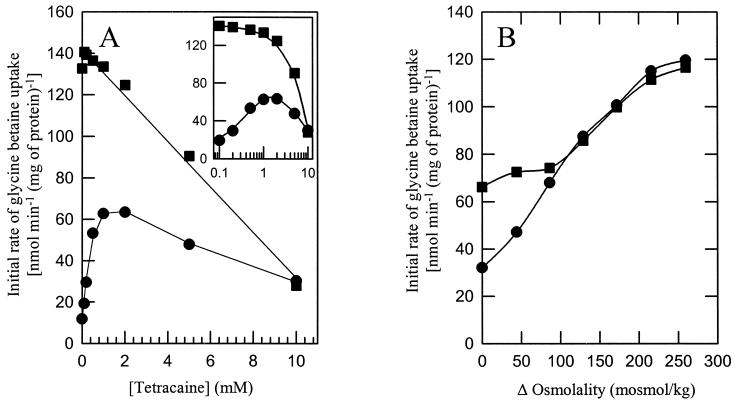
The effect of tetracaine on OpuA activity. (A) Uptake of [14C]glycine betaine (final concentration of 80 μM) was assayed in 90 mM KPi, pH 7.0, with (■) or without (●) 400 mM KCl (680 mosmol/kg). Both curves were fitted with the double exponential decay function f(x) = a⋅exp(−b⋅x) + c⋅exp(−d⋅x). Inset shows the data on a logarithmic scale. (B) Uptake of [14C]glycine betaine (final concentration of 80 μM) was assayed in 90 mM KPi, pH 7.0, with (■) or without (●) 1 mM tetracaine. The osmolality of the medium was varied with KCl. ▵ Osmolality has the same meaning as in the legend to Fig. 3.

References

    1. Poolman B, Glaasker E. Mol Microbiol. 1998;29:397–407. - PubMed
    1. van der Heide T, Poolman B. J Bacteriol. 2000;182:203–206. - PMC - PubMed
    1. Obis D, Guillot A, Gripon J-C, Renault P, Bolotin A, Mistou M-Y. J Bacteriol. 1999;181:6238–6246. - PMC - PubMed
    1. Wood J. Microbiol Mol Biol Rev. 1999;63:230–262. - PMC - PubMed
    1. Csonka L N. Microbiol Rev. 1989;53:121–147. - PMC - PubMed

Publication types

MeSH terms

Associated data

LinkOut - more resources