Review
doi: 10.1136/gut.47.1.148.
DNA mismatch repair genes and colorectal cancer
Affiliations
- PMID: 10861278
- PMCID: PMC1727951
- DOI: 10.1136/gut.47.1.148
Item in Clipboard
Review
DNA mismatch repair genes and colorectal cancer
Gut.
2000 Jul.
No abstract available
Figures

Mismatch repair. A mispaired base is recognised by the hMSH2/GTBP complex while an insertion/deletion loop is recognised by the hMSH2/hMSH3 complex. MutL related proteins (hMLH1/hPMS2 and hMLH1/hPMS1 complexes) then interact with the MutS related proteins that are already bound to the mispaired bases. (The hMSH2/GTBP complex may also support the repair of insertion/deletion loops).
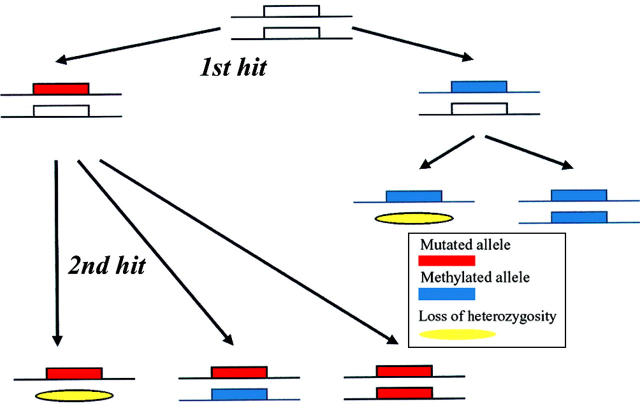
Methylation and Knudson's two hit hypothesis. It has been proposed that epigenetic mechanisms, such as hypermethylation of the promoter region, should be included in the two hit hypothesis for inactivation of tumour suppressor genes. It was suggested that the first hit may be a mutation in the DNA sequence or promoter methylation. The second inactivating hit may be either loss of heterozygosity or a further mutational or methylating event in the second allele.
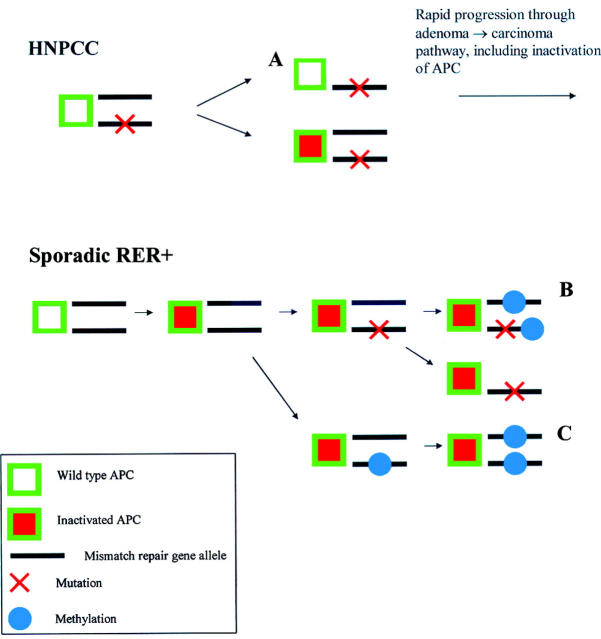
Model for adenoma→carcinoma pathway in HNPCC versus sporadic RER+ colorectal cancers. In HNPCC, a germline mutation is present in every cell, and only one further event (usually loss of heterozygosity (LOH)) is required to inactivate a mismatch repair gene. This may occur at an early stage (A), before inactivation of APC, and result in rapid progression through the adenoma→carcinoma pathway. In contrast, inactivation of a mismatch repair gene in sporadic RER+ cancers is likely to be a late event, after inactivation of APC. Although inactivation may be due to a somatic mutation (with LOH), hypermethylation of the hMLH1 promoter region is the commonest cause of inactivation of mismatch repair genes in these cancers, and is usually a biallelic event (B, C).
References
Publication types
MeSH terms
Substances
LinkOut - more resources
Full Text Sources
Medical