


A prospective randomized study on bilateral carotid endarterectomy: patching versus eversion
- PMID: 10862204
- PMCID: PMC1421116
- DOI: 10.1097/00000658-200007000-00017
A prospective randomized study on bilateral carotid endarterectomy: patching versus eversion
Abstract
Objective: To compare the clinical outcome and restenosis incidence of patients who underwent carotid endarterectomy with patch closure (CEAP) on one side and carotid eversion endarterectomy (CEE) on the other.
Summary background data: Although a few investigators have compared the results of CEAP versus CEE, no reports have compared the outcome of CEAP versus CEE in the same patient.
Methods: Eighty-six patients were randomly selected for sequential surgical treatment involving either CEAP/CEE or CEE/CEAP. All patients underwent postoperative duplex ultrasound study and clinical follow-up at 1, 6, and 12 months and every year thereafter. Various factors were analyzed to ascertain any association with restenosis, and Kaplan-Meier analysis was used to estimate the risk of restenosis.
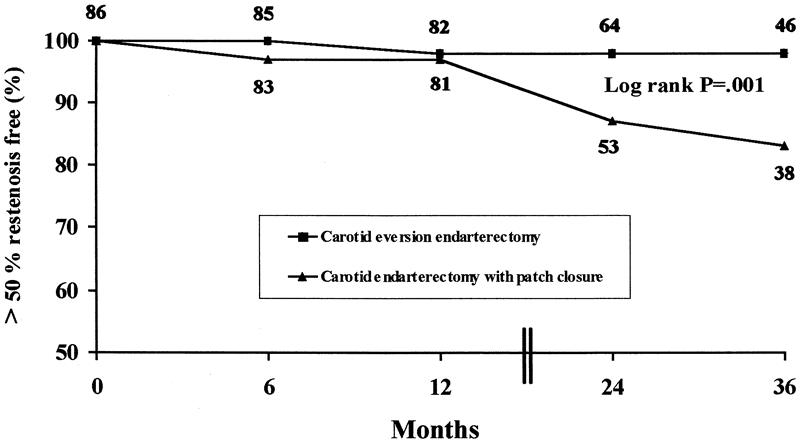
Results: Demographic and clinical data were similar in the CEAP and CEE groups. The selective shunting rate was statistically higher in the CEAP group. There were no perioperative deaths. Although the incidence of perioperative ipsilateral stroke was not significant, CEAP patients had a rate of combined transient ischemic attacks and strokes that approached statistical significance. The mean follow-up was 40 months. CEAP patients had a significantly higher incidence of restenosis and combined occlusive events and restenoses. Kaplan-Meier analysis showed that CEE had a significantly better cumulative patency rate than CEAP and that freedom from restenoses at 24 and 36 months was 87% and 83% for CEAP and 98% and 98% for CEE, respectively.
Conclusions: CEE is less likely to cause perioperative neurologic complications and restenoses than CEAP. The significantly higher rate of unilateral recurrence suggests that local factors play a more important role than systemic factors in the occurrence of restenosis.
Figures
References
-
- North American Symptomatic Carotid Endarterectomy Trial Collaborators. Beneficial effect of carotid endarterectomy in symptomatic patients with high-grade carotid stenosis. N Engl J Med 1991; 325:445–453. - PubMed
-
- European Carotid Surgery Trialists’ Collaborative Group. MRC European Carotid Surgery Trial: interim results for symptomatic patients with severe (70–99%) or with mild (0–29%) carotid stenosis. Lancet 1991; 337:1235–1243. - PubMed
-
- Mayo Asymptomatic Carotid Endarterectomy Group. Results of a randomized controlled trial of carotid endarterectomy for asymptomatic carotid stenosis. Mayo Clin Proc 1992; 67:513–518. - PubMed
-
- Asymptomatic Study Executive Committee. Endarterectomy for asymptomatic carotid artery stenosis. JAMA 1995; 273:1421–1428. - PubMed
-
- Hobson RW, Weiss DG, Fields WS, et al. Efficacy of carotid endarterectomy for asymptomatic carotid stenosis. N Engl J Med 1993; 328;221–227. - PubMed
Publication types
MeSH terms
LinkOut - more resources
Full Text Sources
