


Replacement of the ectodomains of the hemagglutinin-neuraminidase and fusion glycoproteins of recombinant parainfluenza virus type 3 (PIV3) with their counterparts from PIV2 yields attenuated PIV2 vaccine candidates
- PMID: 10864657
- PMCID: PMC112153
- DOI: 10.1128/jvi.74.14.6448-6458.2000
Replacement of the ectodomains of the hemagglutinin-neuraminidase and fusion glycoproteins of recombinant parainfluenza virus type 3 (PIV3) with their counterparts from PIV2 yields attenuated PIV2 vaccine candidates
Abstract
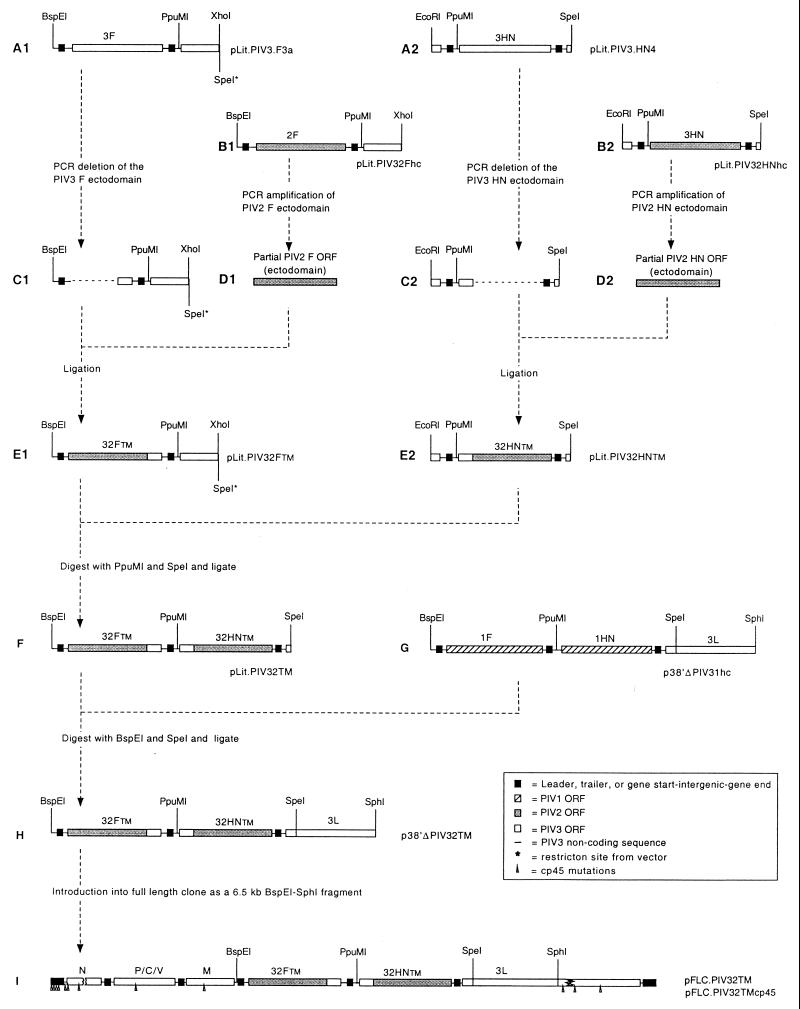
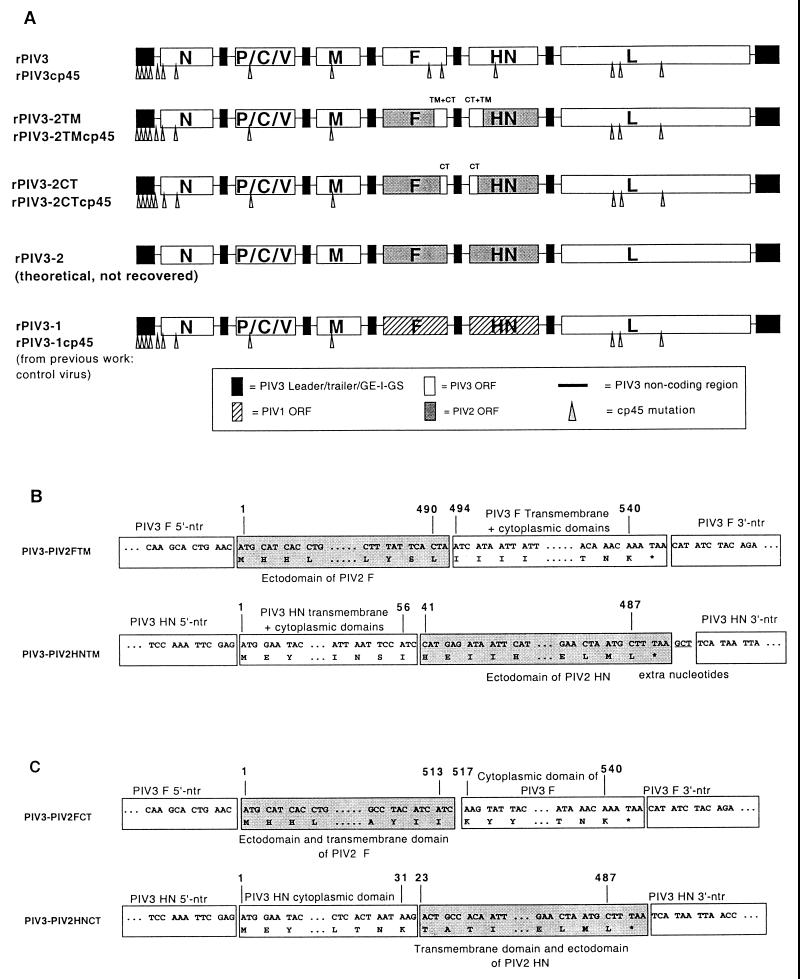
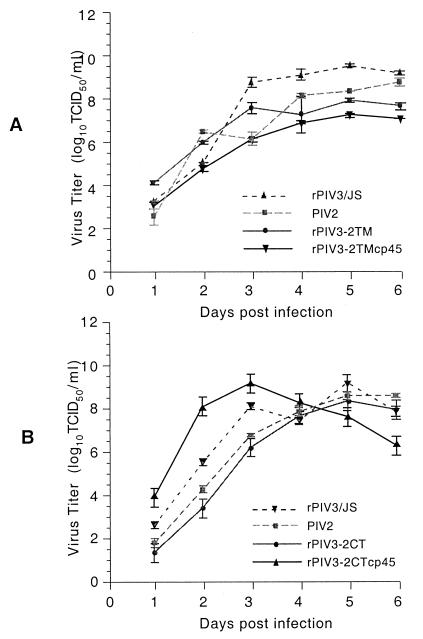
We sought to develop a live attenuated parainfluenza virus type 2 (PIV2) vaccine strain for use in infants and young children, using reverse genetic techniques that previously were used to rapidly produce a live attenuated PIV1 vaccine candidate. The PIV1 vaccine candidate, designated rPIV3-1cp45, was generated by substituting the full-length HN and F proteins of PIV1 for those of PIV3 in the attenuated cp45 PIV3 vaccine candidate (T. Tao et al., J. Virol. 72:2955-2961, 1998; M. H. Skiadopoulos et al., Vaccine 18:503-510, 1999). However, using the same strategy, we failed to recover recombinant chimeric PIV3-PIV2 isolate carrying the full-length PIV2 glycoproteins in a wild-type PIV3 backbone. Viable PIV3-PIV2 chimeras were recovered when chimeric HN and F open reading frames (ORFs) rather than complete PIV2 F and HN ORFs were used to construct the full-length cDNA. The recovered viruses, designated rPIV3-2CT, in which the PIV2 ectodomain and transmembrane domain were fused to the PIV3 cytoplasmic domain, and rPIV3-2TM, in which the PIV2 ectodomain was fused to the PIV3 transmembrane and cytoplasmic tail domain, possessed similar in vitro and in vivo phenotypes. Thus, it appeared that only the cytoplasmic tail of the HN or F glycoprotein of PIV3 was required for successful recovery of PIV3-PIV2 chimeras. Although rPIV3-2CT and rPIV3-2TM replicated efficiently in vitro, they were moderately to highly attenuated for replication in the respiratory tracts of hamsters, African green monkeys (AGMs), and chimpanzees. This unexpected finding indicated that chimerization of the HN and F proteins of PIV2 and PIV3 itself specified an attenuation phenotype in vivo. Despite this attenuation, these viruses were highly immunogenic and protective against challenge with wild-type PIV2 in hamsters and AGMs, and they represent promising candidates for clinical evaluation as a vaccine against PIV2. These chimeric viruses were further attenuated by the addition of 12 mutations of PIV3cp45 which lie outside of the HN and F genes. The attenuating effects of these mutations were additive with that of the chimerization, and thus inclusion of all or some of the cp45 mutations provides a means to further attenuate the PIV3-PIV2 chimeric vaccine candidates if necessary.
Figures
References
-
- Belshe R B, Hissom F K. Cold adaptation of parainfluenza virus type 3: induction of three phenotypic markers. J Med Virol. 1982;10:235–242. - PubMed
-
- Belshe R B, Mendelman P M, Treanor J, King J, Gruber W C, Piedra P, Bernstein D I, Hayden F G, Kotloff K, Zangwill K, Iacuzio D, Wolff M. The efficacy of live attenuated, cold-adapted, trivalent, intranasal influenzavirus vaccine in children. N Engl J Med. 1998;338:1405–1412. - PubMed
-
- Belshe R B, Van Voris L P, Mufson M A, Buynak E B, McLean A A, Hilleman M A. Comparison of enzyme-linked immunosorbent assay and neutralization techniques for measurement of antibody to respiratory syncytial virus: implications for parenteral immunization with live virus vaccine. Infect Immun. 1982;37:160–165. - PMC - PubMed
-
- Bousse T, Takimoto T, Gorman W L, Takahashi T, Portner A. Regions on the hemagglutinin-neuraminidase proteins of human parainfluenza virus type-1 and Sendai virus important for membrane fusion. Virology. 1994;204:506–514. - PubMed
Publication types
MeSH terms
Substances
Grants and funding
LinkOut - more resources
Full Text Sources
Other Literature Sources
Molecular Biology Databases
