


Rapid and general profiling of protease specificity by using combinatorial fluorogenic substrate libraries
- PMID: 10869434
- PMCID: PMC16617
- DOI: 10.1073/pnas.140132697
Rapid and general profiling of protease specificity by using combinatorial fluorogenic substrate libraries
Abstract
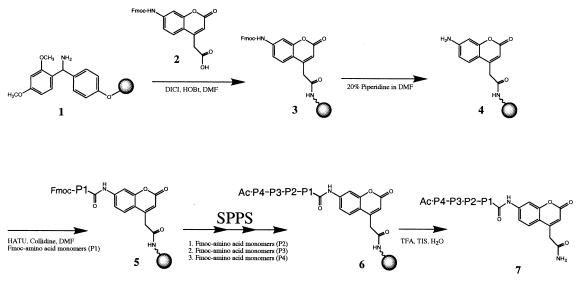
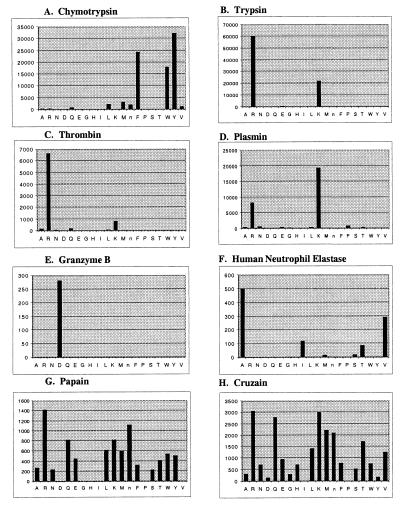
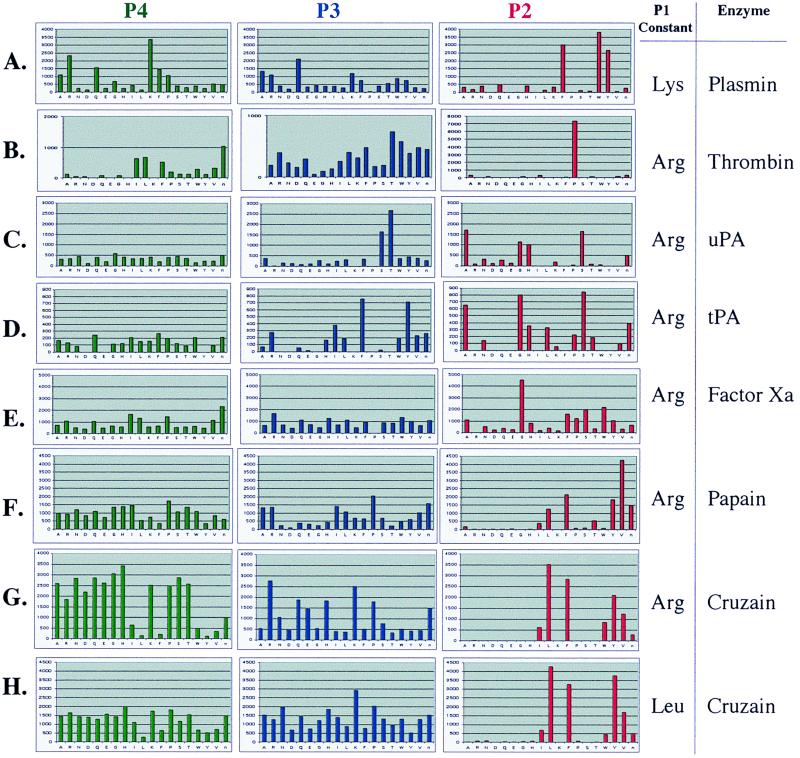
A method is presented for the preparation and use of fluorogenic peptide substrates that allows for the configuration of general substrate libraries to rapidly identify the primary and extended specificity of proteases. The substrates contain the fluorogenic leaving group 7-amino-4-carbamoylmethylcoumarin (ACC). Substrates incorporating the ACC leaving group show kinetic profiles comparable to those with the traditionally used 7-amino-4-methylcoumarin (AMC) leaving group. The bifunctional nature of ACC allows for the efficient production of single substrates and substrate libraries by using 9-fluorenylmethoxycarbonyl (Fmoc)-based solid-phase synthesis techniques. The approximately 3-fold-increased quantum yield of ACC over AMC permits reduction in enzyme and substrate concentrations. As a consequence, a greater number of substrates can be tolerated in a single assay, thus enabling an increase in the diversity space of the library. Soluble positional protease substrate libraries of 137, 180 and 6,859 members, possessing amino acid diversity at the P4-P3-P2-P1 and P4-P3-P2 positions, respectively, were constructed. Employing this screening method, we profiled the substrate specificities of a diverse array of proteases, including the serine proteases thrombin, plasmin, factor Xa, urokinase-type plasminogen activator, tissue plasminogen activator, granzyme B, trypsin, chymotrypsin, human neutrophil elastase, and the cysteine proteases papain and cruzain. The resulting profiles create a pharmacophoric portrayal of the proteases to aid in the design of selective substrates and potent inhibitors.
Figures
References
Publication types
MeSH terms
Substances
Grants and funding
LinkOut - more resources
Full Text Sources
Other Literature Sources
