. 2000 Jul;66(7):2859-65.
doi: 10.1128/AEM.66.7.2859-2865.2000.

Deletion of various carboxy-terminal domains of Lactococcus lactis SK11 proteinase: effects on activity, specificity, and stability of the truncated enzyme

Affiliations

Deletion of various carboxy-terminal domains of Lactococcus lactis SK11 proteinase: effects on activity, specificity, and stability of the truncated enzyme

P G Bruinenberg et al. Appl Environ Microbiol. 2000 Jul.

Abstract

The Lactococcus lactis SK11 cell envelope proteinase is an extracellular, multidomain protein of nearly 2,000 residues consisting of an N-terminal serine protease domain, followed by various other domains of largely unknown function. Using a strategy of deletion mutagenesis, we have analyzed the function of several C-terminal domains of the SK11 proteinase which are absent in cell envelope proteinases of other lactic acid bacteria. The various deletion mutants were functionally expressed in L. lactis and analyzed for enzyme stability, activity, (auto)processing, and specificity toward several substrates. C-terminal deletions of first the cell envelope W (wall) and AN (anchor) domains and then the H (helix) domain leads to fully active, secreted proteinases of unaltered specificity. Gradually increasing the C-terminal deletion into the so-called B domain leads to increasing instability and autoproteolysis and progressively less proteolytic activity. However, the mutant with the largest deletion (838 residues) from the C terminus and lacking the entire B domain still retains proteolytic activity. All truncated enzymes show unaltered proteolytic specificity toward various substrates. This suggests that the main role played by these domains is providing stability or protection from autoproteolysis (B domain), spacing away from the cell (H domain), and anchoring to the cell envelope (W and AN domains). In addition, this study allowed us to more precisely map the main C-terminal autoprocessing site of the SK11 proteinase and the epitope for binding of group IV monoclonal antibodies.


Figures
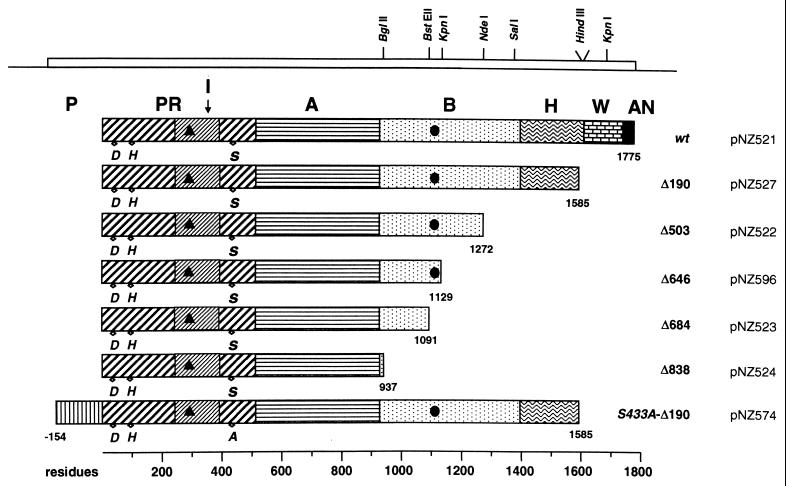
FIG. 1
FIG. 1
Schematic representation of wild-type and C-terminally truncated SK11 proteinases. Domains: propeptide, P; protease, PR; insert, I; A; B; helix, H; wall, W; anchor, AN (47). Residue numbering begins at the N terminus of the mature enzyme. The number of C terminally deleted residues is indicated at the right. The approximate position of catalytic residues D, H, and S in the PR domain are indicated. Putative MAb I (▴) and IV (●) binding sites are indicated. The positions of relevant restriction sites used in cloning experiments are indicated in the coding region of the prtP gene at the top, and plasmids encoding the proteinases are shown at the far right.
FIG. 2
FIG. 2
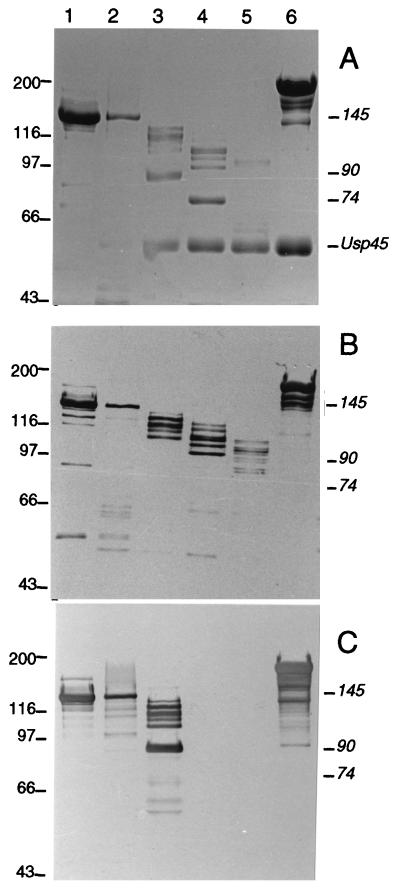
SDS-PAGE and Western blot analysis of proteins secreted into the growth medium of lactococcal cells harboring pNZ527 (lane 1), pNZ522 (lane 2), pNZ596 (lane 3), pNZ523 (lane 4), pNZ524 (lane 5), and pNZ574 (lane 6). (A) Coomassie brilliant blue staining. (B) Western blot with MAbs of group I. (C) Western blot with MAbs of group IV. Molecular mass markers (in kilodaltons) are indicated to the left. Positions of Usp45 and the 145-, 90-, and 74-kDa products of SK11 proteinase are indicated on the right.
FIG. 3
FIG. 3
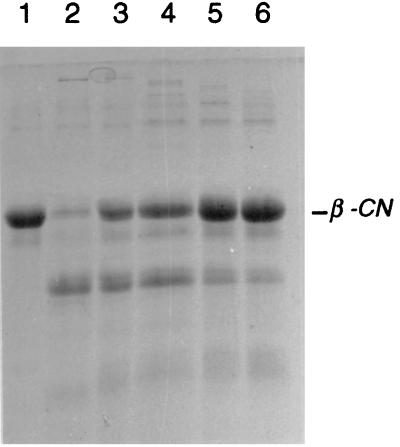
Caseinolytic activity of C terminally truncated SK11 proteinase mutants toward β-casein. Lane 1, no proteinase added; lanes 2 to 6, supernatant fractions added containing truncated proteinases specified by plasmids pNZ527 (lane 2), pNZ522 (lane 3), pNZ596 (lane 4), pNZ523 (lane 5), and pNZ524 (lane 6).
FIG. 4
FIG. 4
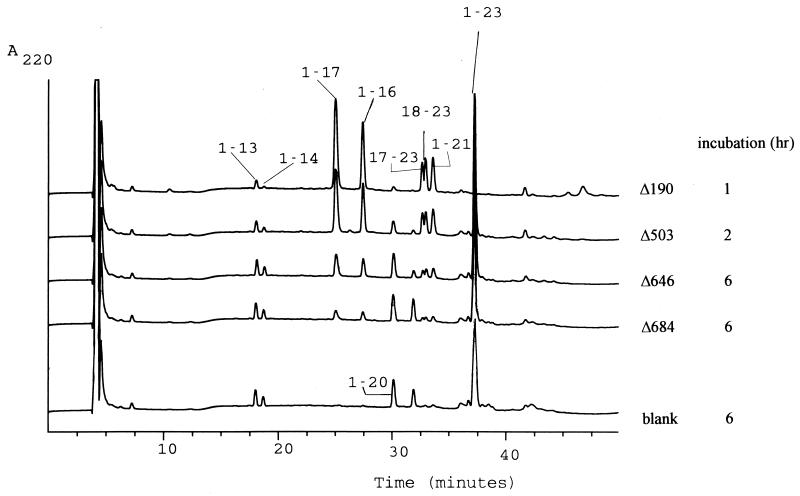
Caseinolytic activity and specificity of C terminally truncated SK11 proteinase mutants toward αs1-casein-(1-23). Analytical reversed-phase high-pressure liquid chromatography patterns of the products of αs1-casein-(1-23) degradation. Note that incubation times were varied between 1 and 6 h to allow for the large differences in proteinase activity. The “blank” data refer to S433A/Δ190 (pNZ527), which has no PrtP activity but shows a low background activity toward the substrate due to released intracellular PepO activity (12, 15).

References

    1. Brenner C, Fuller R S. Structural and enzymatic characterization of a purified prohormone-processing enzyme: secreted, soluble Kex2 protease. Proc Natl Acad Sci USA. 1992;89:922–926. - PMC - PubMed
    1. Bruinenberg P G, Vos P, de Vos W M. Proteinase overproduction in Lactococcus lactis strains: regulation and effect on growth and acidification in milk. Appl Environ Microbiol. 1992;58:78–84. - PMC - PubMed
    1. Bruinenberg P G, Doesburg P, Alting A C, Exterkate F A, de Vos W M, Siezen R J. Evidence for a large dispensable segment in the subtilisin-like catalytic domain of the Lactococcus lactis cell-envelope proteinase. Protein Eng. 1994a;7:991–996. - PubMed
    1. Bruinenberg P G, de Vos W M, Siezen R J. Prevention of C-terminal autoprocessing of Lactococcus lactis SK11 cell-envelope proteinase by engineering of an essential surface loop. Biochem J. 1994b;302:957–963. - PMC - PubMed
    1. Casadaban M J, Chou J, Cohen S N. In vitro fusions that join an enzymatically active β-galactosidase segment to aminoterminal fragments of exogenous proteins in Escherichia coli: plasmid vectors for the detection of translation signals. J Bacteriol. 1980;143:971–980. - PMC - PubMed

Publication types

LinkOut - more resources