Comparison of intranasal midazolam with intravenous diazepam for treating febrile seizures in children: prospective randomised study
- PMID: 10884257
- PMCID: PMC27427
- DOI: 10.1136/bmj.321.7253.83
Comparison of intranasal midazolam with intravenous diazepam for treating febrile seizures in children: prospective randomised study
Abstract
Objective: To compare the safety and efficacy of midazolam given intranasally with diazepam given intravenously in the treatment of children with prolonged febrile seizures.
Design: Prospective randomised study.
Setting: Paediatric emergency department in a general hospital.
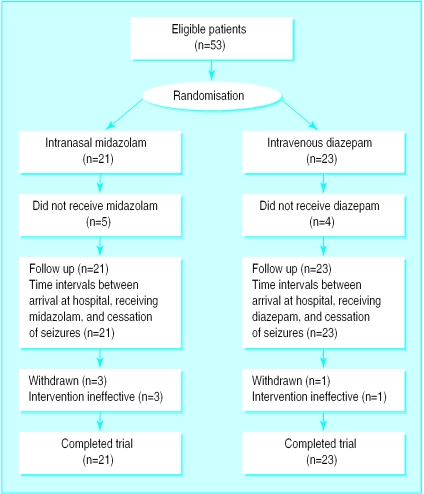
Subjects: 47 children aged six months to five years with prolonged febrile seizure (at least 10 minutes) during a 12 month period.
Interventions: Intranasal midazolam (0.2 mg/kg) and intravenous diazepam (0.3 mg/kg).
Main outcome measures: Time from arrival at hospital to starting treatment and cessation of seizures.
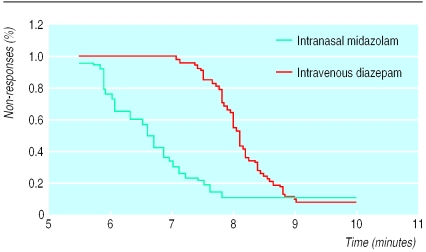
Results: Intranasal midazolam and intravenous diazepam were equally effective. Overall, 23 of 26 seizures were controlled with midazolam and 24 out of 26 with diazepam. The mean time from arrival at hospital to starting treatment was significantly shorter in the midazolam group (3.5 (SD 1.8) minutes, 95% confidence interval 3.3 to 3.7) than the diazepam group (5.5 (2.0), 5.3 to 5.7). The mean time to control of seizures was significantly sooner (6.1 (3.6), 6.3 to 6.7) in the midazolam group than the diazepam group (8.0 (0.5), 7. 9 to 8.3). No significant side effects were observed in either group.
Conclusion: Seizures were controlled more quickly with intravenous diazepam than with intranasal midazolam, although midazolam was as safe and effective as diazepam. The overall time to cessation of seizures after arrival at hospital was faster with intranasal midazolam than with intravenous diazepam. The intranasal route can possibly be used not only in medical centres but in general practice and, with appropriate instructions, by families of children with recurrent febrile seizures at home.
Figures
Comment in
-
Intranasal midazolam for febrile seizures. A step forward in treating a common and distressing condition.BMJ. 2000 Jul 8;321(7253):64-5. doi: 10.1136/bmj.321.7253.64. BMJ. 2000. PMID: 10884237 Free PMC article. No abstract available.
-
Intranasal midazolam for treating febrile seizures in children. Caution is advised in interpreting trial conclusions.BMJ. 2001 Jan 13;322(7278):107. BMJ. 2001. PMID: 11154638 Free PMC article. No abstract available.
-
Intranasal midazolam for treating febrile seizures in children. Buccal midazolam should be preferred to nasal midazolam.BMJ. 2001 Jan 13;322(7278):107. BMJ. 2001. PMID: 11154640 No abstract available.
-
Intranasal midazolam for treating febrile seizures in children. Caution is required in applying hospital based evidence to primary care population.BMJ. 2001 Jan 13;322(7278):108. BMJ. 2001. PMID: 11154641 No abstract available.
-
Intranasal midazolam for treating febrile seizures in children. Safety is as important as efficacy.BMJ. 2001 Jan 13;322(7278):107-8. BMJ. 2001. PMID: 11154642 No abstract available.
-
Intranasal midazolam for treating febrile seizures in children. Buccal midazolam for childhood seizures at home preferred to rectal diazepam.BMJ. 2001 Jan 13;322(7278):108. BMJ. 2001. PMID: 11203721 No abstract available.
References
-
- Hirtz DG. Generalized tonic-clonic and febrile seizures. Pediatr Clin North Am. 1989;36:375–382. - PubMed
-
- Treatment of convulsive status epilepticus: recommendations of the Epilepsy Foundation of America's Working Group in status of epilepticus. JAMA. 1993;270:854–849. - PubMed
-
- Chamberlain JM, Altieri MA, Futterman C, Young GM, Ochsenchlager DW, Waisman Y. A prospective, randomized study comparing intramuscular midazolam with intravenous diazepam for the treatment of seizures in children. Pediatr Emerg Care. 1997;13:92–94. - PubMed
-
- Lahat E, Aladjem M, Eshel G, Bistritzer T, Katz Y. Midazolam in treatment of epileptic seizures. Pediatr Neurol. 1992;8:215–216. - PubMed
-
- Alldredge BK, Wall DB, Ferriers DM. Effect of prehospital treatment on the outcome of status epilepticus in children. Pediatr Neurol. 1995;12:213–216. - PubMed
Publication types
MeSH terms
Substances
LinkOut - more resources
Full Text Sources
Other Literature Sources
Medical