Review
. 2000 Jul;13(3):451-69.
doi: 10.1128/CMR.13.3.451.

Babesiosis

Affiliations
Review

Babesiosis

M J Homer et al. Clin Microbiol Rev. 2000 Jul.

Abstract

Babesiosis is an emerging, tick-transmitted, zoonotic disease caused by hematotropic parasites of the genus Babesia. Babesial parasites (and those of the closely related genus Theileria) are some of the most ubiquitous and widespread blood parasites in the world, second only to the trypanosomes, and consequently have considerable worldwide economic, medical, and veterinary impact. The parasites are intraerythrocytic and are commonly called piroplasms due to the pear-shaped forms found within infected red blood cells. The piroplasms are transmitted by ixodid ticks and are capable of infecting a wide variety of vertebrate hosts which are competent in maintaining the transmission cycle. Studies involving animal hosts other than humans have contributed significantly to our understanding of the disease process, including possible pathogenic mechanisms of the parasite and immunological responses of the host. To date, there are several species of Babesia that can infect humans, Babesia microti being the most prevalent. Infections with Babesia species generally follow regional distributions; cases in the United States are caused primarily by B. microti, whereas cases in Europe are usually caused by Babesia divergens. The spectrum of disease manifestation is broad, ranging from a silent infection to a fulminant, malaria-like disease, resulting in severe hemolysis and occasionally in death. Recent advances have resulted in the development of several diagnostic tests which have increased the level of sensitivity in detection, thereby facilitating diagnosis, expediting appropriate patient management, and resulting in a more accurate epidemiological description.


Figures
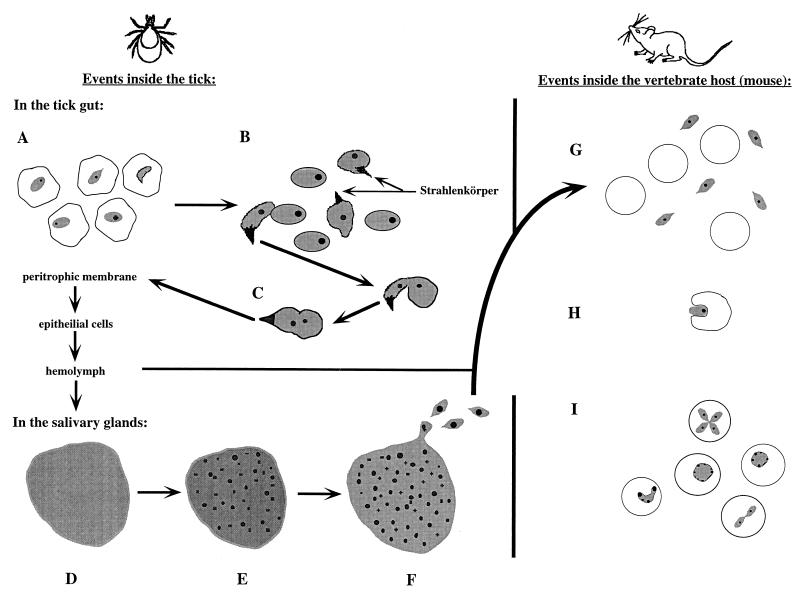
FIG. 1
FIG. 1
Life cycle of Babesia spp. in the tick and vertebrate hosts. Events in the tick begin with the parasites still visible in consumed erythrocytes. Some are beginning to develop Strahlenkörper forms (A). The released gametes begin to fuse (note that only one of the proposed mechanisms is pictured; one gamete has a Strahlenkörper form, whereas the other does not) (B). The formed zygote then goes on to infect and move through other tissues within the tick (C) to the salivary glands. Once a parasite has infected the salivary acini, a multinucleate but undifferentiated sporoblast is formed (D). After the tick begins to feed, the specialized organelles of the future sporozoites form (E). Finally, mature sporozoites bud off of the sporoblast (F). As the tick feeds on a vertebrate host, these sporozoites are inoculated into the host (G). Not shown is the preerythrocytic phase seen in Theileria spp. and T. equi (B. equi). Sporozoites (or merozoites) contact a host erythrocytic and begin the process of infection by invagination (H). The parasites become trophozoites and can divide by binary fission within the host erythrocyte, creating the various ring forms and crosses seen on stained blood smears (I). Illustrations are not to scale.
FIG. 2
FIG. 2
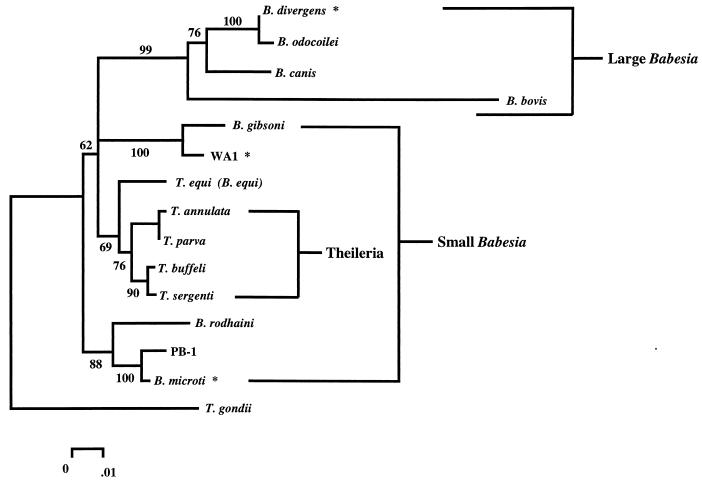
Phylogenetic tree representation of a neighbor-joining analysis of several species of piroplasms. Five hundred nucleotides of the nuclear small-subunit rDNA were aligned by using the Pileup program of the Wisconsin Genetics Computer Group package. Phylogenetic analysis of the alignment was performed as described previously (102) with the Molecular Evolutionary Genetics Analysis (MEGA) computer program, version 1.01 (109), to make a Jukes-Cantor distance measurement and perform a neighbor-joining analysis with 500 bootstrap replicates. The phylogenetic analysis using parsimony (PAUP) computer program, version 3.1.1 (222), was used to confirm the order observed by the neighbor-joining analysis (using a branch-and-bound algorithm with 100 bootstrap replicates). The percentage of neighbor-joining bootstrap replications (>50%) is shown above each node. This tree is consistent with previously published analyses (160, 161). Species that are known to infect humans are marked with an asterisk. The groups of large and small babesias are bracketed and labeled.
FIG. 3
FIG. 3
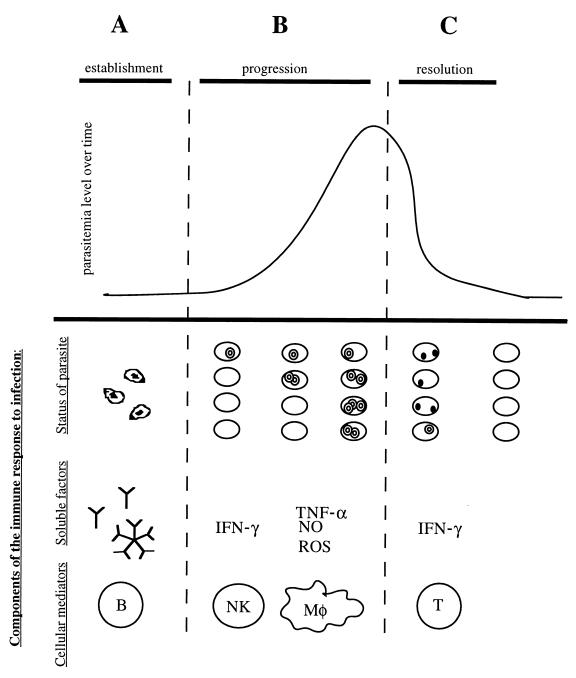
Theoretical model of the cells and molecules involved in immunity to Babesia species. Different immune mechanisms contribute to resistance during each stage of babesial infection. During the establishment stage (A), antibodies (IgG) play a role in preventing erythrocyte infection by binding the free sporozoites. During this progression stage (B), the Babesia organisms succeed in invading the erythrocyte, and the resulting merozoites start proliferating and lyse the infected cell. After lysis has occurred, parasites reach the bloodstream again to initiate a new round of invasion. Several rounds of this cycle cause the overall parasitemia level to increase. Cells of the innate immune system are thought to control the growth rate of the merozoites and therefore the rate of increasing parasitemia. Specifically, NK cells and macrophages have been implicated in antibabesial activity. The inhibition seems to rely on the production of soluble factors: IFN-γ by NK cells and TNF-α, nitric oxide (NO), and ROSs by macrophages (Mφ). The specific mechanism of protection, however, remains unclear. In the resolution stage (C), parasitemia levels in babesiosis usually reach a maximum and then decline. The decrease in parasite numbers seems to be due at least in part to intracellular degeneration inside the erythrocyte, as evidenced by the appearance of crisis forms. T-cell lymphocytes seem to be the cells responsible for parasite clearance, specifically the subpopulation of CD4+ IFN-γ producers. The mechanism of parasite eradication and its relation to IFN-γ production remain unknown.
FIG. 4
FIG. 4
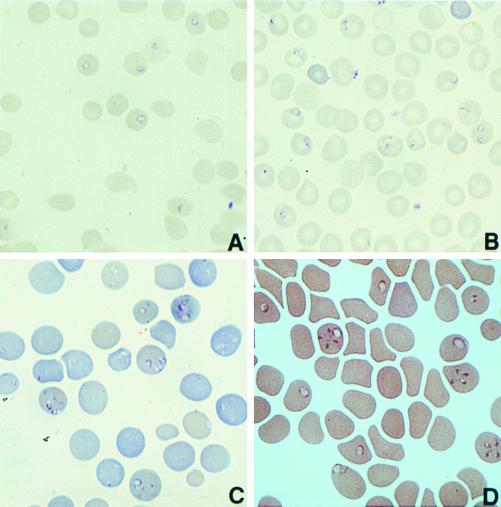
Giemsa-stained thin blood smears from a nonobese diabetic (NOD)-SCID mouse infected with (A) B. microti strain MN1, (B) a hamster infected with B. microti MN1, (C) a NOD-SCID mouse infected with the related piroplasm WA1, and (D) a hamster infected with WA1.

References

    1. Abdalla H S, Hussein H S, Kreier J P. Babesia rodhaini: passive protection of mice with immune serum. Tropenmed Parasitol. 1978;29:295–306. - PubMed
    1. Adachi K, Kawano H, Makimura S. Suppressed antibody response to sheep erythrocytes in experimentally Babesia rodhaini-infected mice. J Vet Med Sci. 1993;55:189–190. - PubMed
    1. Anderson A E, Cassaday P B, Healy G R. Babesiosis in man: sixth documented case. Am J Clin Pathol. 1974;62:612–618. - PubMed
    1. Anderson J F, Johnson R C, Magnarelli L A, Hyde F W, Myers J E. Peromyscus leucopus and Microtus pennsylvanicus simultaneously infected with Borrelia burgdorferi and Babesia microti. J Clin Microbiol. 1986;23:135–137. - PMC - PubMed
    1. Anderson J F, Mintz E D, Gadbaw J J, Magnarelli L A. Babesia microti, human babesiosis, and Borrelia burgdorferi in Connecticut. J Clin Microbiol. 1991;29:2779–2783. - PMC - PubMed

Publication types

LinkOut - more resources